
Pairing Wines with Hot and Spicy Foods

When pairing wines with food, the general goal is to make sure that the flavors of the food don't overwhelm the wine and cover up all of the wine's wonderful flavors. And the basic rule of wine pairing says that you should have a red wine with beef and white wine with chicken or fish. But what about a spicy meal? And spicy includes both highly spiced foods and those hot and spicy foods. These foods can easily overwhelm a wine. But pairing options with hot and spicy foods may surprise you because it's not going to be the big bold wines that work best.

One food and wine pairing that works with almost any meal is a sparkling wine. And it works especially well with spicy foods. It can be anything from a sparkling rosé to Champagne. And even an off-dry (slightly sweet) sparkling wine work well with spicy dishes. Putting some sweetness against a spicy flavor is surprisingly good.

The moat common pairing with a hot spicy meal is to go with a Riesling. And it works.  The high acidity of a Riesling will cut through the heat while the lower alcohol won't add to the burn. In addition to Riesling, you might also consider a Pinot Gris, Sauvignon Blanc or an Albariño. These wines all fit into the lighter side of white wines, having lower alcohol and higher acidity. Serve these wines well chilled and they can be the perfect accompaniment for a spicy meal.

Red wine lovers have options too. But stick to a light bodied red wine, especially with a hot spicy food. A slightly chilled Beaujolais or a Pinot Noir would be a great pairing here. The problem with trying to pair a big, bold red wine with a "hot" and spicy dish is that these reds tend to have high alcohol.  And what you'll find is that the higher alcohol level will add to the burn in your mouth, not reduce it.

So next time you are trying to figure out what to have with that spicy Thai food, Kung Pao Chicken, coconut milk curry or Buffalo Hot Wings, try a little bubbly, a well chilled light white wine or a slightly chilled light red wine. Cheers!
Behind the Cork™ Wine of the Week

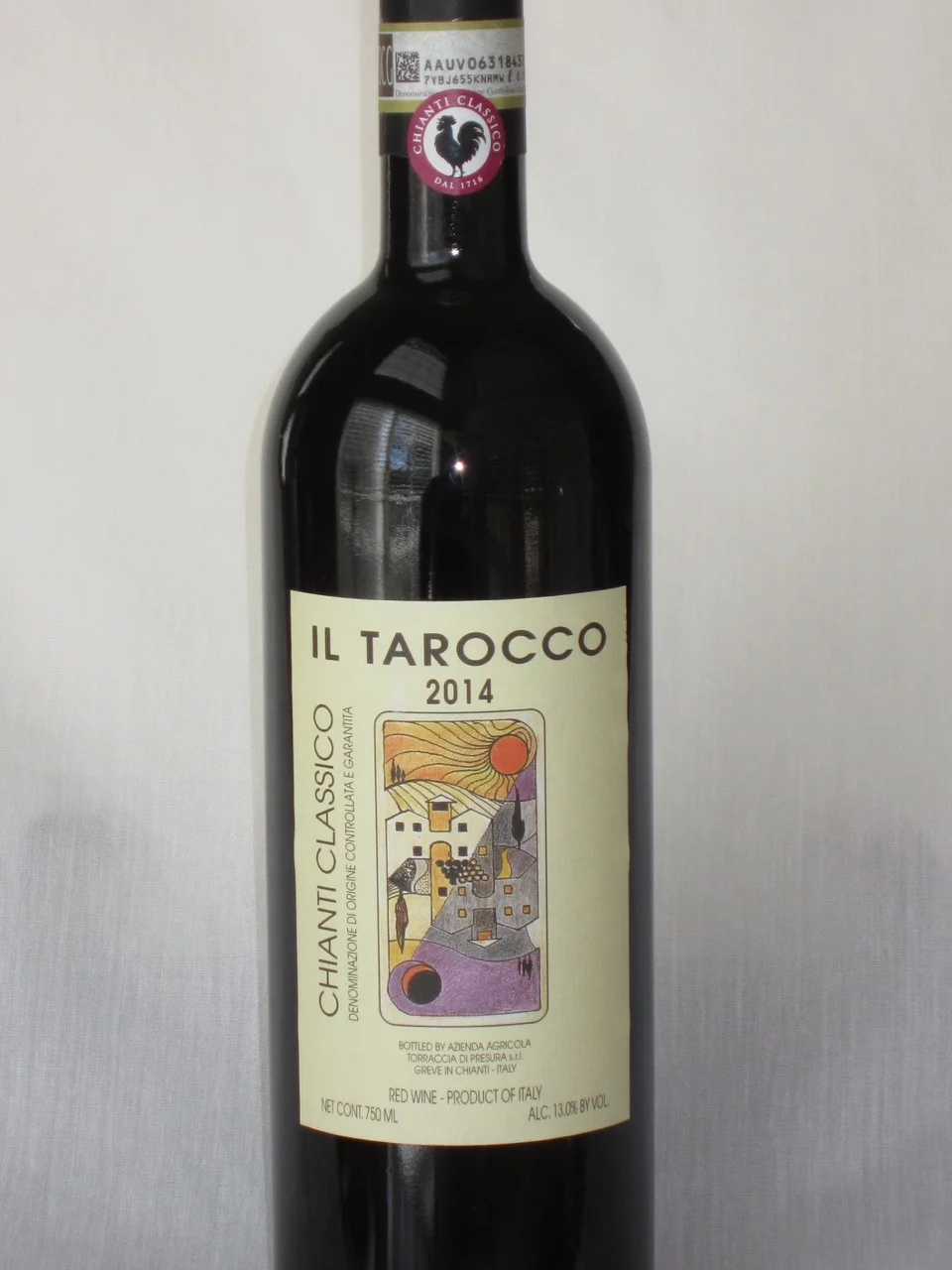
2014 Il Tarocco Chianti Classico ($10)

As you can immediately tell from the black rooster on the neck of the bottle, this is a Chianti Classico. The black rooster let's you know this is a nicer Chianti.  While Chianti is required to be made from at least 70% Sangiovese, and Chianti Classico must be at least 80% Sangiovese, the Il Tarocco is 90% Sangiovese along with 10% Canaiolo Nero. This is a great, affordable and attainable Chianti Classico. Enjoy with beef, pork and lamb dishes. Cheers!


Looking for a Nice Chianti? Look for the Black Rooster!

Chianti is a great wine to enjoy with an Italian meal. Whether it is spaghetti and meatballs, sausages or pizza, a Chianti is a great pairing. And it's not hard to find a good one.

Chianti is a region within Tuscany in central Italy, between Florence and Siena. And it produces the best known of the Italian wines. While the wines have been around since the Middle Ages, the Chianti region was officially established in the 18th century (1716 to be exact). But it wasn't until 1967 that the Chianti Denominazione di Origine Controllata (DOC) was created. Then, in 1984, the region reached Italy's highest level of wines, the Denominazione di Origine Controllata e Garantita (DOCG). This is important because DOC wines are the most commonly found wines in Italy, while DOCG wines only cover a handful of Italian wines with the highest of quality.

And in case you didn't know, Chianti is a region, not a grape.  The wines of Chianti are made from the Sangiovese grape. Local laws require Chianti to have at least 70% Sangiovese with the more prestigious Chianti Classico having at least 80% Sangiovese.

When shopping for Chianti, look for the black rooster (gallo nero in Italian) on the neck of the bottle.  The black rooster indicates it's Chianti Classico making it easy to distinguish from the more common Chianti.

Some may also think of Chianti as the wine in the straw basket.  While it was a distinguishing trait of Chianti in the past, most producers are now using the traditional styled wine bottle. So, if you're trying to create an Italian look for your meal, a bottle of Chianti with a straw basket base will certainly do. But if you're looking for a nicer bottle of Chianti, go with the rooster. Cheers!

Behind the Cork™ Wine of the Week

Boeger 2012 Barbera - El Dorado ($15)

This Barbera is from one of the oldest wineries in the Sierra Foothills. Barbera is a grape grown throughout Italy. It's a grape known for high acidity, soft tannin and dark fruit flavors.  The Boeger Barbera certainly has flavors of plums and spices, with velvety texture but its acidity is restrained, while the body is full and finishes very nicely. Seek this one out if you have never tried a Barbera.  You'll enjoy this great value.

Wine's Body - Comparable to Milk?

We've just completed a series on wines and body. We've addressed light, medium and full bodied white wines and red wines. And within this series, factors such as mouth feel, alcohol, tannin and residual sugar have been discussed. Fruit flavors also vary with lighter bodied red wines having red fruit flavors (e.g., cherry, raspberry) and full bodied reds having black fruit flavors (e.g., plum, black cherry, black currant, blackberry).  And let's not forget about tannin. Light bodied red wines will have little or no tannin from the grape skins, seeds, stems and oak barrels, while full bodied reds can have big "chewy" tannin that can make you pucker.

One of the analogies that gets widespread use when discussing a wine's body is milk.  The analogy states that light bodied wines are like skim milk, medium bodied wines are like 2% milk and full bodied wines are like whole milk.  This is meant to address the characteristic of mouth feel.  Skim milk is thin and watery while whole milk is thick and creamy.  The milk analogy may be okay for comparing watery versus creamy, but it really doesn't work for wine. 

Milk has fat solids that give it the mouth feel of creaminess. Wine doesn't. So maybe a better comparison of a wine's body and mouth feel might be with another common drink. And, since it works so well, let's take grape as an example. A grape drink that is made by mixing powder and water (e.g., Kool-Aid or Crystal Light) will generally be light bodied with more subtle flavors.  Compare the powdered grape drink with pure grape juice (e.g., Welch's 100% Grape Juice) and then you get a better understanding of body from light to full. In this example, ignore the sweetness and just focus on how it feels in your mouth and the boldness of the fruit flavor.

Now, I think that's a better example of mouth feel that translates directly with wine.  It's not perfect, but hopefully you get it. The way something tastes and feels in your mouth is very subjective and difficult to describe. Yet in the wine world, a significant amount of time is spent trying to describe flavors and mouth feel.

The best way to learn about a wine's body is through direct experience. Get a bottle of Pinot Noir and a bottle of Cabernet Sauvignon.  Try tasting the Pinot Noir first, and then try the Cabernet. You should immediately experience light body versus full body. Cheers!