Behind the Cork™ Wine of the Week

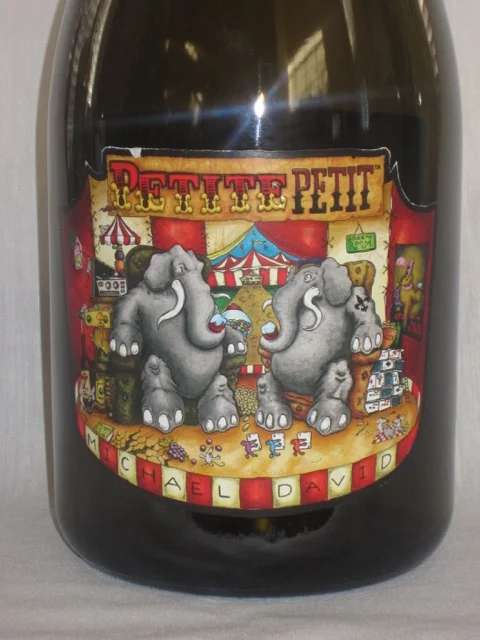
Michael David Petite Petit ($14)

I always passed by this cartoon character label with the two elephants sipping wine. But Wine Enthusiast named this Petite Sirah their #2 pick on the 2015 top 100 wines, giving it a 94 point rating.  That caught my eye!  So, as Wine Enthusiast says "Don't let the cartoony label fool you, this is a fantastic wine."  This is dark red wine with big rich fruit flavors. But, as Wine Enthusiast goes on "For all its density and depth, however, this is not an overpowering monster." A really good highly rated wine at a terrific price.  You need to try this one!

Full Bodied Red Wines

We've explored the various styles of white wines and made it through the light and medium bodied reds. Now it's time to take the final step and look at the big, full bodied red wines.

These full bodied reds are going to be very dark in color, have rich fruit flavors, moderate to high acidity and big tannin. And it's often the tannin in young full bodied reds that will turn people away from these wines. But, given a little breathing space in a decanter, or a few years of cellar time, these can be the best of all wines.

Full bodied red wines are going to be centered around the black fruit flavors of plum, black cherry, fig, boysenberry, black currant, blackberry, raisin and include other flavors such as chocolate, vanilla, leather, tobacco, pepper, and even tar.

Full bodied red wines include:

  • Malbec, Mourvèdre, Nebbiolo and Tempranillo

  • Bordeaux blends (primarily Cabernet Sauvignon and Merlot)

  • Rhone Blends including Châteauneuf-du-Pape (Grenache, Syrah and Mourvèdre)

  • Italian Super Tuscan blends (Sangiovese, Cabernet Sauvignon, Merlot, Syrah

  • Cabernet Sauvignon, Petit Verdot, Petite Sirah and Syrah

Again, it's the tannin that will play a huge role in these full bodied reds.  And tannin is the reason these wines go so well with a steak or other fatty foods.  The tannin acts to cleanse the fats and proteins that collect on your tongue leaving you with a wonderful mouth-feel and an amazing lingering finish. On one end of the scale tannin can be described a 'chewy,' 'muscular,' 'grippy,' or 'firm' and on the other end you may hear words such as 'smooth,' 'soft,' and 'velvety.' Regardless of which end of the spectrum the tannin falls, it is key to the structure of the wine and it's ability to age.

Tannin often gets a bad rap for causing headaches. But if you believe that it's the tannin you need to avoid in red wine, you are also going to have to avoid tea, dark chocolate, nuts, pomegranate, squash, chickpeas, red beans and apple juice all of which all have significant natural tannin.

If you find upon opening a bottle of full bodied red that the tannin is a bit harsh, give it an hour in a decanter that allows the wine maximum surface area for exposure to the air. Quite often you'll find that this will soften it out and make it less harsh. Or, lay the bottle down in a properly controlled cellar or wine refrigerator for five to ten years. The tannin in these big reds will soften with age and reward your patients with a really nice, smooth wine.

Pair one of these full bodied red wines with a nice steak or some flavorful cheese and enjoy. Cheers!


Behind the Cork™ Wine of the Week

Alexander Valley Vineyards Merlot ($15)

The Alexander Valley in Sonoma County turns out some terrific wines, including this Merlot from the winery named for the originator of the valley. 

The Wetzel family who own and run Alexander Valley Vineyards, purchased a large portion of a homestead built by Cyrus Alexander, the valley’s nineteenth century namesake. Today, the Wetzel Family Estate grows fourteen grape varieties, on diverse sites stretching from the banks of the Russian River up onto the hillsides.

This Merlot is a fine example of a medium body red with soft tannin and good black fruit flavors of black cherry, blackberry and plum with a touch of oak to add a subtle vanilla flavor. The finish is long and lasting. This medium bodied Merlot is great for food pairings due to its moderate acidity and tannin. It works well with beef, pork, cured meats and even a flavorful chicken dish. 

Exploring Medium Bodied Red Wines

Recent posts have addressed light bodied red wines including two of the most common, Gamay and Pinot Noir. Light bodied red wines have bright red fruit flavor and little to no tannin.  But looking across all red wines you'll find very few that are light bodied. On the other hand, not all red wines are big and bold either. So let's take a look at medium bodied reds.

Many medium bodied red wines continue with red fruit flavors such as cherry, raspberry, cranberry and strawberry, but what sets them apart is tannin. If you're not familiar with tannin, it is an astringent compound that comes from the grape's skin, seeds and stems as well as wood barrels. Tannin is responsible for the characteristic of producing a mouth-drying sensation.  Tannin builds character in red wines and allows them to age well.

So, just as you might expect, a medium bodied red wine will have medium levels of fruit flavor, acidity and tannin. And, as described previously, the terroir and the winemaker can have a big influence on the style of wine produced from the same grape. Cool growing climates tend to produce lighter bodied wines while warmer climates lead to bolder wines. And oak aging will also influence a red wine's flavor with new oak adding flavor and neutral oak yielding little to no additional flavors.

Although the Sangiovese grape can be made into light bodied Chianti, it can also produce medium bodied wines. While Chianti is aged a minimum of six months, Chianti Classico is aged for one year and Chianti Reserva is aged two years.  This additional aging smooths out the acidity and produces a bolder wine.

Another example of a grape capable of producing a light bodied wine as well as a medium bodied wine is Pinot Noir. As previously described, the Pinot Noir grape, when grown in warmer climates such as Oregon's Willamette Valley, produces a fuller bodied wine.

Medium bodied red wines also begin the transition to flavors of black fruits including plum, black cherry, black currant, blueberry and blackberry.  These flavors are evident in Barbera, Grenache, Cabernet Franc, Merlot and Zinfandel. The moderate tannins attributable to all these grapes gives them a smooth mouth-feel and allows the fruit flavors to shine through.

Medium bodied red wines are great for food pairings due to their acidity and tannin. They work well with beef, pork, cured meats and even chicken.  As always, the key to pairings wines with meats is to pair them with the overall flavor of the meal that often includes sauces. So, you might not think of pairing a medium red with chicken, unless its got a flavorful sauce (e.g., Coq Au Vin). Then a red wine works quite well.

As mentioned earlier, medium bodied red wines age well due to the compounds in tannin. These reds can easily age for three to five years under proper wine storage conditions. Serve these reds at a cellar temperature of approximately 60 degrees F (not room temperature) in a large wide-mouth wine glass and store any leftover wine in an air evacuate bottle in the refrigerator for up to 3-5 days for best flavor. Cheers!

Behind the Cork™ Wine of the Week

Louis Jadot Beaujolais ($12)

This week's wine is a light bodied Beaujolais from France. This wine is made from the Gamay grape that results in a easy to drink wine with fresh fruit flavors including hints of strawberry and cherry. Chill this one slightly and enjoy with chicken, salmon and light cheeses such as Brie or Gruyere.