
What is a Fortified Wine?

You may have heard of "Fortified" wine and wondered what it is. Or, wondered if it really is wine?

Simply put, fortified wine is wine to which additional alcohol has been added. And its origin comes from the days when wine spent considerable time being shipped at sea. It was found that adding additional alcohol to the wine acted as a preservative, allowing the wine stay fresher longer. 

Today fortified wines are produced in one of two ways. The first method involves the addition of alcohol (typically grape brandy which is distilled, not fermented) during a wine's fermentation process.  When added during fermentation, the alcohol will kill the remaining yeast before it gets a chance to consume all the natural sugar in the grape juice.  With the residual sugar in the grape juice, this results in a fortified wine that is sweet. The second method has the additional alcohol added after the wine is fermented, producing a dry fortified wine. One way or the other, fortified wines end up being 15-20% alcohol by volume (ABV).

Examples of fortified wines include:

  • Port - From Portugal, this is a sweet fortified wine. The name was originally derived from the Portuguese city of Oporto where wines were shipped.  Styles of port include:

    • Tawney Port: Aged 2 to 40+ years

    • Ruby Port: Aged 2 to 3 years then bottled. Meant to be enjoyed young

    • Late-Bottled Vintage (LBV) port:  Single vintage bottled after 4 to 6 years

    • Vintage Port: The highest quality single vintage port that is wood aged for 2 years

  • Sherry - From Spain's Andalucía region. Two basic styles of Sherry:

    • Fino: Light and dry with alcohol levels of 15-16%

    • Oloroso: Oxidation makes this style deep brown in color, with higher alcohol levels (18-20%). Often sweetened and colored for variation. Also available as a cream Sherry

  • Marsala - From Sicily, this wine can be sweet or dry. It is produced through repeated heating and oxidation cycles.  Although Marsala is most often thought of as a cooking wine, the higher quality Marsala wines are meant to be enjoyed as a fine wine.  Quality levels include:

    • Fine: Aged for 1 year. Typically a cooking wine

    • Superior: Aged for 2 years

    • Superior Reserve: Aged for 4 years

    • Virgin (or Solera): Aged for 5+ years

    • Virgin Stravecchio Reserve: Aged for 10+ years

  • Madeira - From the island of Madeira, this can be dry or sweet, blended or single varietal. Like Marsala, this wine is repeatedly heated during production. Two main types:

    • Blended:

      • Reserve: Aged 5+ years

      • Special Reserve: Aged 10+ years

      • Extra Reserve: Aged 15+ years

    • Single Varietal:

      • Colheita: Aged 5+ years

      • Frasqueira: Aged 20+ years

  • Vermouth - Made from white wine that is then infused with herbs, fruits, and spices. There is no official, legal definition of vermouth, and no regulation controlling which grapes are used in its production.  Vermouth can be dry or sweet. A typical sweet vermouth contains somewhere between 10-15% sugar that is added during the production process. Dry versions, which are lighter bodied, usually have less than 5% sugar.

While these fortified wines are often served as an apéritif before or after a meal, they are different from dessert wines. In future posts we'll address some of these fortified wines in more detail and discuss dessert wines. For now, cheers!
What is Beaujolais Nouveau?

Ever heard of Beaujolais Nouveau?  Well, its name literally mean 'new Beaujolais' and it really is 'new.'  

On the third Thursday of each November, France releases Beaujolais Nouveau wine to the world. The 'new' part of this wine is due to the fact that the grapes used to make this wine are picked from the vineyards just a couple of months prior to its release!  Yes, just of couple of months! That's compared to most wines that spend a year or more going through the fermentation and aging process before being bottled and shipped to market.  But Beaujolais Nouveau gets from the vineyard to you in about two months!

Word has it that this wine was originally produced for the harvest workers in France to immediately thank them for all their hard work just after harvest was complete. But now its production is somewhere between 30-60 million bottles so that the entire world can enjoy.

This wine is named for the village of Beaujeu in France, which is a small region just south of Burgundy. And there is a celebration in France each year, the 'Les Sarmentelles' festival to celebrate the release of Beaujolais Nouveau that includes music, dancing, fireworks and plenty of wine.

This wine is produced entirely from handpicked Gamay grapes and because it is so new, it is very fresh and fruity. Many describe Beaujolais Nouveau as having flavors of candied cherries, strawberries, red plum, bananas and even bubble gum!  When was the last time you heard of a wine having flavors of banana and bubble gum?  

Many may say that Beaujolais Nouveau is "not very good," but you have to look at the fact that millions of bottles are sold worldwide and that Beaujolais Nouveau is meant to be enjoyed, not critiqued.  What you will find is that this wine is low in tannin (doesn't make you mouth feel dry) and has high acidity (mouth watering) and is great with foods.

So go out to a local wine store and pick up a bottle or two of Beaujolais Nouveau.  It's not going to be the best wine you've ever tried, but it will be an experience. And raise your glass to the French harvest workers and, for that matter, all vineyard harvest worker around the world. Rather than critique it, just enjoy it!  Cheers!


What is Orange Wine?

It was recently brought to my attention that there is another type of wine out there.  It's called orange wine. But what exactly is this orange wine?

We are all familiar with red wine, white wine and rosé.  These are commonly produced throughout world. And, as a quick reminder, here is how they are produced:

  • Red Wine - Amazingly, the juice from a dark skinned grape is actually quite light, practically clear. But, in the making of red wine, the juice is allowed to remain in contact with the grape's dark skin during the fermentation process. With prolonged skin contact, the juice takes on the dark purple-red coloring from the pigment of the grape's dark skin.

  • White Wine - The juice from light colored (green) grape is immediately separated from the skins. The juice remains light in color throughout fermentation, but can turn a bit more golden and deeper in color when aged in oak barrels.

  • Rosé Wine - Here, like a red wine, the juice from dark skinned grapes is allowed to remain in contact with the dark skin for a relatively brief portion of the fermentation process. Then, the juice is separated from the skins, leaving it a wonderful pink color.

So, now on to orange wine.  These wines are produced using white wine grapes, but the juice remains in contact with the skin of the light colored grape during the fermentation process, just as in red wine making.  The skin contact during the fermentation process darkens the juice color to anything from a deep yellow color, an orange color, or even to a golden-brown color.  Thus, 'orange' wine.

And it's not just the color that's different in orange wines. Since the juice has had so much skin contact, these wines can take on bigger, bolder flavors and they can be quite tannic, like a red wine.

Although orange wine has been around since the beginning of wine making, the jury is still out on today's orange wines.  As for me, I think a need to do a little further 'hands-on' research on these orange wines.  I'll get back to you.  Cheers!

Sparkling Wines in the United States

It should be no surprise that the great wine producing states in the U.S. also produce great sparkling wines. And while French Sparkling wine from the Champagne region still sets the standard, many U.S. sparkling wines are on-par with their French counterparts.

Sparkling wine has traditionally been associated with the holidays.  And, indeed, 30%-40% of sparkling wine sales occur during the holidays. But, sales of sparkling wines are increasing year-round in the U.S. People are finding just how well sparking wine goes with so many foods and how wonderfully refreshing it is as a summertime drink.

California, Oregon and Washington are producing great sparkling wines. These sparkling wines are being produced with the same grapes used in Champagne and yielding comparable results at much more approachable prices.  But, did you know that New Mexico is also producing sparkling wines that score highly?  These are great tasting sparkling wines at a great value and should not be overlooked.

The U.S. sparkling wine producers are taking direct aim at the young consumers of beverages by producing and marketing unique, handcrafted, small  batch offerings that range from the fruity styles (like Prosecco) to more complex offerings.  And look for great rosé sparkling wines being produced in the U.S. While some are sweeter than others, there are many great rosé sparkling wines that are dry (no residual sugar). 

In the U.S., you will find many excellent 90+ sparkling wines in the $40 to $100 range and an even greater assortment of top value sparkling wines in the $15 to $25 range.

Remember, sparkling wines go well with a variety of foods and should be part of a meal, and not just reserved for special occasions.  And don't be ashamed to enjoy a sparking wine with salty snacks. You'd be surprised how well they pair. Serve all sparkling wines in a traditional white wine glass to experience the full-body and flavors they have to give.  

Excuse me while I go pop the cork on a nicely chilled bottle. Cheers!


Italian Sparkling Wines - Prosecco and Asti

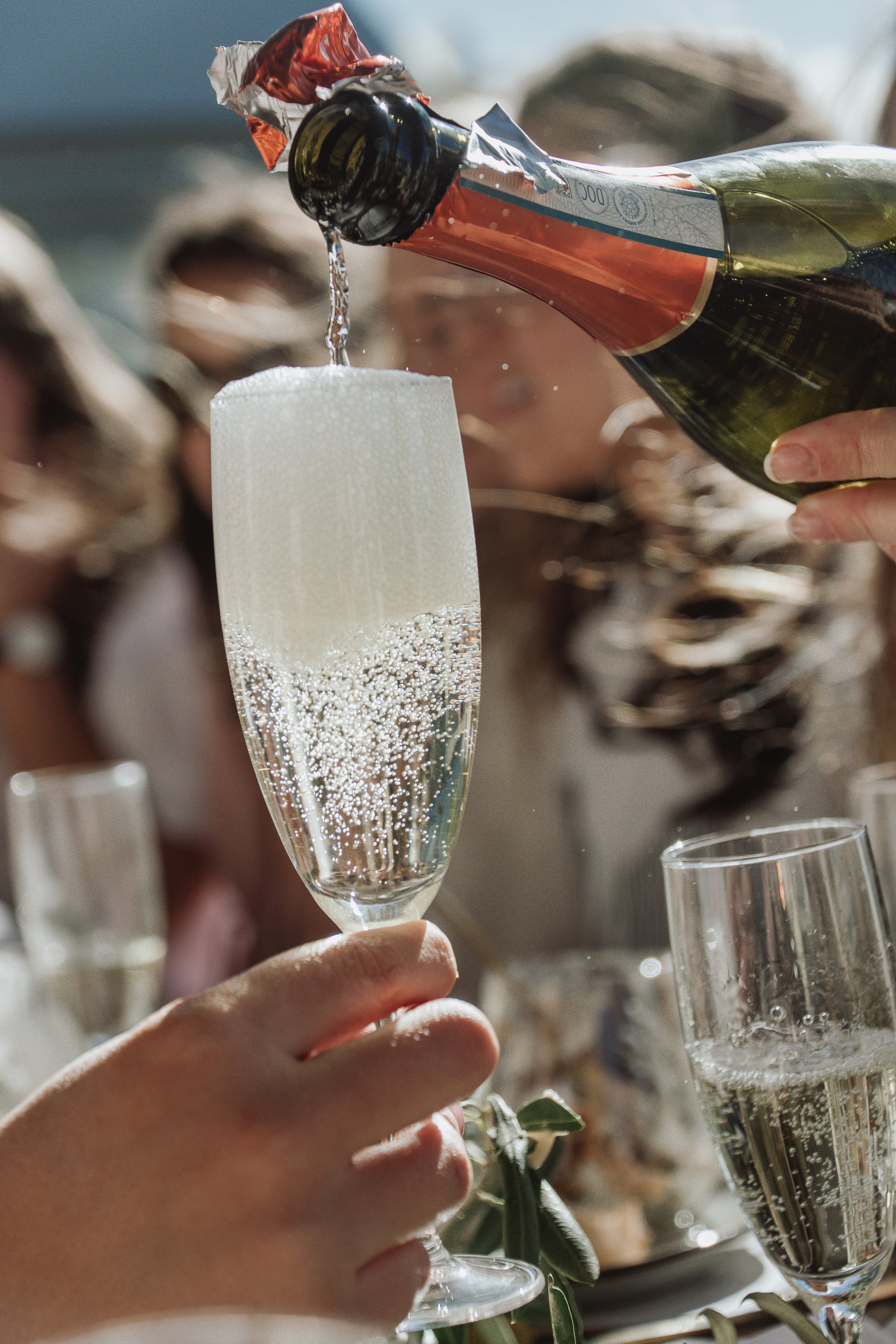
France has its Champagne. Spain has Cava. In Italy, Prosecco and Asti are its two most popular sparkling wines.

Prosecco is primarily from the Veneto region of Italy and made from the Glera grape.  Like Champagne, Prosecco must be produced in designated regions of Italy to be called Prosecco on the label. Unlike Champagne and Cava that undergo a secondary fermentation in the bottle (the 'traditional method'), Prosecco is produced using the Charmat ('transfer') method.  Using this process, large quantities of wine are kept under pressure in stainless steel tanks during the second fermentation.  The resulting sparkling wine is then bottled. While most people can't tell the difference in the secondary fermentation process used, it is generally believed that the traditional method results in smaller, more persistent bubbles, while the transfer method results in lighter bubbles, being almost frothy, and having a creamier feel in the mouth.  Prosecco tends to be fruiter than Champagne and usually sweeter. Prosecco has been described as having flavors of melon, peer, apple, honey suckle and cream.  There are three main styles of Prosecco: Brut has up to 12 gram per liter of residual sugar, while Extra Dry has 12-17 gm/liter and Dry has 17-32 gm/liter.  Prosecco also tends to be lower in alcohol, around 11-12%  And, nice entry-level bottles of Prosecco are easily found in the $12 - $15 range. 

Asti is another popular sparkling wine from Italy. It is produced in the Piedmont region around the towns of Asti and Alba from the Moscato Bianco grape.  Originally known as 'Asti Spumante' (spumante means fully sparkling), the name was shortened to just Asti in 1993 when it received its official designation.  This fully sparkling wine has an alcohol content around 8% to 9% by volume. Sharing the Asti designation is Moscato d'Asti that is also made from the Moscato Bianco grape. This sparkling wine is typically in the frizzante style (frizzante means lightly sparkling). Like Asti, Moscato d'Asti is made using the transfer process, but the fermentation is stopped quite early, resulting in a sparkling wine that is sweet, has fewer bubbles and is low in alcohol (5-6%). Because Moscato d'Asti is lightly sparkling, it is typically packaged with a standard bottle and cork. Both Moscato d'Asti and Asti sparkling wines can be found in the $10 - $15 range.

These Italian sparkling wines are not meant for aging and should be consumed young and fresh. So pick up a bottle or two, chill them, and enjoy them right away. Cheers!