

Sparkling Wines to Consider for the Holidays

Sparkling wines really do shine during the holidays—both literally and figuratively. Here’s a few tips on the various types of sparkling wines to enjoying them to the fullest.

Champagne

Champagne is a sparkling wine that is produced in the relatively small region of Champagne in France. An entry level bottle of Champagne is going to start in the $50 range.

Some Champagne facts:

  • Champagne is typically produced from three grapes — Pinot Noir, Chardonnay and Pinot Meunier

  • To be called Champagne, it must be produced in the Champagne region of France. Otherwise, it must be called Sparkling Wine

  • Champagne is produced using a process called the méthode champenoise where the bubbles are formed in the bottle during a second fermentation.

U.S. Sparkling Wine

In the U.S., there are a tremendous number of makers of sparkling wine. Most will produce a wine that can taste very much like the French Champagne. And, you can also find rosé sparkling wines.  An entry level bottle of sparkling wine in the U.S. can be as little as $10. Read more

Prosecco and Asti

In Italy, Prosecco is their signature sparkling wine. Produced in the Veneto region just north of Venice, this sparkling wine usually produces bigger bubbles. Bottles of Prosecco can be purchased in the $10- $15 range. Read more

Cava

The sparkling wine of Spain is Cava that is produced in the Catalonia region of Spain where Barcelona is located.  Nice bottles of Cava can be purchased for around $15. Read more

Styles of Champagne and Sparkling Wine

Brut Nature - This style is bone dry meaning it has little or no sugar content (0–3 g/L sugar).

Extra Brut - This style is also very dry but, it can have up to twice the sugar level of Brut Nature (0–6 g/L sugar). This little bit of sweetness creates a wonderful balance with Champagne’s naturally high acidity.

Brut - This is the most common style. While considered “Dry” this style can have twice the sugar of Extra Brut (0–12 g/L sugar).

Extra Dry - This is the one that always confuses people. This style is sweeter which actually makes it also taste a bit fruity (12–17 g/L sugar).

Dry - The confusing continues. This style is getting up there in sweetness (17–32 g/L sugar).

Demi-Sec - Now you’re talking Sweet (32–50 g/L sugar). This style works well with desserts or cheeses.

Doux - This one, while very rare to find, is really sweet (50+ g/L sugar).

A few serving tips

  • Chill properly: About 40–45°F (4–7°C) is ideal

  • Use proper glassware: Tulip or white wine glasses preserve aroma better than narrow flutes

  • Open gently: Twist the bottle, not the cork, for a quiet, elegant release

No matter which type or style you choose, give sparkling wines a try this holiday season. Cheers!
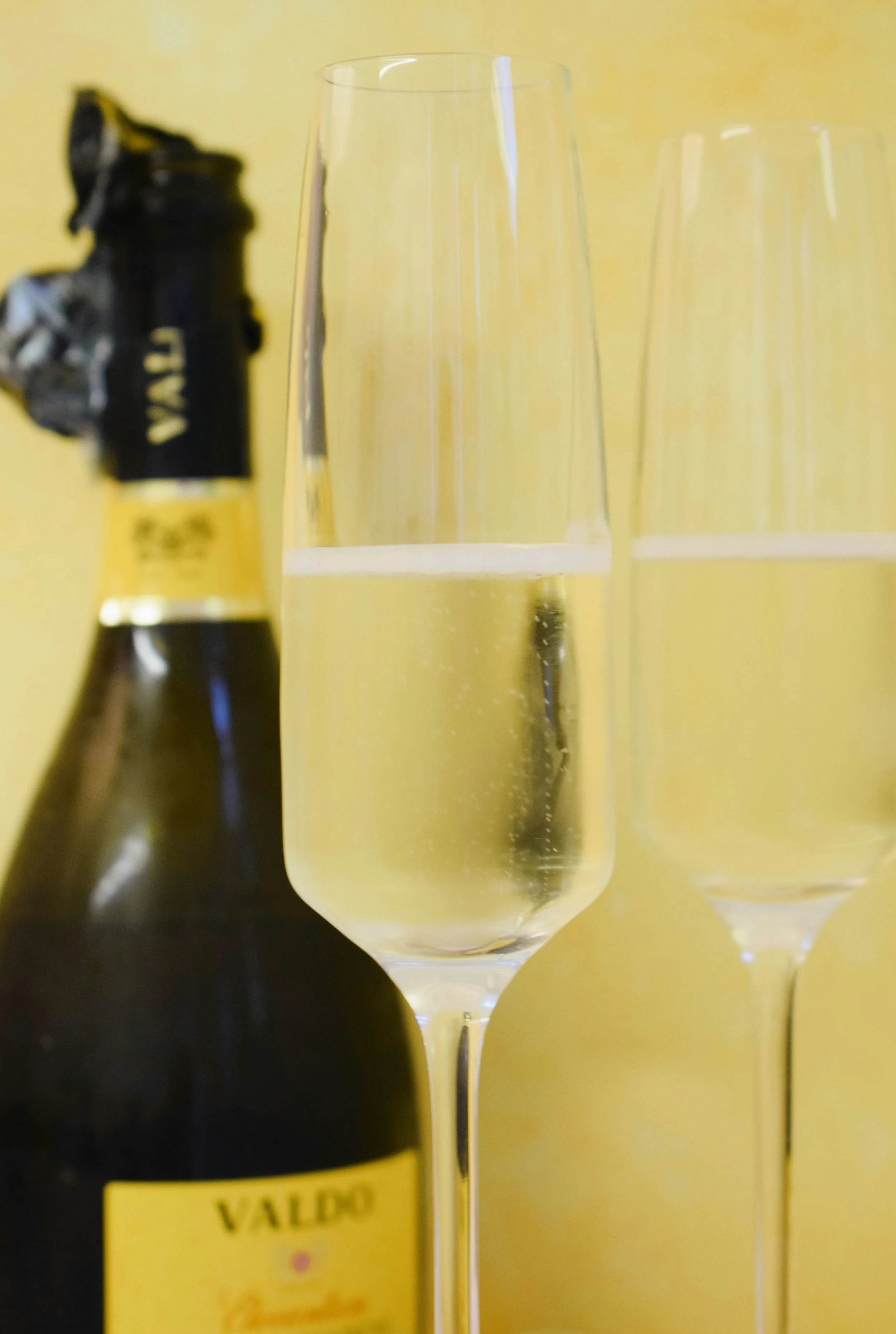
Prosecco - The Sparkling Wine of Italy

Photo by Fran Taylor on Unsplash

Sparkling wines always seem to be special. And plenty of corks get popped each year. It’s estimated that in 2024, the global consumption of sparkling wine was about 5.4 billion liters or 7.2 billion bottles!

In 2024, the Prosecco DOC denomination of Italy produced about 660 million bottles. So, Prosecco DOC accounts for about 9‑10% of global sparkling wine consumption.

Prosecco is the sparkling wine from the Veneto region of northeastern Italy that is often compared to the best known sparkling wine, Champagne. But, unlike Champagne, it is produced using the Charrmat method where the secondary fermentation occurs in large stainless steel tanks versus in the bottle. And, the grapes used in Prosecco but be at least 85% Glera whereas Champagne is produced from Chardonnay, Pinot Noir and Pinot Meunier. Prosecco’s bubbles do tend to be larger and actually softer than Champagne.

Prosecco is produced in several quality levels:

  • Prosecco DOC - The most common Prosecco that is produced is the Veneto and Friuli Venezia Giula regions

  • Prosecco Conegliano Valdobbiadene Superior DOCG - a top-tier Prosecco made exclusively in a specific hilly area of Veneto

  • Prosecco Colli Asolani DOCG - Known as Asolo Prosecco Superiore DOCG, this is the second DOCG-level Prosecco zone though smaller and less famous

  • Prosecco Conegliano Valdobbiadene Superiore Rive DOCG - Some of the highest-quality, terroir-specific sparkling wines within the Prosecco world

  • Prosecco Valdobbiadene Superiore di Cartizze DOCG - The most prestigious, limited, and luxurious of the entire Prosecco classification system

These Prosecco sparkling wines are produced in the following styles:

  • Extra Brut - Contains 0-6 g/L of Residual Sugar that tend to somewhat rare

  • Brut - Contains 0-12 g/L of Residual Sugar with crisp, clean and zesty flavors

  • Extra Dry - Contains 12-17 g/L of Residual Sugar with sweet, fruit flavors

  • Dry - Contains 17-32 g/L of Residual Sugar that is sweet and rich, a dessert-like wine


So, be sure to look for and try Prosecco. It’s a lot more affordable than Champagne with similar light, fresh and fruity flavors. Perfect for any celebration for just sipping with most any food. Cheers!

Sparkling Wines are Perfect for the Holidays!

Sparkling wines are perfect for the holidays. Here’s a few types to consider enjoying:

Champagne

Champagne is a sparkling wine that is produced in the relatively small region of Champagne in France. Only those sparkling wines produced in this region are allowed to be labeled as 'Champagne.'  And an entry level bottle of Champagne is going to start in the $50 range. So, typically you are toasting with some other sparkling wine. Read more

Some Champagne facts:

  • Champagne is typically produced from three grapes — Pinot Noir (Yes! A red wine grape!), Chardonnay and Pinot Meunier

  • To be called Champagne, it must be produced in the Champagne region of France. Otherwise, it’s called Sparkling Wine

  • Champagne is produced using a process called the méthode champenoise where the bubbles are formed in the bottle during a second fermentation.

U.S. Sparkling Wine

In the U.S., there are a tremendous number of makers of sparkling wine. Most will produce a wine that can taste very much like the French Champagne. And, you can also find rosé sparkling wines.  An entry level bottle of sparkling wine in the U.S. can be as little as $5. Read more

Prosecco and Asti

In Italy, Prosecco is their signature sparkling wine. Produced in the Veneto region just north of Venice, this sparkling wine usually produces bigger bubbles. Bottles of Prosecco can be purchased in the $10- $15 range. Read more

Cava

The sparkling wine of Spain is Cava that is produced in the Catalonia region of Spain where Barcelona is located.  Nice bottles of Cava can be purchased for around $15. Read more

Styles of Champagne and Sparkling Wine

Brut Nature - This style is bone dry meaning it has little or no sugar content (0–3 g/L sugar).

Extra Brut - This style is also very dry but, it can have up to twice the sugar level of Brut Nature (0–6 g/L sugar). This little bit of sweetness creates a wonderful balance with Champagne’s naturally high acidity.

Brut - This is the most common style. While considered “Dry” this style can have up to twice the sugar of Extra Brut (0–12 g/L sugar).

Extra Dry - This is the one that always confuses people. This style is sweeter which actually makes it also taste a bit more fruity (12–17 g/L sugar).

Dry - The confusion continues. This style is getting up there in sweetness (17–32 g/L sugar).

Demi-Sec - Now you’re talking Sweet (32–50 g/L sugar). This style works well with desserts or bold cheeses.

Doux - This one, while very rare to find, is really sweet (50+ g/L sugar).

No matter which type or style you choose, give sparkling wines a try this holiday season. Cheers!

Behind the Cork™ - Fiol Extra Dry Prosecco DOC

Fiol Extra Dry Prosecco ($19)

As we bid farewell to summer and “Hello” to the Fall, there’s no shortage of excuses to raise a glass of bubbly in the months that lie ahead.

“FIOL” means “son” in the Venetian dialect, but these days is more commonly understood to denote a natural leader or friend within a group who happens to stand out. The drive behind FIOL was to produce Prosecco in the authentic style, from the Prosecco heartland in Treviso.

Behind FIOL are childhood friends Gian Luca Passi and Giovanni Ciani Bassetti, whose families have lived and farmed in the Prosecco heartland of Treviso for generations.

The striking FIOL label, designed by FIOL co-founder Gian Luca Passi, features five vertical lines, both a stylized nod to the poles used to support the vines, and a reference to tradition and modernity.

FIOL Extra Dry Prosecco DOC is produced using the Charmat Method, in Stainless Steel tanks, to preserve the fresh and vibrant flavors using 100% Glera grapes. It undergos 40-days of secondary fermentation in tank for extra depth and complexity. [ABV: 11 %, Residual Sugar: 16 g/L (i.e., Extra Dry)]

This FIOL Prosecco is a beautiful pale straw color with subtle floral and citrus aromas. On the palate, this Prosecco has delicate notes of lemon along with refreshing acidity and a touch of tartness on the finish. While this is an “Extra Dry” Prosecco (13 g/L of residual sugar), it’s not sweet - the acidity does a wonderful job of making this a well-balanced bubbly. [ABV: 11%l]

This FIOL Prosecco is great as an aperitif, along with everyday meals or a real treat for special occasions. And, at this price, is a great value! That makes it the perfect fit as this week’s Behind the Cork™ Wine of the Week! Cheers!


Disclosure of Wine Sample Submission: I received this sample at no cost for review. The opinions expressed are entirely my own.

Media Sample Provided by Fiol Prosecco DOC

Italian Sparkling Wines - Prosecco and Asti

France has its Champagne. Spain has Cava. In Italy, Prosecco and Asti are its two most popular sparkling wines.

Prosecco is primarily from the Veneto region of Italy and made from the Glera grape.  Like Champagne, Prosecco must be produced in designated regions of Italy to be called Prosecco on the label. Unlike Champagne and Cava that undergo a secondary fermentation in the bottle (the 'traditional method'), Prosecco is produced using the Charmat ('transfer') method.  Using this process, large quantities of wine are kept under pressure in stainless steel tanks during the second fermentation.  The resulting sparkling wine is then bottled.

While most people can't tell the difference in the secondary fermentation process used, it is generally believed that the traditional method results in smaller, more persistent bubbles, while the transfer method results in lighter bubbles, being almost frothy, and having a creamier feel in the mouth.  

Prosecco tends to be fruiter than Champagne and usually sweeter. Prosecco has been described as having flavors of melon, peer, apple, honey suckle and cream.  There are three main styles of Prosecco: Brut has up to 12 gram per liter of residual sugar, while Extra Dry has 12-17 gm/liter and Dry has 17-32 gm/liter.  Prosecco also tends to be lower in alcohol, around 11-12%  And, nice entry-level bottles of Prosecco are easily found in the $15 - $20 range. 

Asti is another popular sparkling wine from Italy. It is produced in the Piedmont region around the towns of Asti and Alba from the Moscato Bianco grape.  Originally known as 'Asti Spumante' (spumante means fully sparkling), the name was shortened to just Asti in 1993 when it received its official designation.  This fully sparkling wine has an alcohol content around 8% to 9% by volume. Sharing the Asti designation is Moscato d'Asti that is also made from the Moscato Bianco grape. This sparkling wine is typically in the frizzante style (frizzante means lightly sparkling). Like Asti, Moscato d'Asti is made using the transfer process, but the fermentation is stopped quite early, resulting in a sparkling wine that is sweet, has fewer bubbles and is low in alcohol (5-6%). Because Moscato d'Asti is lightly sparkling, it is typically packaged with a standard bottle and cork. Both Moscato d'Asti and Asti sparkling wines can be found in the $10 - $20 range.

These Italian sparkling wines are not meant for aging and should be consumed young and fresh. So pick up a bottle or two, chill them, and enjoy them right away. Cheers!