
Proper Wine Storage -- It's Starts at the Store!

A lot of people are concerned with ensuring that they store their wine properly. And, that’s important. But to ensure you are getting a wine that’s at its best, you also need to take into consideration the store where you’re buying your wine.

Sure, there are potential storage issues between the winery and the store. Like the method of shipment and the time of year (e.g., getting too hot). But, how your local wine shop or store handles your wine is very important because it may sit on the shelf for a longer period of time.

While visiting the eastern U.S. last winter, I took a short snowy walk to a place where I’ve purchased wine before. While it was below freezing outside, the store was nice and warm. But, that caused me to pause. As I took off my layers to be comfortable while shopping, it struck me that it was probably in the high 70s F in the store, if not 80 degrees. While that’s a comfortable temperature for shoppers on a cold winter day, that’s not anywhere near an ideal temperature for a wine.

Maybe you’ve noticed that most grocery stores are kept quite cool. That’s intentional to help keep their merchandise as fresh as possible. And that’s especially true for wine. While most guidance for wine storage is in the 50s F, even a “cool” temperature in a store will be in the high 60s. While that’s fine for short amount of time, finding an older bottle of a nice wine that been sitting at nearly 80 degrees F for who knows how long, could be an issue.

So, just keep in mind that while you may have the ideal wine storage system at home, you also must ensure that the wine you’re putting into it has not been damaged while in the store.

Oh! And also consider where the wine is placed within the store. I’ve seen too many wine shelves in direct sunlight. That’s not good either!

Cheers!
Ever Wonder? Should You Chill a Bottle of Wine in the Freezer?

Frozen Wine.JPG

It’s a common problem. You buy a bottle of wine that you want to server that same day. And you want it chilled. So, is the freezer a good option for quickly chilling a bottle of wine?

Well, chilling a bottle of wine in the freezer is one method. But, it has a couple of issues.

First, a freezer by definition is an environment that is below freezing. Right? So, that’s 32 degrees F or below. And, assuming you are trying to chill a bottle of white wine, rosé or sparkling wine, the best serving temperatures for those are going to be somewhere in the range of 38 to 55 degree F range, depending of the type of wine. Thus, a freezer is going to be too cold if the bottle remains in the freezing environment too long.

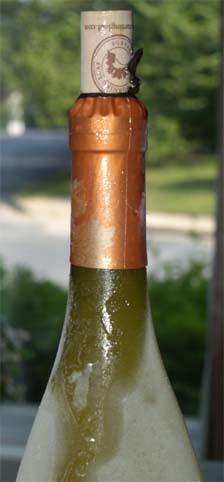
And, you run the risk of actually damaging the bottle. Depending on the alcohol content of the wine, it will freezer somewhere in the 15 to 20 degree F range. Because wine is mostly water, it’s going to expand when it freezes which can either push the cork out of the bottle (see photo) or, even worse, break the bottle!

The second issue with using a freezer to quickly chill a bottle of wine is that it’s really not that quick. It will still take quite a while to get that bottle to your ideal serving temperature.

Wine Bucket with Ice.jpg

So, what’s the best way to quickly chill a bottle of wine? Well, find a container that’s a bit larger than the bottle or bottles, fill it with ice and then fill it with water. The ice-cold water will then fully surround your bottle and it’ll be chilled rapidly. And, you don’t need to worry about it freezing!

Cheers!

Ever Wonder? - What's that Stuff at the Bottom of Your Wine Glass?

Have you ever taken that last sip of wine only to find a nasty surprise either at the bottom of your glass or in your mouth? Sediment! It can be a very unpleasant discovery. But, luckily, it’s nothing to be worried about.

Sediment is a natural bi-product of the wine making process.

Wines are made from the juice of grapes. And, the skins of the grapes. And the seeds. And sometimes the stems. So, there are actually a lot of solids that are involved in wine making. That’s why, in some cases, you get some ugly particles in your wine glass.

It doesn’t just happen with red wines. White wines are susceptible too.

There’s a lot of chemistry involved in for formation of various types of sediment in wine. But, keeping it simple, these solids in your glass are mostly filtered out at the winery and are just microscopic when they leave the winery in the bottle.

But, age and temperature then act upon these microscopic particles to form the stuff you see in your wine glass.

Next time, I’ll get into a bit more detail on this topic. But, for now, don’t worry. This sediment is not harmful to consume. Cheers!

Ever Wonder? - What is the Best Way to Store an Opened Bottle of Wine?

Last time we looked at a rather unorthodox way of storing an open bottle of wine — in the freezer. And then thawing it in the microwave. Well, that’s not the common advice.

Here’s some of the the more typical ways to store an opened bottle of wine. Even if you follow these steps they will only keep the wine good for a few days.

Re-Seal It

First, you need to re-seal the opened wine bottle either with the cork that you pulled out of the bottle or with a stopper. A stopper is the most convenient way because if you’ve ever tried to put a cork back in the bottle, it can be difficult. Especially if you try to put the same end back in. But don’t be tempted to put the top or ‘clean’ end into the bottle. It may be easier but you really don’t know how ‘clean’ that end was to start with. So, either put the original end or the cork back into the bottle or use another stopper. And, if the bottle was a twist-off, you’ll definitely want a stopper. The best stoppers are those that allow you to pump the air out of the bottle. That will ensure your wine doesn’t have too much exposure to air which leads to the wine going down-hill even more rapidly.

Keep It Cool

Once you’ve resealed the bottle, you’ll want to keep it cool. Don’t leave it out on the counter. Room-temperature and sunlight will quickly degrade the wine. And besides, like any perishable, it needs to be refrigerated after opening. Keeping it cold will slow the process of the wine’s degradation but, again, it’ll only keep for a few days. Then, just remember to take the cold bottle out of the refrigerator well before serving. For white wine, it probably needs to sit at room temperature for 30 minutes to be at proper serving temperature. For reds, give them around an hour.

Using these simple steps should ensure that your opened bottle of wine will still be good for a few days after your first open it. As for the freezer and microwave, I’m not yet convinced. Cheers!

Wine Storage with a Freezer and a Microwave?

EWW Browser Icon.png

I was catching up on some reading recently when I came upon an article from James Laube in Wine Spectator. He’s been a wine writer for Wine Spectator since 1980, is very well respected and one of my favorites. But his piece titled “Ice Age” had me scratching my head. I had to check the date on the edition — Was it an April Fool’s Edition? No, it was actually the edition from October 31, 2018.

Having been a wine writer for so many years, Laube stated that the most common question he gets is “How do you preserve an open bottle of wine?” I expected to hear a bunch of the most common ways — in the frig, in a cool dark place, sealed with a stopper that allows the air to be pumped out, etc. But, that’s not what this wine legend recommended. Instead, he recommends the use of a freezer and a microwave!

Now, a freezer and microwave are couple of the last places I’d ever expect an opened bottle to end up. But, he’s used this process for decades when he wants to preserve a nice bottle for a few days or longer. He acknowledges “that freezing wine sounds preposterous to many wine lovers” but he says it works quite well.

He recommends placing the cork back in the bottle of wine and sticking it in the freezer. Then, when you’re ready to drink the wine again, simply pop the frozen bottle of wine in the microwave for 15 to 20 seconds. That he says “…renders a wine that looks like a Slurpee, ice shavings and all.” You can then put it through second short cycle in the microwave “and then it’s ready.

Really? I’m not sure I’d do this with a cheap bottle of wine. But Laube is drinking, freezing and microwaving the good stuff! He claims “But one you try it — and discover for yourself that the wine is fine after thawing — you’ll be hooked.

So, maybe I’ll give this a try. That is, if I ever end up with a nice bottle of wine that I haven’t emptied! Cheers!