Why is There a Foil Capsule on a Wine Bottle?

Last time we looked at where cork comes from and learned that it's actually the bark of the Cork Oak tree. It is bark that can take 25 to 50 years to get to the point where it is usable for wine bottles and each tree can only be harvested every nine years so as to not do permanent damage to the inner bark of the tree.  But then there is a capsule that covers the cork and the top of the bottle. Ever wonder why there is a capsule on a wine bottle?

Originally the capsule was placed over the cork as a means of protecting the cork from insects and rodents that found the cork to be an enjoyable meal.  The capsule served as a barrier between the critters and the cork.  There are also some theories that the capsule was also a way of covering the cork from would-be wine thieves. The capsule kept unscrupulous individuals from being able to pull the cork on a good bottle, drink the contents, replace it with inferior wine and re-cork the bottle!  I'm not completely sure of this one, but it makes some sense. But, it certainly was the original reason behind the wire-netting that was used over some bottles of wines.

The wine bottle capsule, and wire-netting, continue to be used today. But not to protect the cork from critters or the wines from dishonest thieves. Today the capsule and netting serve purely as decorative elements of the wine bottle packaging.  This was abundantly clear during a recent visit to a small winery. While standing at the tasting bar, the owner came out with a couple different gold-colored capsules and asked which one looked best with their label.  After a bit of comparison with the colors on the wine label, it seemed obvious that one was the better shade of gold.  "Yes" the owner said, "but it's considerably more expensive than the other one."  I don't actually know which capsule they ended up choosing, but the capsule is all about packaging. And economics. 

Originally the capsule was made of lead. It was a very malleable metal that was easily formed into the proper shape. But, in the 1990's, it was confirmed that the lead left enough residue on the bottle's lip so as to be a potential lead poisoning health hazard to wine drinkers. So lead was replaced with tin or plastic.  There are also many wineries that are eliminating the capsule completely, or just placing a small dollop of sealing wax over the top of the cork.

One other bit of trivia regarding the capsule. If you take a close look at the top of the capsule you'll typically see one or two tiny pinholes in the cap.  These holes have been attributed to allowing the cork and the wine to ever-so-slightly breath over time. But the commonly accepted reason is much more practical.  These tiny holes in the top of a wine capsule actually allow the air to escape while the capsule is being installed. Without these 'vents' the air inside the capsule would become trapped and the capsule would not be able to fully seat on the lip of the bottle.

Well, that's a lot of information on something that we usually ignore and simply cut off before enjoying a bottle of wine.  So here's to pulling that cork and enjoying a nice glass of wine. Cheers!


Behind the Cork™ Wine of the Week - Columbia Crest Chardonnay ($8)

Looking for an attainable, affordable wine?  You've come to the right place. Each week I feature just such a wine on the Behind the Cork Wine of the Week page of EverWonderWine.com

This week's wine is Columbia Crest Chardonnay. A great value at $8!  While the pendulum of Chardonnays has swung away from the heavily oaked "Big Buttery" Chardonnays, the Columbia Crest still gives buttery-oak Chardonnay lovers a viable option.  While the oak is bold and rich, it is not over-the-top. This is a great wine with seafood, chicken or a salad.

Where Do Corks Come From?

During a visit to the Dry Creek Valley in Sonoma California, I stopped at the beautiful Ferrari-Carano winery. After tasting their wonderful wines, my server stated that walking their gardens was not to be missed. And while in the gardens, he said to be sure to stop by and check out the Cork Oak.

I had always known that cork comes from a tree, but not much beyond that.  So, while strolling through the garden, I came upon the Cork Oak (Quercus Suber) shown in the photo.  In reading about the Cork Oak I was surprised by several facts.

First, and most surprising, was that cork comes from the bark of the Cork Oak.  I had always assumed that the cork somehow came from some soft inner wood of the trunk. But no. It's from the bark.  And then to learn that the bark can only be harvested every nine years, so as to not harm the tree.  The Cork Oak actually has two layers of bark. The outer soft, woody, bark and another inner bark that must not be harmed while harvesting the cork.

Another interesting fact is that cork trees can take 25 years before they are ready for their first harvest.  And typically this first harvest is not suitable for wine stoppers. The first harvest of cork is usually ground up and molded into large block for use as other cork products such as cork tiles and message boards. It isn't until the tree is approximately 50 years old, and on its third harvest, that it produces cork suitable for wine stoppers.

Finally, a Cork Oak can yield 13 to 18 harvests during its life of around 300 years old!

The Cork Oak is grown around the Mediterranean in Portugal, Spain, Morocco, France, Algeria, and Italy.  Attempts to commercially grow Cork Oak in other parts of the world have not been successful.

Whenever wine corks are discussed, the topic of synthetic corks and twist-offs comes up. And I'll hold off on that topic for a future blog.  But next time I want to address that beautiful foil capsule that covers the cork and the upper portion of the bottle. Until then, cheers!


Behind the Cork™ Wine of the Week - Kenwood Jack London Zinfandel ($16)

Looking for an attainable, affordable wine?  You've come to the right place. Each week I feature just such a wine that may be great for taking to a party, enjoying with a dinner or just sipping on Wine Wednesday. 

This week's wine is Kenwood's Jack London Zinfandel. This is a great one that I enjoyed with a short rib dinner. From Sonoma Mountain, this wine is described by the winery as having "fruity aromas of raspberry and fig combined with subtle notes of vanilla and white pepper. With its delicate and well-structured tannins, it provides an elegant mouth feel and a long finish." Another great one to try!

Is Your Wine Too Hot, Too Cold or Just Right?

It is said that most American's drink their white wines too cold and their red wines too warm. And I've certainly observed this myself.  Wine flavors can be amazing, but serving a wine too cold or too warm can significantly affect a wine's flavors. While the serving temperature that is just right for you is a matter of individual taste, there are some common rules of thumb.

When it comes to light white wines, sparkling wines and rosé, the common thought is that they should be served in the range of 40 to 50 degrees Fahrenheit (F). A more full-bodied white wine, such as Chardonnay, should be served in the 50 to 60 F range.  And as you can see, these temperatures are well above the typical refrigerator temperature of 34 F.  When a wine is served too cold, the flavors are not allowed to fully come out. So you end up with flat, bland or weak tasting white wines.

A friend of mine recently commented that he had never really liked Chardonnay. He was more of a red wine drinker.  But during a winery visit he had been served a Chardonnay and really liked it.  Not just because it was a nice Chardonnay, but because it was being served well above the refrigerator temperature that he was used to. So at the proper temperature he got to truly experience all the flavors of Chardonnay for the first time.  It was a real eye opener for him.

For red wines, the lighter and fruitier ones can be served in the range of 50 to 60 F with full-bodied reds being in the 60 to 65 F range.  These temperatures are well below 'room temperature.'  Serving a red wine too warm can make it more harsh, exaggerate the tannin and enhance the mouth-feel of the alcohol causing a burning sensation.

If you do have a white wine in the refrigerator, pull it out and let it sit for 30 minutes. And, if you have a bottle of red that's at room temperature, put it in the refrigerator for 30 minutes.  Or better yet, invest in a wine refrigerator that will ensure your wines are stored and served at just the right temperature. Cheers!


Behind the Cork™ Wine of the Week - Stags' Leap Merlot ($20)

Looking for an attainable, affordable wine?  You've come to the right place. Each week I feature just such a wine that may be great for taking to a party, enjoying with a dinner or just sipping on Wine Wednesday. 

This week's wine is Stags' Leap Merlot. This medium-bodied wine from Napa Valley is an excellent wine at $20. Nice big flavor of berry fruit with soft tannin and a smooth finish. You can't go wrong with a wine from Stags' Leap.


Do You Know Primitivo?

It's always fun to find and try new and different wines. And, when it comes to exploring "Old World Wines" it can be even more of an adventure. That's what happened to me when studying the shelves of Italian wines. I came across a completely unknown wine called Primitivo (Prim-ah-TEE-voh).  Excited by this new find, I bought a bottle and tried it.  It was nice. It had a good bold fruity flavor with a bit of tannin and nice finish. I thought I'd discovered yet another great wine.  But as soon as I did a little research into this newly found wine I discovered that I'd actually met an old friend.

Primitivo, meaning "early one" due to its relative early ripening, does have heritage from Italy. It is a well-known wine from the Puglia region that is located in the far southeastern corner of the 'boot' of Italy. But it is believed that it arrived in Italy via Croatia, just across the Adriatic Sea.  And, it is a naturally cloned version of the Croatian grape Crljenak Kastelanski.

It wasn't until DNA testing in the 1990's that it was revealed that not only was Primitivo a clone of Crljenak Kastelanski, but American Zinfandel was also a naturally cloned relative. So, Primitivo and Zinfandel are actually the direct clones of the Croatian grape and essentially the same.

Interesting enough, in Europe, where wine restrictions are seemly very strict, Primitivo and Zinfandel may legally be used interchangeably. But, in the U.S., labeling laws don't allow interchangeability. So, it's possible that a U.S. made wine could be labeled as a Primitivo-Zinfandel blend.

But, for all intents and purposes, Primitivo and Zinfandel are the same grape. Though the Italian Primitivo is often somewhat different than the California Zinfandel.  This is usually attributed to the growing conditions such as the soil and the weather (terrior) and the winemaking process, not the grape.

So, if you are a Zinfandel lover, be sure and pick up a bottle of Primitivo. The Italian Primitivo wines likely to be lighter in style than California Zinfandel, but still have the great depth of flavors just like Zinfandel. And, you'll typically find great values on these wines from Italy.  Cheers!


Behind the Cork™ Wine of the Week - Layer Cake Primitivo ($13)

This wine from Puglia Italy is a Primitivo, but as stated in the blog, is also allowed to be labeled as a Zinfandel by European laws. This is a very accessible Italian Primitivo that is made very much in the style of California Zinfandels.  It has nice bright fruit and a smooth finish, with just a hint of earthiness and minerals from the ancient seabeds of Puglia Italy.

The Never Ending Search for Great Wine

A few years back as I started to become interested in wines, I was searching for a really great wine that I could dependably go back to time after time. While the search for a great wine was a fun adventure, it never seemed to converge on a wine that I could always go back to and enjoy as much as the first time.  As it turns out, that was just the start of the never ending search for a great wine.

Part of the reason that it's difficult, if not impossible, to find a consistently good wine year after year is the very nature of wine making.  Each year's harvest is different, with weather playing a huge role. The spring weather determines how many of the grapevine buds will turn into bunches of grapes. And the fall sun or rain determines how well the grapes will ripen. And not only is there the variability of the grape harvest, but there are all the factors that go into fermentation and aging of the wines.  All these variables make for ever-changes nuances in wines.

Then you come to understand that there's yet another factor.  As you make your way along the journey in search of a great wine, you get exposed to more and more wines. And in this process, your pallet changes.  What was once a really nice wine becomes a so-so wine. So you keep searching, trying to find that one really great wine.

And to this day, I'm sure that there has to be that one great wine out there. Somewhere.  So I'll keep searching. But I also realize that it's a never ending search for great wine.  Enjoy your search. Cheers!


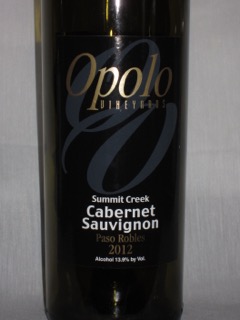
Behind the Cork™ Wine of the Week -  Opolo Vineyard Summit Creek Cabernet Sauvignon ($20)

This wine from Paso Robles CA is a great find. Described as having defined tannins with flavors of cherry, blackberry, toasted almonds and vanilla this Cabernet is a winner.  A super wine to enjoy grilled meats, cheeses, or just by itself.  Check this one out!