Toasted Oak Barrels and Their Effect on Wine Flavor

Last time we looked at the differences between new oak versus neutral oak wine barrels. New oak imparts lots of flavors to wine. But after about three vintages, the oak no longer imparts flavor so it is called neutral oak.

Much of the flavor imparted by the oak occurs naturally from the raw wood. But winemakers learned long ago that by "toasting" the inside of an oak barrel, they can enhance these flavors.

After a barrel is built, its inside can be exposed to fire to "toast" it. This is done either over an open flame or using a hand-held torch. The fire 'caramelizes' the wood's natural sugars and brings out complex compounds. From this, the wine will ultimately take on flavors that are toasty, charred, spicy and sweet depending on the amount of time the wood is toasted.

A lightly toasted barrel spends about 25 minutes exposed to flame while a heavily toasted barrel may get up to one hour of flame exposure.

Essentially, the heavier the toast, the stronger and more varied are the imparted flavors:

Light Toasting - Vanilla, coconut, caramel, clove and cinnamon

Medium Toasting - Vanilla, honey, caramel, toast, coffee, cocoa

Heavy Toasting - Vanilla, espresso, smoke, crème brûlée, butterscotch, toffee, molasses

Oak interacts with wine differently depending of the different grape varieties. Oak may impart hints of chocolate to a Merlot, and vanilla or coconut to a Zinfandel. White wines aged in oak (think Chardonnay) typically develop flavors of vanilla, baked apple, caramel, honey, toasted marshmallow, or buttered toast.

A winemaker will decide on what degree of toasting is appropriate for their wine’s style. Our 'job' is to enjoy all the wonderful flavors that oak, and toasted oak, add to our wine. Cheers!

Aging Wine in New Oak versus Neutral Oak

Wine may be fermented and aged in a variety of materials including stainless steel, oak and ceramic vessels, including concrete. The use of oak barrels is very common and its use dates back to the early days of Roman wine making.

While stainless steel imparts no additional flavor to a wine, and ceramics and concrete can add hints of minerality, oak barrels can have influences that range from subtle to intense.

When wine is aged in oak barrels, it develops flavors from the wood. Most commonly, oak barrels result in vanilla flavor that works well with many white and red wines. Oak barrels may also be toasted on their insides to varying degrees, and that adds smoky or toasty flavor to the wine.

If a wine is aged in 100% new oak, it will likely be very bold, rich, spicy and, of course, oaky. But, wines pull these flavors out of barrels relatively quickly. After the first year of use, a barrel loses much of its flavoring ability and, after three vintages, the wine has extracted most all of the oak's flavors, thus it is considered neutral oak.

Wines may still be fermented or aged in neutral barrels. Such aging tends to soften wines, particularly tannic wines, without adding the extra flavors. Neutral oak is typically used to maintain the fruit qualities in a wine while still getting some of the other benefits of aging in oak.

Next time we'll look a bit further into the process of 'toasting' the inside of an oak barrel. Until then, Cheers!

Is there an Egg in Your Wine?

It may sound like an odd question; an egg in wine?  Winemakers use many different products to fix flaws and flavors. But it usually difficult to know which ones have gone into your glass.

There’s no law requiring bottles to be labeled with
these ingredients, and it seems that most winemakers don't want to disclose that information.

Among the things used in wine making are animal products including isinglass which is derived from fish bladders, casein which comes from milk protein, gelatin and egg whites. So, in fact, there may have been egg in your wine before it was bottled.

Egg whites are just one of the products used in the process called 'fining' of red wines. Adding a solution of egg whites and water to the wine as it ages initiates a process that removes solid particles by binding to loose particles in the wine and causing them to settle out so that sediment can be easily removed before the wine is bottled. The fining agents are typically undetectable in the final product, with only trace amounts remaining.

The result is a stable, clear and pleasant-looking glass of wine instead of something that would otherwise be cloudy-looking.

Here's to raising a clean and clear glass of red wine. Cheers!


Old Vine Zinfandel - Is it Better?

Often, you'll see the words "Old Vine" on the label of a Zinfandel. But what does it really mean and does it equate with a better wine?

First, you need to realize that "Old Vine" is not a regulated term.  It can appear on any bottle of wine. Most in the wine industry consider 50 years and over to be worthy of the title.  And, in many cases, these old vines are more toward 100 years of age.  So, let's assume that wineries are using the 50+ definition for their old vine Zinfandel. The question remains - Is it a marketing gimmick or does the fruit from these old vines really result in a better wine?

Let's take a quick look at the life of a grape vine. When first planted, it may produce fruit in the first year or two, but these fruit-baring vines are often pruned before the grapes ripen. Typically, after about five years a vine is capable of producing a harvest-able annual crop. The vines really hit their stride in their teens and twenties, but their decline begins after that. At age 50, the vines are really in their fading years but are now worthy of being called "Old Vine."

Their deep roots that grow to a depth of approximately 25 feet are able to pull moisture and nutrition from the ground in the driest years and not create bloated fruit in wet years.

But, in their golden years, the vines are producing fewer and smaller grapes. This is where the difference can be.  The juice of these smaller grapes tends to be more concentrated in flavor. And, after pressing, the concentrated juice is less affected by the smaller amount of skin in the mixture, leading to lower tannin and a smoother wine.

So, yes, an old vine Zinfandel can be better. Or the vines can be badly in decline and in need of being dug up. But with good land, weather and proper farming an old Zinfandel vine can produce some great wines.

Given the choice on the store shelf, or on the wine list, I'd say go with the old vine. Cheers!

Is There a Relationship Between a Wine's Sweetness and Its Alcohol Level?

When choosing a wine, one of the characteristics of interest to you might be its sweetness.  But how can you really tell if a wine has sweet tendencies?  The label may have some sentences on the back label to tell you just a little bit about the wine but rarely will it give an indication of its sweetness. The only quantified characteristic of a wine that is printed on a label is its alcohol by volume (ABV) expressed as a percentage.

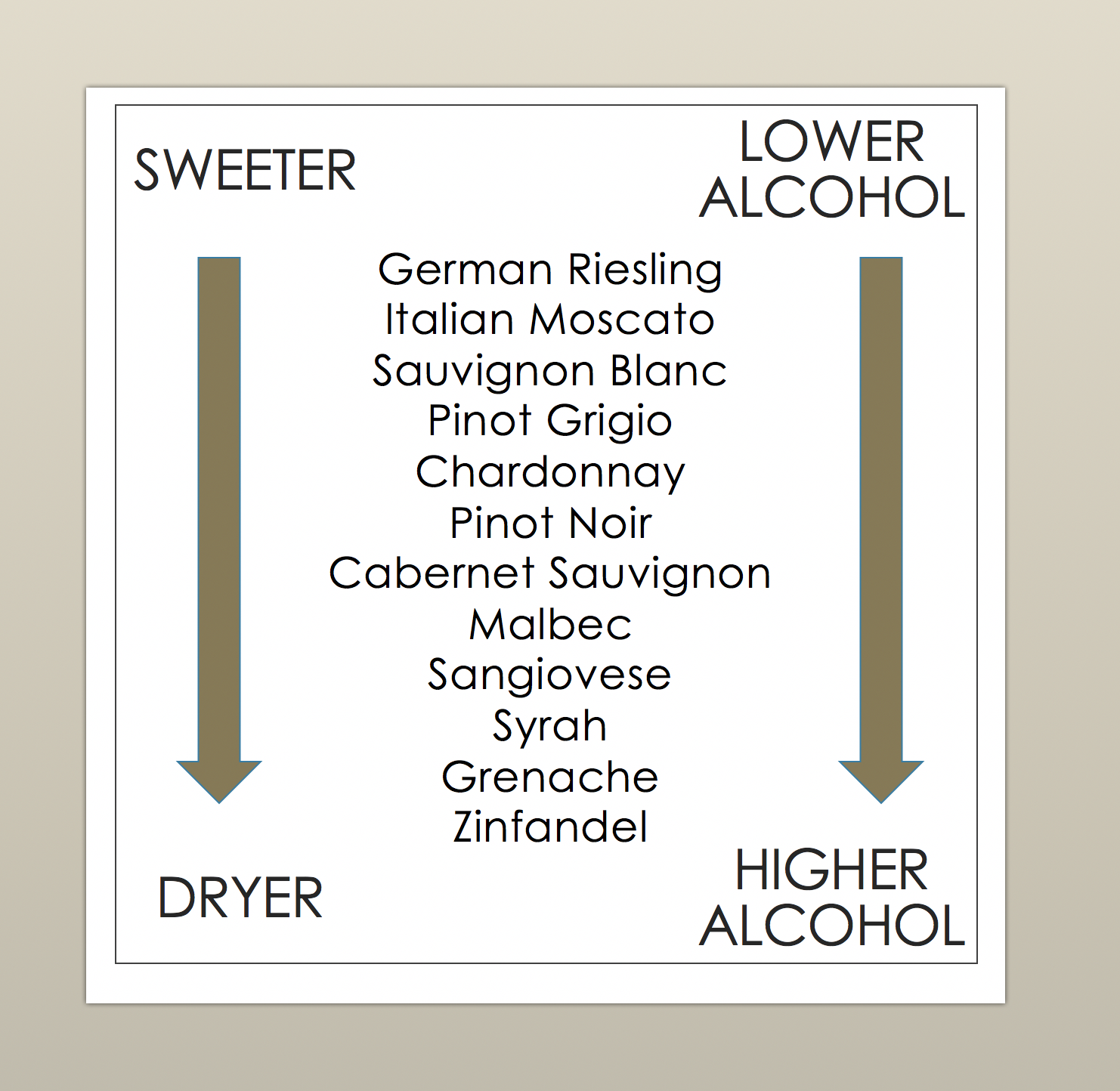
From this, you can make some indirect assumptions about a wine's sweetness. Rough rules of thumb say if a wine's alcohol content is 10% or less it will have sweet characteristics.  Wines that are even lower (especially down around 8 or 9 percent) will definitely be sweet. Wines in the 11% to 12.5% ABV range are considered 'off-dry' meaning that there is some notable residual sugar.  If it’s 12.5 percent or higher, the wine will be 'dry' and have little to no perceptible sweetness.

Most wines under 10% ABV will be sweet. Typically, wines such as German Riesling and Italian Moscato fall in this category. Wines in the range of 10.5% to 12.5% include Riesling's from Austria, Australia and the U.S., Sauvignon Blanc, and Pinot Grigio (a.k.a. Pinot Gris).  Then, in the 12.5% to 15.5% range you find Chardonnay, Pinot Noir, Cabernet Sauvignon, Malbec, Sangiovese, Syrah, Grenache and Zinfandel.

But, as previously pointed out, a grape that starts with low sugar levels, and ferments to the point where all the sugar is consumed by the yeast, will result in a wine with lower alcohol levels and little to no residual sugar. So, this is why alcohol levels are not a dependable way of determining a wine's sweetness.

So, while there’s definitely a loose relationship between a wine’s residual sugar and its alcohol level, it’s not a simple relationship.  But you can use the percent alcohol printed on the label as a first indication. Cheers!