Some Wine Grapes You May Have Never Heard of Before

While Cabernet Sauvignon and Chardonnay are well known grapes used for making wines, here are just a few grape varieties that you may not have heard of previously. But, several Behind the Cork Wines of the Week have and will feature these lesser known grapes from the Shenandoah AVA being used to produce award winning wines (see hyperlinks off to past blogs and stay-tuned for upcoming blogs).

Cayuga is a French-American hybrid grape variety. It’s a crossing of Schuyler (see below) and Seyval Blanc (see below). It has been specially bred for its cold hardiness and resistance to disease. Cayuga has enough acidity to make a wonderful sparkling wine, as well as still wines that are crisp and dry.

Schuyler is a blue-skinned hybrid wine and table grape created in 1947 by crossing Zinfandel with Ontario. It is used in the USA as table grapes, for grape juice and the production of simple red wines not meant for aging.

Ontario is a white variety that has a frost-hardy vine that is well suited to cooler regions. It can produce white wines with a pronounced foxy attribute. They are also used as table grapes.

Seyval Blanc has become a successful French hybrid grape that produces dry white wine. It is often described as having flavors somewhere between Chardonnay and Sauvignon Blanc. It has high acidity and responds well to malolactic conversion and barrel maturation.

Refosco (rēh-fōse-kō) is a dark-skinned wine grape originally from Northern Italy and neighboring Slovenia that is related to the grapes of Valpolicella. Refosco wines typically have high acidity. Flavors include dark peppery spices and plums. Often slightly astringent and can produce harsh tannins.

Lagrein is an ancient grape variety originally from Trentino-Alto Adige in northeastern Italy. It produces full-bodied wines with flavors of plum and wild cherry. It is known for the deep, dense color it imparts on wines. It is acidic and slightly astringent on the finish. Smokey notes are found in wines made from the Lagrein varietal.

Sagrantino is a red wine grape variety from the Umbria region of Central Italy. black cherries to ripe blackberry. Wines made from Sagrantino tend to have notes of black cherries and ripe blackberry along with spicy and earthy characteristics. Smokiness and sappy pine flavors have also been attributed to wines produced with Sagrantino. Its high tannins and affinity for oak aging mean that it can age well.

Vidal is a hardy hybrid grape that is grown mainly in Canada and the northeastern United States. It is best known as one of the ice wine grapes that produces sweet dessert wines.

Traminette is a hybrid white wine grape variety originally bred at the University of Illinois in 1965. It is the result of a crossing between Gewurztraminer and Joannes Seyve 23.416, a hybrid grape named for its creator. Traminette wines tend to be floral and spicy, and are made in both dry and off-dry styles.

Vignoles is a light-skinned hybrid grape variety first bred in France, but now grown in the Finger Lakes AVA, Shenandoah AVA, as well as in a few mid-western U.S. states. The variety was first bred in Saone-et-Loire in the 1930s by grape breeder J. Ravat, and is believed to have either Pinot Noir or Chardonnay as one of its parents, along with one of the hybrid Siebel varieties. It is well suited to cold weather. It’s high acidity and sugar levels make Vignoles a good choice for vintners looking to make dessert wines, and if the region is cold enough, ice wine can be produced from these frozen grapes.

Ever Wonder? Is Montepulciano a Wine Grape or a Wine-Producing Region?

A Montepulciano (mon-ta-pull-channo) wine can be a bit confusing. Typically, the name of the wine either represents the type of grape used to produce the wine or, most commonly in Europe, the place where the grapes are grown.

Montepulciano as you might guess by its name, is an Italian wine. So, you’d probably also guess that it’s from a region or town of Montepulciano, Italy. But, there you’d be wrong.

It is true that Montepulciano is a beautiful medieval town in Tuscany, in central Italy. But, oddly enough, Montepulciano wines are not produced in Montepulciano.

Instead, Montepulciano wines are from Marche, Molise, northern Puglia and most notably, Abruzzo regions of Italy. All of these regions are along the eastern coast of Italy and benefit from the cooling winds off the Adriatic Sea.

So, yes, Montepulciano wines are made of Montepulciano grapes but they have nothing to do with the town Montepulciano.

To make things even more confusing, the wines that are produced in Montepulciano are, like most Tuscan wines, made from the Sangiovese grape.

Montepulciano is the second most planted red grape in Italy. Sangiovese, the grape used to make Chianti, is the most widely planted grape of Italy.

Montepulciano has long held a reputation for being low-priced fruity red wines that go well with pizza and bold tomato-based sauces. This reputation is true. But, there are many producers, especially in Abruzzo, that are making some very well-structured wines displaying notes of cherry, crushed herbs and tobacco.

Although a bit confusing, Montepulciano wines can be quite good and, as the most exported Italian wine to the U.S., it can be very reasonably priced. Cheers!

Get to Know the Pinots -- Pinot Noir

In previous blogs we got an overview of the Pinot grape and the tremendous number of Pinot synonyms (258!) and looked at the least known of the Pinots, Pinot Meunier and Pinot Gris. Now let’s look at the most notable of the Pinots - Pinot Noir.

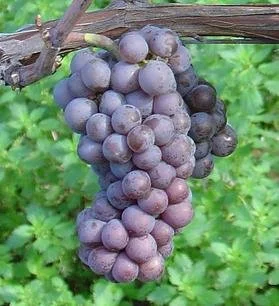
Pinot Noir’s name is derived from the French words for pine and black. The word pine refers to the shape of the tightly clustered, pinecone–shaped bunches of fruit, while noir (black) comes from the dark colored grapes.

Pinot Noir is probably best known as the “red” wine in Burgundy and least known as one of the three primary varietals in the making of Champagne.

Pinot Noir is the world’s most popular light-bodied red wine that is low in tannin. It’s also a favorite for the production of rosé wines and can also be found as a white wine!

Cluster of Pinot Noir Grapes

The most common flavors of Pinot Noir include cherry, cranberry and raspberry. But, its flavors tend to be highly dependent on terroir (i.e., where it is grown). Pinot is grown around the world and most notably in France, USA (California and Oregon), Australia, New Zealand and Chile.

Because Pinot Noir has such delicate aromas, it is generally recommended that it be served in a large round bell-shaped glass. Cheers!

Get to Know the Pinots -- Pinot Gris

In previous blogs we got an overview of the Pinot grape and the tremendous number of Pinot synonyms (258!) and looked at the least known of the Pinots, Pinot Meunier. Now, let’s take a look at Pinot Gris.

A member of the extended Pinot family of grape varieties, Pinot Gris (PEE-no GREE) is a mutation of Pinot Noir that has skins that are not green like other white grape. And, in the vineyard, Pinot Gris and Pinot Noir varieties look identical right up until veraison (when the grapes begin to ripen and change color). This is when Pinot Gris berries take on colors from orange-pink to pale, dusty purple. In fact, the word gris is French for "gray" and refers to the dusty, light-gray sheen the grapes usually take on.

Pinot Gris Grapes

And, by the way, Pinot Gris is simply the French name for the grape that Italian’s refer to as Pinot Grigio. So, they are both the same but, as with all wines, they can taste different based their terrior (i.e., soil, climate, topography).

Pinot Gris wine is typically pale gold in color with aromas and flavors of citrus, pear, green apple, white peach and nectarine. There can also be herbal and spice notes along with floral and honey. It tends to be high in acidity.

So, next time we’ll look at yet another Pinot - Pinot Blanc. Cheers!

Get to Know the Pinots -- Pinot Meunier

In previous blogs we got an overview of the Pinot grape and the tremendous number of Pinot synonyms (258!).

But, there are just four Pinot wine grapes that we’ll now focus on - Pinot Noir, Pinot Gris, Pinot Blanc and Pinot Meunier. But, let’s save those three for later and start with probably the least known of the Pinots but one that plays a very important role- Pinot Meunier.

The word Meunier (mun·yay) is French for "Miller", and gets its name from the grapevines because the hairy underside of its leaves makes it look as though it had been dredged in flour.

Pinot Meunier is a dark-berried grape variety that is mostly grown in France (more than 3/4s of the worlds Pinot Meunier production). While you are less likely to find a Pinot Meunier varietal wine (it does make a very Pinot Noir-like red wine), you’ve more likely experienced it in a blend; namely Champagne. It is one of the three primary grapes used in the production of Champagne along with Pinot Noir and Chardonnay.

Pinot Meunier Grapes

And, yes, the Pinot Meunier and Pinot Noir grapes are dark-skinned but used in Champagne. The grapes are simply pressed to release their juice which is immediately separated from the skins. Remember, it the skins of the grapes that give the wine its color.

In Champagne, Pinot Meunier provides aromatics and fruit flavors to the wine such as cherry, raspberry and pomegranate. Pinot Meunier doesn’t tend to age well so Champagnes with a substantial proportion of Pinot Meunier are intended to be consumed young when its fruit flavors are at their peak.

So, that a quick look at the first of the Pinots. Next time we’ll move on to Pinot Gris. Cheers!