
The Art of Wine Making: Choosing Whether or Not to Filter a Wine

Just before the wine is bottled, it may go through one of several processes to remove any remaining sediment.

The processes for removing sediment from wine include (1) racking, (2) fining or (3) filtering. Let’s take quick look at each of these processes.

Racking allows for the natural settling of the sediment to the bottom of the barrels. Then, the wine is pumped out of the top of the barrel leaving the ‘bottom of the barrel’ remains. 

Filtering can also be used to remove sediment but too much filtering can remove important particles that yield a wine’s aromas and flavors. 

Fining is a process that also removes sediment from wine but it’s done by adding coagulants to the wine.  These coagulants immediately bind to the sediment particles and under the force of gravity, fall to the bottom of the vessel. Fining agents can include egg whites, gelatin or a milk protein called casein. In all cases, these fining agents do not remain in the wine, do not leave any residual flavor and are removed with the sediment.

The result of each process is a stable, clear and pleasant-looking glass of wine instead of something that would otherwise be cloudy-looking. Cheers!
What to Do About Sediment in Wine

Sediment_2.jpg

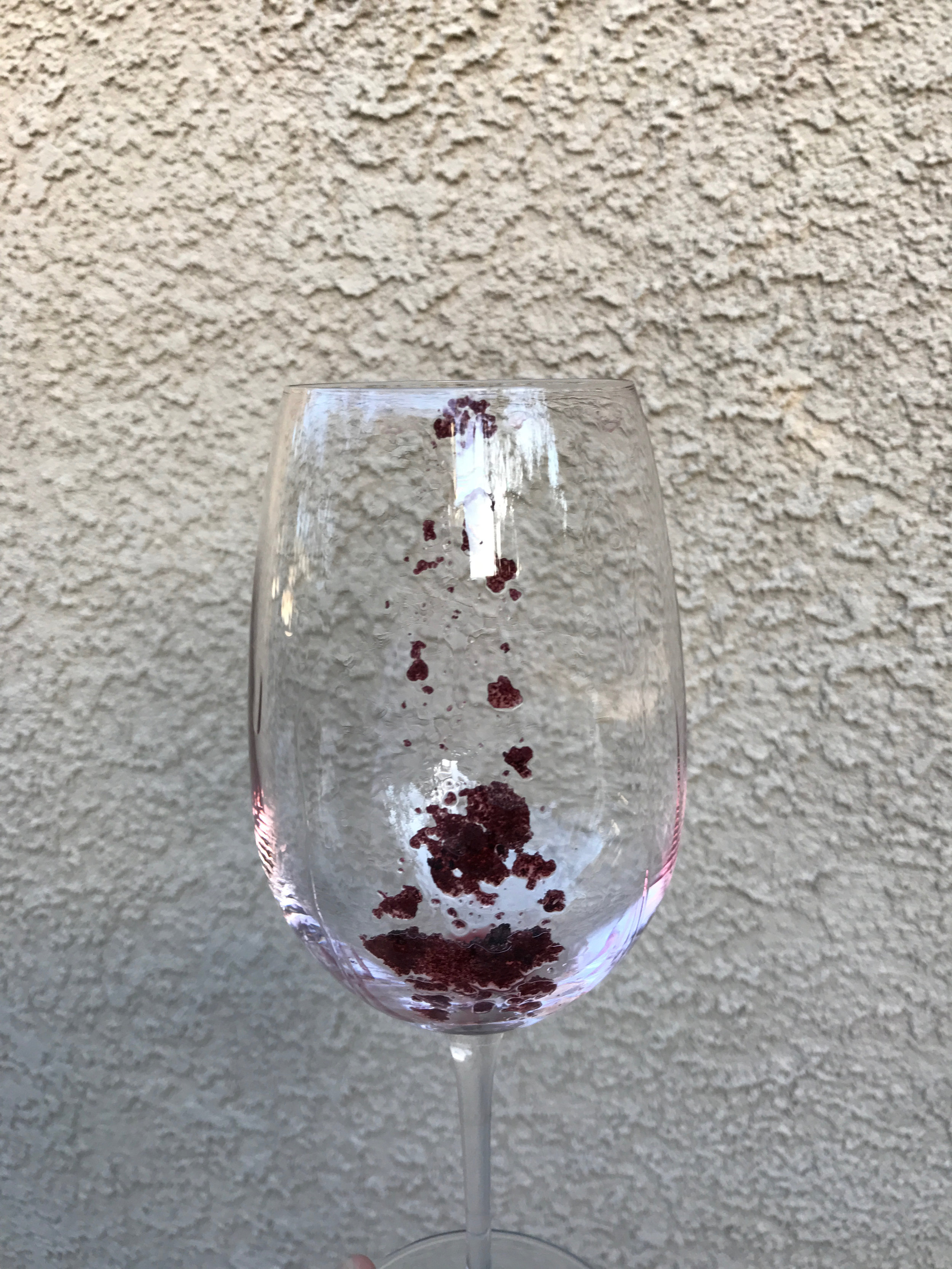
Have you ever gotten to that last sip of a glass of wine only to get a mouth-full of sediment? Instead of savoring that last sip, you end up spitting it out. An unpleasant way to finish.  And that's what recently happened to me as shown in the photo. But it doesn't have to go that way.

As discussed last time, lees (dead yeast cells and bits of grape seeds and solids) are natural in the wine making process and often desirable to be left in the wine during fermenting or aging.  This process is most common in red wines. Some wine makers will then filter out these solids (fining or racking), but others prefer to leave them in the wine as it's bottled to continue to add flavor.

There are several ways to avoid getting a mouth full of these particles in your glass of wine.

The first way is try to keep the solids in the bottle and not in your glass. If the bottle has been standing still and upright for a couple of days, the solids will have naturally fallen to the bottom of the bottle. As long as you are careful to not stir them up while opening the bottle and are gently tipping the bottle while pouring, the sediment should stay in the bottom of the bottle. But why take the risk.

The most dependable way is to do your own filtering before serving. There are several inexpensive devices on the market for doing this. The best one is a combination filter/aerator funnel. You simply hold this funnel above your decanter (or any other suitable container) and pour the wine through.  It has a micro-fine filter built-in that traps all those undesirable particles while allowing all the wine to pass through. As the wine exits the funnel, it gets aerated (exposed to air) which will usually help a young red wine. You'll then find all those undesirable particles trapped in the bottom of the funnel.  Not lurking in your wine glass.

While sediment is not harmful if consumed, it does significantly detract from a nice glass of wine.  So, filter and forget! Cheers!