
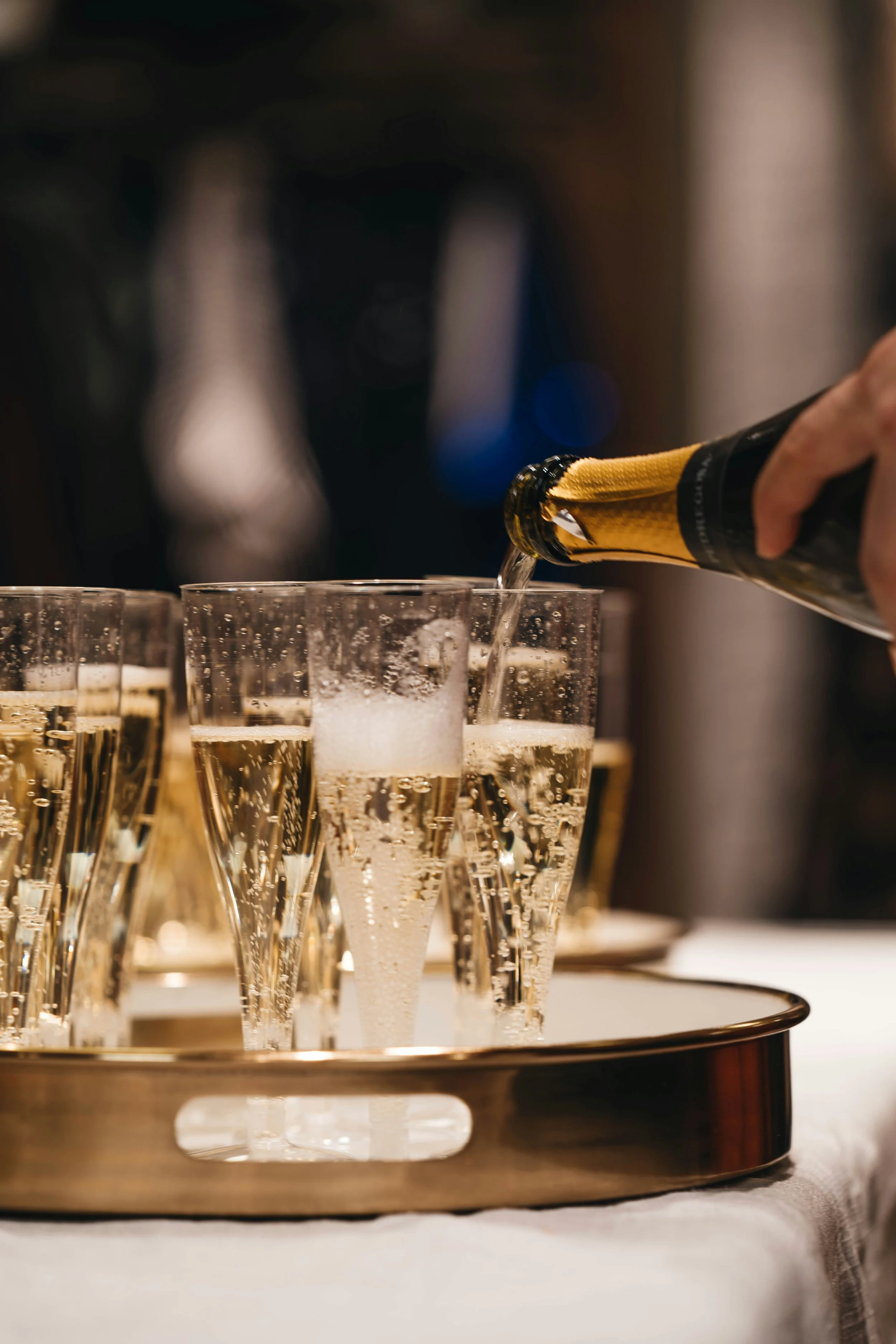
Sparkling Wines to Consider for the Holidays

Sparkling wines really do shine during the holidays—both literally and figuratively. Here’s a few tips on the various types of sparkling wines to enjoying them to the fullest.

Champagne

Champagne is a sparkling wine that is produced in the relatively small region of Champagne in France. An entry level bottle of Champagne is going to start in the $50 range.

Some Champagne facts:

  • Champagne is typically produced from three grapes — Pinot Noir, Chardonnay and Pinot Meunier

  • To be called Champagne, it must be produced in the Champagne region of France. Otherwise, it must be called Sparkling Wine

  • Champagne is produced using a process called the méthode champenoise where the bubbles are formed in the bottle during a second fermentation.

U.S. Sparkling Wine

In the U.S., there are a tremendous number of makers of sparkling wine. Most will produce a wine that can taste very much like the French Champagne. And, you can also find rosé sparkling wines.  An entry level bottle of sparkling wine in the U.S. can be as little as $10. Read more

Prosecco and Asti

In Italy, Prosecco is their signature sparkling wine. Produced in the Veneto region just north of Venice, this sparkling wine usually produces bigger bubbles. Bottles of Prosecco can be purchased in the $10- $15 range. Read more

Cava

The sparkling wine of Spain is Cava that is produced in the Catalonia region of Spain where Barcelona is located.  Nice bottles of Cava can be purchased for around $15. Read more

Styles of Champagne and Sparkling Wine

Brut Nature - This style is bone dry meaning it has little or no sugar content (0–3 g/L sugar).

Extra Brut - This style is also very dry but, it can have up to twice the sugar level of Brut Nature (0–6 g/L sugar). This little bit of sweetness creates a wonderful balance with Champagne’s naturally high acidity.

Brut - This is the most common style. While considered “Dry” this style can have twice the sugar of Extra Brut (0–12 g/L sugar).

Extra Dry - This is the one that always confuses people. This style is sweeter which actually makes it also taste a bit fruity (12–17 g/L sugar).

Dry - The confusing continues. This style is getting up there in sweetness (17–32 g/L sugar).

Demi-Sec - Now you’re talking Sweet (32–50 g/L sugar). This style works well with desserts or cheeses.

Doux - This one, while very rare to find, is really sweet (50+ g/L sugar).

A few serving tips

  • Chill properly: About 40–45°F (4–7°C) is ideal

  • Use proper glassware: Tulip or white wine glasses preserve aroma better than narrow flutes

  • Open gently: Twist the bottle, not the cork, for a quiet, elegant release

No matter which type or style you choose, give sparkling wines a try this holiday season. Cheers!

What "Dry" Means for a Still Wine versus a Sparkling Wine

Have you ever taken a sip of red wine and noticed that your mouth feels dry or dusty? Almost that ‘cotton-mouth’ feel? Well, that is a sensation that is generally associated with red wines.

The dry sensation is due to the wine being astringent and its effect on the tissue in your mouth. Some people have also described the sensation as making their mouth pucker.

The culprits that causes this drying sensation in your mouth are actually chemical compounds (phenolics) that naturally occur in grapes. These ‘tannin’ come from the grape skins, seeds and stems.

But, while a ‘dry’ sensation in your mouth is associated with tannin, the wine term “Dry” actually refers to the lack of sweetness - the amount of residual sugar. A “Dry” wine will have little to no residual sugar, meaning that the fermentation process converted all the natural sugar in the grape juice to alcohol. Residual Sugar (RS) in still wines is categorized as follows:

  • Dry: Less than 1% sweetness or <10 gm/L of Residual Sugar

  • Off-Dry: 3% to 5% sweetness or 10-35 gm/L RS

  • Sweet: Above 5% sweetness or 35-120 gm/L RS

  • Very Sweet: Above 12% sweetness or 120 - 220 gm/L RS

In sparkling wines, there are multiple styles of produced:

  • Extra Brut: 0-6% RS

  • Brut: 0-15% RS

  • Extra Dry: 12-20% RS

  • Dry: 17-35% RS

  • Demi Sec: 35-50% RS

  • Doux: Greater than 50% RS

So, a ‘dry’ still wine will have less than 1% residual sugar, while a ‘dry’ sparkling wine will have 17-35% residual sugar! Just another example of the confusing terms in the wine world.

Here’s to making the wine world just a bit less confusing. Cheers!

Ever Wonder? Why are Wines Referred to as Dry?

You may have heard of wines being described as “dry.” When I started out learning about wines, I was told that the best wines are dry wines. But what does that really mean?  The problem is that the term can mean a couple of different things.

Some people will refer to a wine as being dry because of the way that it tastes or the sensation that the wine produces in their mouth.  And, yes, wines can make your mouth feel dry.

The sensation of dryness in the mouth is actually the result of tannic compounds in the wine or 'the tannins.'  Tannins come from the skins and seeds of the grape. And these tannic compounds are the same ones that you experience when you drink a strong cup of tea or when you eat nuts such as walnuts.  They yield the same effect; a drying sensation in the mouth.

But 'dry' generally refers to the lack of residual sugar in a wine. That is, during the fermentation process, the yeast is allowed to consume all the natural sugar in the juice of the grape and convert it into alcohol. Thus, dry wines actually contain little to no sugar.  If the fermentation process is interrupted before the natural sugars are converted to alcohol, then you end up with a wine that has a residual sugar level greater than zero.  These wines are referred to as being ‘off-dry'.’

Now, the question that still don’t know the answer to is why the word ‘dry’ became synonymous with wines of low or no residual sugar. But, I’ll keep digging!

Cheers!

Ever Wonder? - What Does 'Vin Sec' Mean on a Riesling Label

Ever wonder what “Vin Sec” means on the label of a bottle of Riesling?

In French it literally means ‘dry wine.’

Riesling is a wine that is most famously produced in Germany where nearly half the world's Riesling grapes are grown. Other great producers of Riesling include the Alsace region of France, Australia, Austria, Canada and the United States.

Riesling that is grown in cooler climate regions result in highly aromatic wines with great acidity and big, bright fruit flavors. But mention a Riesling and most often you'll hear "Oh, that's a sweet wine."

But not all Rieslings are sweet. They can span the range from dry to sweet. The Alsace region of France is known for its dry Riesling. And warmer climates, such as California, Oregon and Washington, produce dry Rieslings that typically have more muted fruit flavors, are more medium to full-bodied.

So, if you are looking for Riesling that is not sweet, look for the words ‘Vin Sec’ on the label. This will ensure that you’re getting a ‘dry’ or low-sugar wine.

Cheers!

Ever Wonder How Rosé is Made?

Spring-time is a great time to start enjoying Rosé. It’s bright fruit flavors and wonderful acidity makes a nice chilled rosé very thirst quenching. And its bright pink hue just seems to go with all the beautiful blooms of the season. But, you may wonder how the color of this wine is achieved.

Rosé is made from red wine grapes.  But, it's made in the traditional white wine making process. Hence, the process can be a bit confusing. 

So, first, realize that all juice from wine grapes, whether from red grapes or white grape, is nearly clear. And, all the color in a finished wine comes from the skin of the grapes, not from the juice.

With that in mind, rosé wines are made in a couple different ways.

Maceration is the most common method used. The word 'Maceration' literally means to soften by soaking. And in the case of rosé production, it means to allow the grape skins to soak in the grape's juice. For rosé, the red wine grape skins spend limited time (2-24 hours) soaking with the juice. Just enough to give it its pink color.

The Saignèe ("San-yay") method allows the grapes to be crushed under their own weight and the 'free run' juice is collected.  Since this juice spends such little time in contact with the red grape skins, the resulting color is light pink.

Regardless of the method used, rosés can be dry or sweet. Typically, rosés with alcohol levels around 8 or 9 percent are going to be quite sweet.  In the 11 to 12 percent range, they will be mid-range between sweet and dry. And, above 12 percent it's going to be dry. So, check the label. The alcohol level must always be shown.

And, remember, with rosé wines they should be enjoyed young (within two years of its vintage) while they still have their bright fruit flavors and crisp acidity, and they should be served cold.