Behind the Cork™ - County Line Pinot Noir

2020 County Line Pinot Noir ($32)
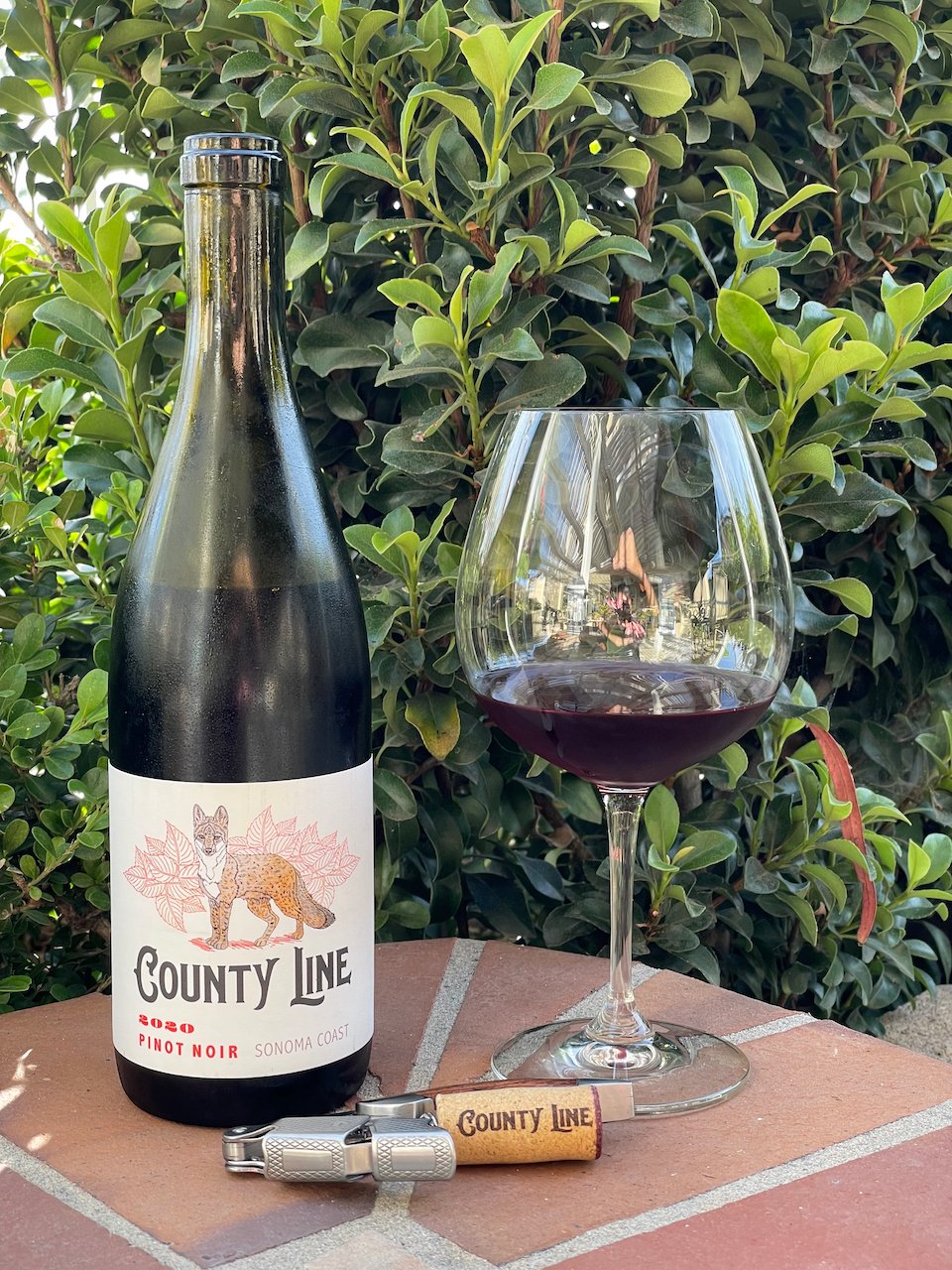
This County Line Pinot Noir is from California’s Sonoma Coast.

The first vintage of County Line was solely dedicated to producing a dry Rosé from a whole-cluster pressed Champagne clone of Pinot Noir. Subsequently, they followed with a handful of varietals including this Pinot.

County Line Vineyards uses traditional winemaking techniques, and a shorter élevage in neutral French oak barrels for stainless steel tanks. Each of their wines is made to provide a snapshot of one of their cool-climate appellations that include the Anderson Valley, Sonoma Coast, Russian River, and the North Coast.

This 2020 County Line Pinot Noir was produced from organically grow fruit, was barrel aged for 10 months in neutral French oak and bottled unfiltered.

It is pale ruby in color with the distinctive cranberry aroma of a Pinot Noir. On the palate it has flavors of sour cherry, raspberry and cranberry, is light in tannin and medium in acidity.

This is a tasty Sonoma Coast Pinot Noir that fits right in as the Behind the Cork™ Wine of the Week. Look for it on-line from County Line Vineyards and also from STOMPY. Cheers!


Disclosure of Wine Sample Submission: I received this sample at no cost for review. The opinions expressed are entirely my own.

Sample Provided by Rebekah Polster 401 West Communications, STOMPY and County Line Vineyards

Ever Wonder? What does "Estate" Mean on a Wine Label?

There are lots of confusing terms used in the wine world and the term “Estate” is one of those.

Generally, when you see the word “Estate” on a wine label it means that the winery oversees all of the farming of the grapes. The winery may or may not own the land, but the farming is done by them.

But, “Estate bottled” wines must be produced from grapes that are farmed, fermented, aged and bottled on the winery’s property - they do everything associated with the wine in the bottle. That provides the winery with complete control of their final product.

So, keep an eye out for “Estate Bottled” wines. They are a bit more special. Cheers!

Behind the Cork™ - Red Wines of Maremma Toscana

Red Wines of Maremma Toscana

These red wines from the Maremma Toscana sub-region of Italy’s Tuscany are considered “Super Tuscans” using non-native Italian grapes and/or blends.

Many fine examples of Super Tuscans come from the region of Maremma, on the Tyrrhenian Sea coast in the southwest of Tuscany.

Here are five wonderful examples:

2017 Cantina I Vini di Maremma Sangiovese ($12)

This wine is a blend of “no less than 40% of Sangiovese with other red grapes according the production protocol restrictions” of the region. It was fermented on the skins and aged in concrete tanks. It is medium garnet in color with aromas of black cherry and plum. On the palate it has deep, rich fruit flavors, medium acidity, medium-low tannin and a hint of caramel on the finish.

2016 I Cavallini Pause Merlot ($18)

This wine is produced from 100% Merlot that is hand harvested and undergoes spontaneous fermentation in small barrels with indigenous yeast for four to six weeks. It is then aged sur lie for 12 months in barrels with weekly battonage. It is medium garnet in color with an aroma of black cheery. On the palate it has distinct black cherry flavor with just a hint of tartness on the finish.

2016 Fattoria di Magliano Perenzo Syrah ($23)

This wine is 100% Syrah that is fermented in stainless steel vats for 20 to 25 days. It was aged 12-24 months in medium toasted oak barrels that have a minimum of 24 months seasoning. It is pale ruby in color with a delicate aroma of black fruit. On the palate it has good depth of character and complexity, medium tannin and a nice finish.

2013 Villa Pinciana Terraria ($24)

This wine is a blend of 45% Sangiovese, 45% Cabernet Sauvignon and 10% Petite Verdot. It was fermented in stainless steel tanks and aged for 15 months in small French oak barrels. It is deep garnet in color with aromas of black fruit and spice. On the palate it has flavors of cherry and raspberry, medium tannin and good acidity.

2015 Prelius Prile ($12)

This wine is produced from 40% Cabernet Sauvignon, 40% Sangiovese and 20% Merlot. It was barrel aged in French oak for 18 months. It is medium ruby in color with delicate aromas of black fruit and spices. On the palate it shows sweet red cherry and black fruit flavors, good depth of character, with moderate tannin and acidity.


Disclosure of Wine Sample Submission: I received these samples at no cost for review. The opinions expressed are entirely my own.

Samples Provided by Francesco Mazzei, President of the ‘Consortium for the protection of Maremma Toscana Wines’ (via ZEDCOMM)

A Break from Tradition in Italy: The Super Tuscan Wines

Much like France, Italy has a long tradition of wine. In the 1960s, Italy formalized their wine appellation system modeled after the French system. Under this system, each wine region in Italy was required to operate under strict rules for the types of grapes they were allowed to grow and how their wines were to be produced.

Under this system, native Italian grapes were required to be used in Italian wines. These native grapes included Sangiovese, Barbera, Nebbiolo, and Montepulciano. But these regulations were quickly criticized as being overly restrictive and led small groups to push-back against them. By the end of the ’60s, these groups were producing wine blends with non-native grapes such as Cabernet Sauvignon, Merlot and Syrah.

But, these producers of wines using non-native Italian grapes were forced to bottle their wines using the generic title of Vino da Tavola (Table Wine) that is associated with Italy’s lowest-quality wines. Instead of settling for this, they chose to unofficially call their wines “Super Tuscans” so as to distinguish them from inexpensive table wines.

Finally, in 1992, the Italian government created a new wine classification called “Toscana IGT” for these Super Tuscan wine blends.

Many fine examples of Super Tuscans come from the region of Maremma, on the Tyrrhenian Sea coast in the southwest of Tuscany. Look for several in the next Behind the Cork™ Wine of the Week feature. Cheers!

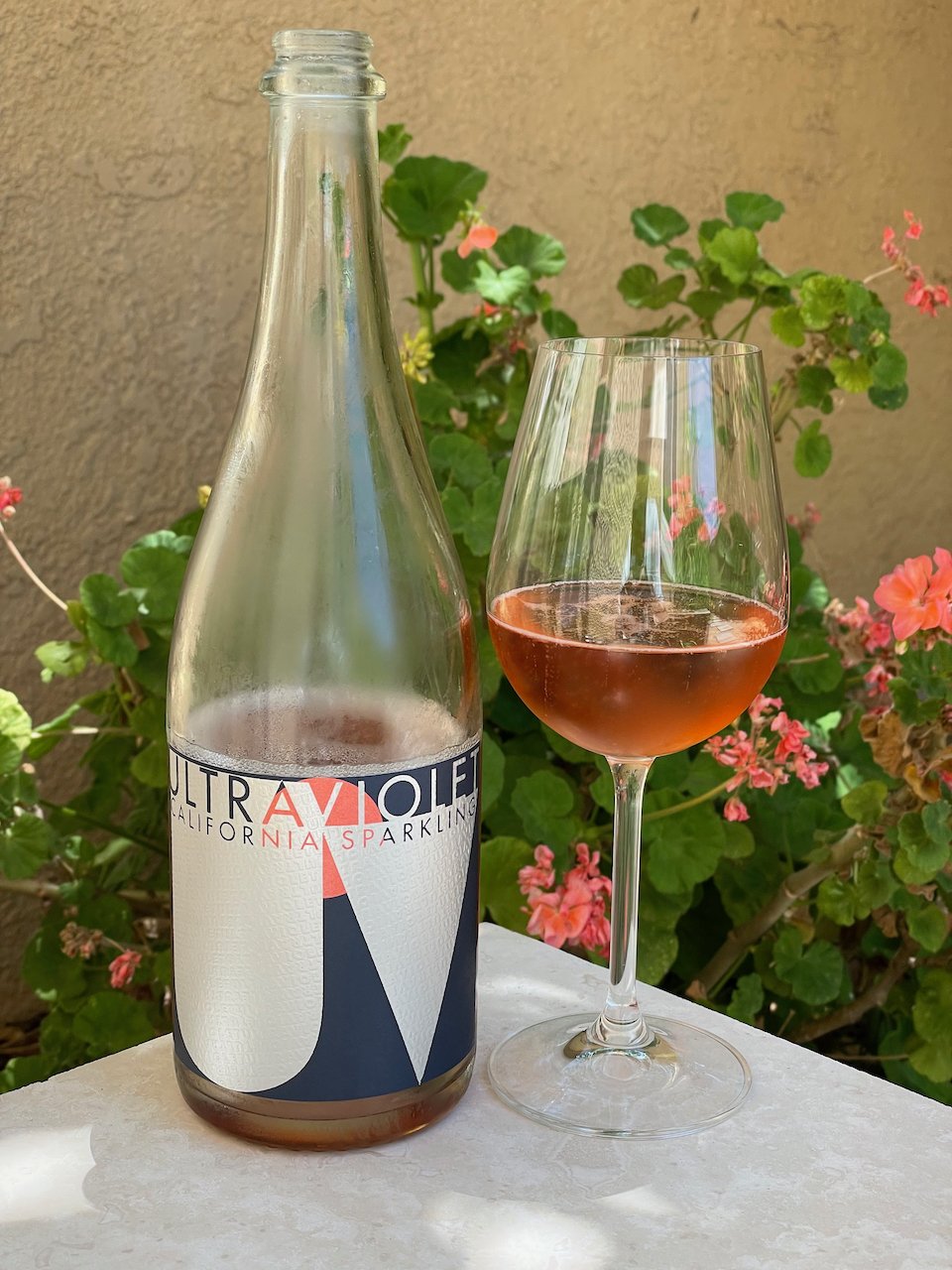
Behind the Cork™ - Ultraviolet Sparkling Rosé

Ultraviolet Sparkling Rosé ($24.99)

This Ultraviolet sparkling rosé is from Poe Wines, in Napa, which was founded by Samantha Sheehan in 2009 after being inspired by the wines she tasted in Burgundy and Champagne. Their goal “is not to replicate Burgundy, but rather create alluring, vineyard specific, age-worthy wines revealing the beautiful terroir of California. There is minimal intervention, judicious use of sulfur, and never any additives.

This sparkling Rosé is made from Pinot Noir grown at Manchester Ridge vineyard in Mendocino Ridge - 2000' above Anderson Valley. It is made in the Charmat method by allowing the still Rosé to ferment a second time in a closed pressurized tank for the bubbles to form.

This Ultraviolet sparkling rosé is a beautiful salmon color with a very delicate nose. On the palate it has wonderful flavors of raspberries and strawberries with a slight citrus note. It has a light sparkle from the fine bubbles, refreshing acidity and a hint of minerality on the finish.

This is a really nice dry sparkling rosé that’s a great fit for Behind the Cork™. Cheers!


Disclosure of Wine Sample Submission: I received this sample at no cost for review. The opinions expressed are entirely my own.

Sample Provided by Rebekah Polster 401 West Communications, STOMPY and Poe Wines