
Ever Wonder? Is Box Wine Any Good?

In recent years, box wine has become quite popular. But, a lot of wine drinkers are still on the sidelines wondering if box wine is any good. So, let’s take a look.

It turns out that that box wine was actually developed and patented in the 1960s. Box wine in the 70s, 80s and 90s tended to be inexpensive (‘cheap’) wine. Then, in the early 2000s ‘premium wines’ in a box began appearing that were very well received and really started knocking down the stigma of boxed wine.

Today there a lot of really good wines available in boxes. And, they’re great values.

Sure, you can’t ‘lay down’ a box wine in the cellar and expect it to age like a bottle of wine, but there are several advantages to boxed wine over bottled wine. An open box of wine will last up to six weeks compared to three to four days for an open bottle of wine. It’s also easy to store, keep in the refrigerator or take it to an outdoor outing. And, it can be a great value. A typical box of wine is three liters (3000 ml) which is the same as four 750 ml bottles of wine. You’ll pay a lot less for most box wines than for four bottles.

So, everyone’s taste in wine is different, and I’m certainly not going to tell you that all box wine is going to please your palate. But, the quality of box wine has definitely improved to the point where you should give it a try. It just might become one of your ‘regular’ wines that you keep around for everyday enjoyment. Cheers!
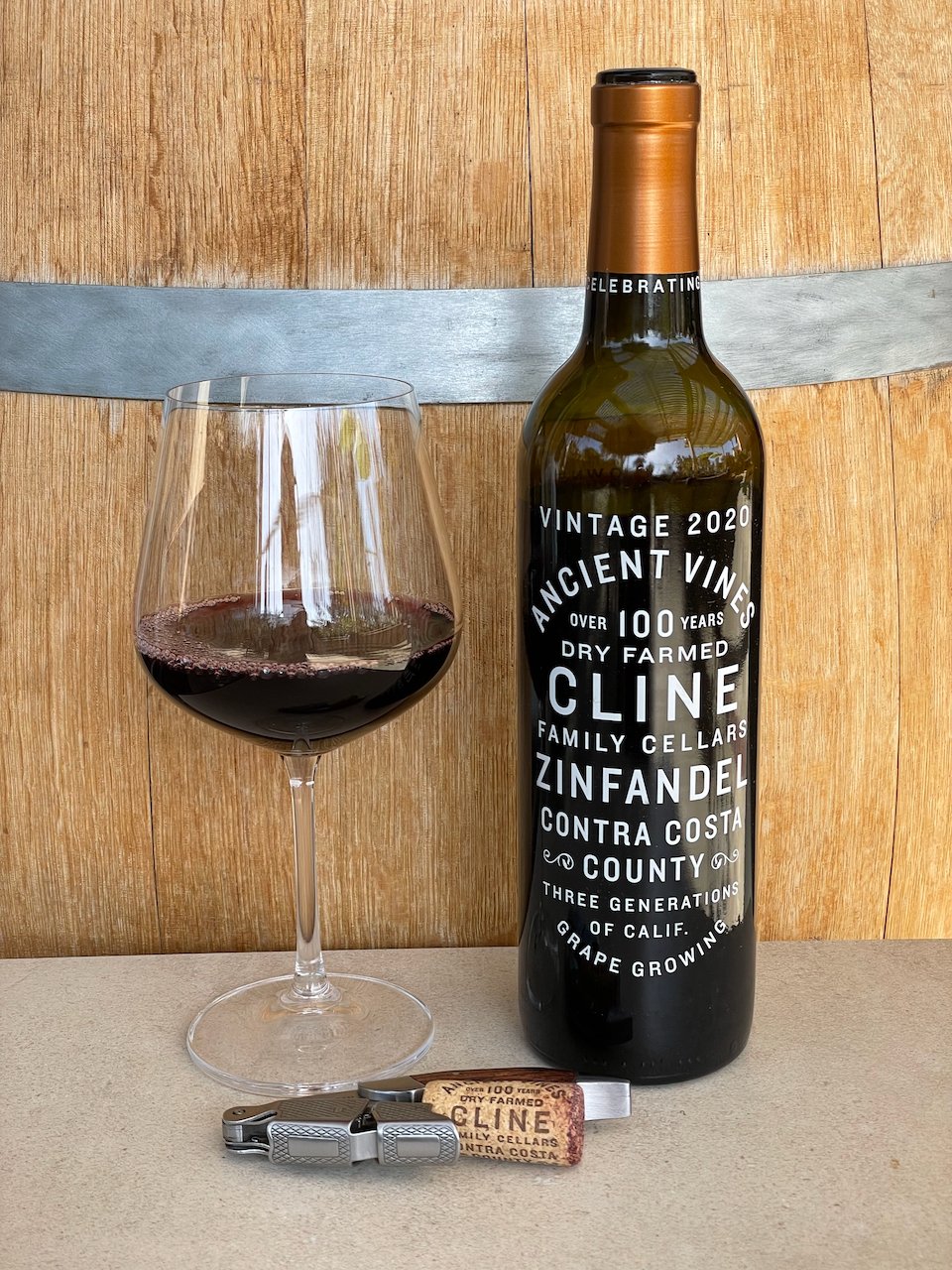
Behind the Cork™ - Cline Family Cellars Ancient Vines Zinfandel

2020 Cline Family Ancient Vines Zinfandel ($16)

Fred Cline founded Cline Family Cellars in 1982 in Oakley, California, which is part of Conta Costa County. With this 40th year vintage, they have created the special anniversary bottle design shown in the photo.

The 2020 Ancient Vines Zinfandel draws from their oldest, most historic Zinfandel blocks. There, the soils are deep sand from the banks of the San Joquin and Sacramento River delta’s which have been depositing the sand from the Sierra Nevada mountain range for millennia. Their ancient, dry-farmed vineyards have survived through phylloxera and prohibition and consistently produce great fruit.

The Zinfandel grapes for 2020 vintage underwent near total destemming and a very gentle crushing to ensure a large proportion of whole berries in the must which contributes to the fruit character of the wine. The grapes were fermented in temperature-controlled open-top concrete tanks. The wines were pressed off their skins and aged in 40% French oak for 15 months before being blended and bottled.

This 2020 Cline Family Ancient Vines Zinfandel is deep ruby in color with aromas of black berry and black plum with herbal notes. On the palate it is medium-bodied with flavors of black and red fruits, some spiciness and finishes with sweet tobacco and chocolate.

This 40th anniversary Cline Family Ancient Vines Zinfandel is a great value and widely available, making it a great fit as the Behind the Cork™ wine of the week. Look for this one at your favorite wine seller and check them out on the web at clinecellars.com Cheers!


Disclosure of Wine Sample Submission: I received this sample at no cost for review. The opinions expressed are entirely my own.

Sample Provided by Cline Family Cellars (via Donna White Communications)

Ever Wonder? Why are Wines Referred to as Dry?

You may have heard of wines being described as “dry.” When I started out learning about wines, I was told that the best wines are dry wines. But what does that really mean?  The problem is that the term can mean a couple of different things.

Some people will refer to a wine as being dry because of the way that it tastes or the sensation that the wine produces in their mouth.  And, yes, wines can make your mouth feel dry.

The sensation of dryness in the mouth is actually the result of tannic compounds in the wine or 'the tannins.'  Tannins come from the skins and seeds of the grape. And these tannic compounds are the same ones that you experience when you drink a strong cup of tea or when you eat nuts such as walnuts.  They yield the same effect; a drying sensation in the mouth.

But 'dry' generally refers to the lack of residual sugar in a wine. That is, during the fermentation process, the yeast is allowed to consume all the natural sugar in the juice of the grape and convert it into alcohol. Thus, dry wines actually contain little to no sugar.  If the fermentation process is interrupted before the natural sugars are converted to alcohol, then you end up with a wine that has a residual sugar level greater than zero.  These wines are referred to as being ‘off-dry'.’

Now, the question that still don’t know the answer to is why the word ‘dry’ became synonymous with wines of low or no residual sugar. But, I’ll keep digging!

Cheers!

Behind the Cork™ - Wairau River Wants to Take You Back to Nature

2021 Wairau River Sauvignon Blanc ($20.99)

As the weather gets warmer it’s time to start enjoying. Wairau River Wines wants to remind us that while life moves fast, there is always time to unwind, unplug and head outside.

And, what better way to enjoy the outdoors than with a SoloStove, a Primus cutting board and knife, and, of course, a chilled bottle of Wairau River Sauvignon Blanc!

The stainless steel SoloStove is super efficient for burning sustainable fuel sources such as sticks or twigs, and provides hot cooking temperatures in minutes with its 360 degree airflow design. Or use it for roasting marshmallows, or just as a safe and efficient way to have a warming campfire.

The Primus cutting set provides a durable oak cutting board and a stainless steel knife with sheath that wraps up into the poly-cotton transportation roll. A super way of preparing your food for outdoor cooking or just for cheese and crackers while you cook.

Then to top off your outdoor adventure, enjoy a chilled bottle of refreshing Wairau River Sauvignon Blanc. At the edge of the Wairau River in Marlborough New Zealand, Phil and Chris Rose established their vineyard in 1978 and today, with the help of their extended family, they continue to produce some of the best wines that Marlborough has to offer.

This 2021 Wairau River Sauvignon Blanc is medium straw in color and has aromas of citrus and lime. On the palate this 100% Sauvignon Blanc is light-bodied, bright and refreshing with flavors of tropical fruit, guava and pear and finishes clean and dry.

So, get outside and enjoy a warm evening of food and wine with your SoloStove, Primus cutting set and a delicious bottle of Wairau River Sauvignon Blanc. Cheers!


Disclosure of Wine Sample Submission: I received these samples at no cost for review. The opinions expressed are entirely my own.

Samples Provided by Terlato Wines (via Donna White Communications)

Ever Wonder? Should You Rinse a Wine Glass with Water When Switching Wines?

I was recently enjoying a glass of white wine and, when finished, asked to switch to a glass of red. The host said “Oh, let me rinse that glass for you first.” I stated that it was not necessary, but he insisted that he ‘freshen’ my glass.

While this is no great wine faux pas, this isn’t generally helpful. Let’s look at a couple of reasons why.

First, when switching from one wine to another, if you rinse a wine glass with water, you might actually leave enough water in the glass to slightly dilute the incoming wine. Again, not generally a big deal, but if you are using a small glass or being served ‘just a taste’ then any residual water in the glass could affect the taste of the wine.

And, speaking of the taste of the wine, it’s also possible that other harsh flavors from the water, including chlorine, could also affect the aromas and flavors of a wine.

So, if you are transitioning from white wine to a red wine, its’ probably not necessary to do any rinsing of the glass in between. But, if you are moving from a red wine to a white wine, you should probably just pour a splash of the white wine in your glass, twirl it around and dump it. This will remove enough of the red wine color from the glass so that you don’t end up with a rosé colored glass of white wine.

Rinsing with a splash of wine is another way to clear any sediment from the bottom of a wine glass or to clear any off-flavors of a flawed wine.

Swirling a splash of wine in your glass and then dumping it is also a good idea if you’ve just removed the wine glass from the dishwasher or off the shelf to remove any soap residue or dust.

So, skip the water rinse of your wine glass so that you get the greatest enjoyment of that next glass of wine. Cheers!