
Sparkling Wines in the United States

It should be no surprise that the great wine producing states in the U.S. also produce great sparkling wines. And while French Sparkling wine from the Champagne region still sets the standard, many U.S. sparkling wines are on-par with their French counterparts.

Sparkling wine has traditionally been associated with the holidays.  And, indeed, 30%-40% of sparkling wine sales occur during the holidays. But, sales of sparkling wines are increasing year-round in the U.S. People are finding just how well sparking wine goes with so many foods and how wonderfully refreshing it is as a summertime drink.

California, Oregon and Washington are producing great sparkling wines. These sparkling wines are being produced with the same grapes used in Champagne and yielding comparable results at much more approachable prices.  But, did you know that New Mexico is also producing sparkling wines that score highly?  These are great tasting sparkling wines at a great value and should not be overlooked.

The U.S. sparkling wine producers are taking direct aim at the young consumers of beverages by producing and marketing unique, handcrafted, small  batch offerings that range from the fruity styles (like Prosecco) to more complex offerings.  And look for great rosé sparkling wines being produced in the U.S. While some are sweeter than others, there are many great rosé sparkling wines that are dry (no residual sugar). 

In the U.S., you will find many excellent 90+ sparkling wines in the $40 to $100 range and an even greater assortment of top value sparkling wines in the $15 to $25 range.

Remember, sparkling wines go well with a variety of foods and should be part of a meal, and not just reserved for special occasions.  And don't be ashamed to enjoy a sparking wine with salty snacks. You'd be surprised how well they pair. Serve all sparkling wines in a traditional white wine glass to experience the full-body and flavors they have to give.  

Excuse me while I go pop the cork on a nicely chilled bottle. Cheers!
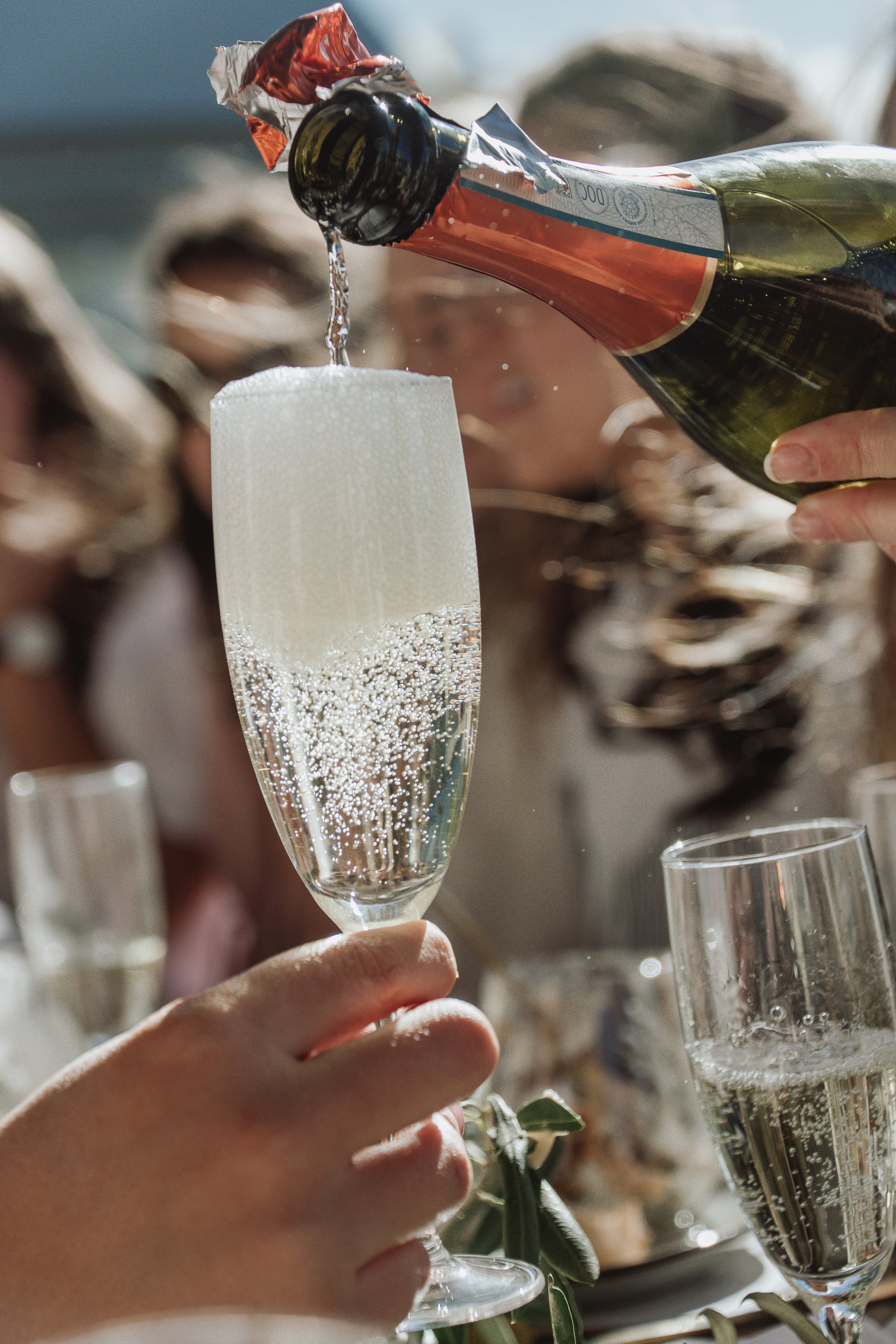
 

Italian Sparkling Wines - Prosecco and Asti

France has its Champagne. Spain has Cava. In Italy, Prosecco and Asti are its two most popular sparkling wines.

Prosecco is primarily from the Veneto region of Italy and made from the Glera grape.  Like Champagne, Prosecco must be produced in designated regions of Italy to be called Prosecco on the label. Unlike Champagne and Cava that undergo a secondary fermentation in the bottle (the 'traditional method'), Prosecco is produced using the Charmat ('transfer') method.  Using this process, large quantities of wine are kept under pressure in stainless steel tanks during the second fermentation.  The resulting sparkling wine is then bottled. While most people can't tell the difference in the secondary fermentation process used, it is generally believed that the traditional method results in smaller, more persistent bubbles, while the transfer method results in lighter bubbles, being almost frothy, and having a creamier feel in the mouth.  Prosecco tends to be fruiter than Champagne and usually sweeter. Prosecco has been described as having flavors of melon, peer, apple, honey suckle and cream.  There are three main styles of Prosecco: Brut has up to 12 gram per liter of residual sugar, while Extra Dry has 12-17 gm/liter and Dry has 17-32 gm/liter.  Prosecco also tends to be lower in alcohol, around 11-12%  And, nice entry-level bottles of Prosecco are easily found in the $12 - $15 range. 

Asti is another popular sparkling wine from Italy. It is produced in the Piedmont region around the towns of Asti and Alba from the Moscato Bianco grape.  Originally known as 'Asti Spumante' (spumante means fully sparkling), the name was shortened to just Asti in 1993 when it received its official designation.  This fully sparkling wine has an alcohol content around 8% to 9% by volume. Sharing the Asti designation is Moscato d'Asti that is also made from the Moscato Bianco grape. This sparkling wine is typically in the frizzante style (frizzante means lightly sparkling). Like Asti, Moscato d'Asti is made using the transfer process, but the fermentation is stopped quite early, resulting in a sparkling wine that is sweet, has fewer bubbles and is low in alcohol (5-6%). Because Moscato d'Asti is lightly sparkling, it is typically packaged with a standard bottle and cork. Both Moscato d'Asti and Asti sparkling wines can be found in the $10 - $15 range.

These Italian sparkling wines are not meant for aging and should be consumed young and fresh. So pick up a bottle or two, chill them, and enjoy them right away. Cheers!


Cava - The Spanish Sparkling Wine

In the 1800s, Spain began producing sparkling wines to mimic their French neighbor's Champagne and they called it Champaña.  But in the 1970s, French regulations were put into place such that only sparkling wine produce in the Champagne region of France could rightfully be called Champagne.  So, the Spanish re-named their sparkling wine for the caves or cellars where the sparkling wine was kept for aging. Hence the name Cava.

Cava, mostly produced in Penedes near Barcelona, is traditionally produced from three regional grapes: Macabeo (~50%), Xarel-lo and Paralleda. But, Chardonnay and Pinot are sometimes used in smaller quantities. And Cava rosé gets it color from Granacha (Grenache), Monaastrell (Mouvedre) or Pinot Noir.  Cava is produced in the traditional French method, where secondary fermentation is done in the bottle. All Cava must be at least 10% alcohol by volume but no greater than 13%. 

There are three types of Cava and multiple styles. Of the three types, Cava is aged for 9 months, Reserva for 15 months and Gran Reserva for at least 30 months.  And like Champagne, there are many styles, reflecting the amount of residual sugar:

  • Brut Nature: 0-3 gm/liter 

  • Extra Brut: 0-6 gm/liter

  • Brut: 0-12 gm/liter

  • Extra Seco: 12-17 gm/liter

  • Seco: 17-32 gm/liter

  • Semi-Seco: 32-50 gm/liter

  • Dulce: Greater than 50 gm/liter

Cava is a sparkling wine worth trying. It can be a bit more 'earthy' than Champagne, but nice bottles can be found in the $20 range. The Spanish don't relegate their consumption of Cava to special occasions and neither should you. Cheers!

Sparkling Wine - Champagne

Last time, the topic of sparkling wine was introduced. And Champagne is the first thing that comes to most people's mind when ordering or purchasing a sparkling wine. It is synonymous with celebrations and splurges.   

As mentioned last time, only sparkling wine produced in the small French region of Champagne may legally be labeled 'Champagne.'  And because of this region's northern location and cool weather, three grapes have been found to grow best and hence became the basis for Champagne: Pinot Noir, Pinot Meunier and Chardonnay.  To this day, most Champagne relies on these grapes. But, Champagne producers are also allowed to use Pinot Blanc, Pinot Gris, Petit Meslier and Arbane. When these latter grapes are used, they are typically used in very small quantities.

Champagne is actually a blended white wine that undergoes a second fermentation. Once each of the individual wines is produced, they are blended per the winemaker's liking and bottled. After the wine is bottled, a small amount of sugar and yeast is added to the bottle and then each individual bottle is tightly corked.  As the newly introduced yeast consumes the added sugar, it gives off carbon dioxide (CO2). Since the CO2 gas has nowhere to go, it stays in the bottle and is absorbed into the wine.  Then, when the cork is removed from the bottle, the gas is able to 'escape' from the wine. These are the famous bubbles in Champagne.  And generally, the bubbles in Champagne are smaller and longer lasting than other sparkling wines.

The amount of sugar added during the second fermentation also leads to the various styles of Champagne.  An 'Extra Brut' will have 0-6% residual sugar while a 'Brut' can have 0-15% residual sugar. And, whereas a 'dry' wine has little to no residual sugar, an 'Extra Dry' Champagne will have 12-20% sugar while the 'Dry' style can have 17-35% sugar.  And finally, on the very sweet end of the spectrum are 'Demi Sec' (35-50%) and Doux (50%+).

Unlike most wines, Champagnes are produced as both vintage and non-vintage. The non-vintage Champagnes allow the winemaker to select and blend grapes from different vintages (i.e., years) to achieve the best flavors. But, when there is a particularly good year for the grapes, the Champagne may be vintage bottled and usually commands a higher price.

If you are only raising and sipping a glass of Champagne by itself, you are missing out. Champagne pairs very nicely with food and should be served with meals.  Foods such as fish and shellfish, chicken and even fried foods and salty foods pair very well.  

And finally, while the thin fluted Champagne glasses are traditionally used to show off the bubbles, choose a nice white wine glass to serve your Champagne. Because, after all, it is a white wine and the larger, more open bowl of a white wine glass will allow you to fully enjoy the aromas and flavors of your Champagne.  Cheers!

Sparkling Wines

Everybody loves Champagne.  It's a treat that is generally poured in small fluted glasses and raised during toasts at special occasions. But what a lot of people don't realize is that they are not drinking Champagne.

Champagne is a sparkling wine that is produced in the relatively small region of Champagne in France. Only those sparkling wines produced in this region are allowed to be labeled as 'Champagne.'  And an entry level bottle of Champagne is going to start in the $50 range. So, typically you are toasting with some other sparkling wine.

In the U.S., there are a tremendous number of makers of sparkling wine. Most will produce a wine that can taste very much like the French Champagne. And, you can also find these sparkling wines infused with fruit flavors such as peach and nut flavors such as almond.  An entry level bottle of sparking wine in the U.S. can be as little as $5.

In Italy, Prosecco is the their signature sparkling wine. Produced in the Veneto region just north of Venice, this sparkling wine usually produces bigger bubbles. Bottles of Prosecco can be purchased in the $10- $15 range.

The sparkling wine of Spain is Cava that is produced in the Catalonia region of Spain where Barcelona is located.  Nice bottles of Cava can be purchased for around $15.

In future postings we'll explore more about these wonderful sparkling wines, the grapes used to produce them, the fermentation processes, the various types of each, and how well they pair with food.

Here's to popping a bottle of sparkling wine!  Cheers!