It's Summer! Time for Some Light and Refreshing Wines!

Summer is a great time to enjoy light, refreshing wines.

Light wines are versatile and can be enjoyed on their own as a refreshing drink or paired with a wide range of summer dishes, from salads and grilled vegetables to seafood and lighter meats and they won’t overpower the flavors of lighter summer foods.

Many light wines have lower alcohol content. This can be preferable in hot weather as they are more thirst-quenching and more likely to leave you refreshed.

The flavor profiles of light wines, such as citrus, green apple, and floral notes, just shout freshness which is especially appreciated during the warm summer months.

Summer foods tend to be lighter and fresher. So, light wines will complement these foods well and enhance their flavors.

When choosing a wine for summer, consider lighter styles, lower alcohol content, and wines that can be served chilled. These characteristics make them ideal for enjoying on a warm day or pairing with seasonal cuisine.

Here are just a few wines that are perfect for summer:

  • Rosé - Rosé wines come in various styles from dry to sweeter options. They can have flavors ranging from red berries to citrus, making them extremely versatile and a refreshing option.

  • Sparkling Wines - Sparkling wines go with almost any food. But, the chilled bubbles make them especially fit for summer. Prosecco, a sparkling wine from Italy, is light, fruity, and often slightly sweet. It's perfect for summer celebrations.

  • Sauvignon Blanc - This seems to be the go-to wine of summer with bright, refreshing acidity and fresh fruit flavors of citrus, green apple, and sometimes tropical fruits like passion fruit or pineapple.

  • Chenin Blanc - This is another light, refreshing wine that offers crisp acidity with flavors of apple, pear, and honey.

  • Pinot Grigio/Pinot Gris - Also a go-to summer light-bodied wine with refreshing acidity. Its flavors can range from crisp citrus to stone fruits like pear or peach.

Brandy is Actually Distilled Wine!

Brandy refers to a wide range of spirits, made mostly from wine grapes but sometimes also from other fruits (e.g., apricot brandy).

The name brandy is a shortened form of brandywine, which an anglicized form of Dutch brandewijn, which means "burnt wine.” And, that’s precisely what brandy is - burnt wine. Well… sort of.

To make brandy, wine is heated in a still until it separates into its components using the distillation process. So, put simply, brandy is really distilled wine.

Like wine and whisky, brandy is often aged in wooden barrels, which increases flavor, complexity and color intensity.

The length of aging and the type of barrel used are both important elements in determining the final quality of the brandy.

Brandy, like some wines, gets even better with age. The designation of the style depends on how long the brandy has been aged.

There are various styles of brandy and they all depend on the aging process:

  • Trois étoiles, Trois pommes, Very Special (VS): Aged at least 2 years

  • Vieux or Reserve: Aged for minimum 3 years

  • V.O., Vieille Reserve, and Very Special Old Pale (VSOP): Aged 4+ years

  • Napoléon, Très Vieille Réserve, Très Vieux, and Extra Old (XO): Aged at least 6 years

  • Hors d’âge: Aged at least 30 years

How Low-Alcohol and Non-Alcoholic Wines are Made

Photo by Marek Mucha on Unsplash

Low and non-alcoholic wines have been around for years. But, you may have wondered:

  • “What exactly is a low-alcohol or a non-alcoholic wine?”

  • “How are they made?”

  • “Are they any good?”

Low-Alcohol Wine

Low-alcohol wines are produced just as any other wine. Usually, winemakers want the grapes to have high levels of sugar for a full fermentation to take place. All of this sugar is then converted to alcohol during fermentation, resulting in wines with 11-15% alcohol levels. In the case of low alcohol wines, the grapes are harvested up to two months earlier than normal with lower sugar levels. This way, the fermentation goes until the lower levels of sugar are completely fermented, resulting in reduced levels of alcohol. They are still '‘dry’ wines (i.e., very low residual sugar) with full flavors to have sufficient body and structure.

Non-Alcoholic Wine

Non-alcoholic wines are actually ‘real’ wine that’s been made from fermented grapes. It then goes through one of two processes to remove the alcohol. One method is called vacuum distillation where the wine is heated to temperatures where the alcohol begins to evaporate. This temperature is below the boiling point of the wine but, because the boiling point of alcohol is lower than water, the alcohol ‘boils’ off and is pulled away in a vacuum chamber.

The other method is reverse osmosis. This process uses an extremely fine filter that only allows the water and the alcohol to pass through. The filter catches all the fine grape particles that give the wine its color, its tannin and its flavors. The mixture of water and alcohol is then distilled to remove the alcohol. The left-over water is then recombined with the grape solids to form a non-alcoholic wine.

The Bottom Line

Now, there’s that final question “Are these low-alcohol and non-alcoholic wines any good?” The simple answer is “Yes!” These white wines can be bright and refreshing while the reds can have great depth of fruit flavor and balance.

So, stay tuned for the next Behind the Cork™ Wines of the Week that will feature two quality low-alcohol wines, a Chardonnay and a Malbec. Until then, cheers!

Give Red Wine Blends a Try!

Photo by Mauro Lima on Unsplash

In years past in the U.S., red wine blends were sold by the jug as "Red Wine" or "Table Wine."  These were inexpensive wines that were blends of grapes, vineyards or even vintages. So, today, blends are often disregarded as being of lower quality.

We only need to look to France, home of some of the world’s best wines, to see that wine blends are nothing to turn your nose up at.  France's famous region of Bordeaux produces red blends almost exclusively.  Depending on which bank the wine is from in Bordeaux, it will be a different blend. The Left Bank is known for its blends based on Cabernet Sauvignon while the Right Bank blends are Merlot based. These blends may also include Cabernet Franc, Petite Verdot and Malbec.

Other famous regions known for their blends include the Rhône Valley that uses Grenache, Syrah and Mourvèdre and the so-called Super Tuscans from Italy that may include Merlot, Cabernet Sauvignon, Sangiovese, Syrah, Cabernet Franc and others.

The main reason that winemakers produce blends is to make the best wine possible. Blending different grape varieties is useful in accentuating a particular grape's virtues. Winemakers have learned never to blend an inferior wine with a good wine because the result is usually an inferior wine. Again, the goal is to produce a wine that is actually better than the sum of its parts. And by blending wines, a winemaker can produce wines that are well balanced and complex in their aromas, flavors, colors and textures. The blended grapes can add layers of flavor that will change through the process of taking the first sip, letting it sit on your tongue and then as you swallow.

Another thing you may not realize is that many wines labeled in the U.S. as single varietals are actually blends.  The laws state that for a wine to be labeled as a single varietal, it must contain at least 75% of the noted grape. But that leaves the other 25% for the winemaker to be creative and generally to blend in other grape-types that results in their best possible wine.

So don't shy away from red wine blends.  These can actually be some of the best wines in the world. Cheers!

So How Does Orange Wine Get its Color?

Last time we learned that grape juice is basically clear and the color of wine comes from the skins of the grapes. The juice from white wine grapes spend little or no time in contact with the grape skins and juice of red wine grapes spend days or weeks in contact with the red/purple grape skins. Rosé is made from the juice of red wine grapes that spend just a small amount of time (minutes or hours) in contact with their grape skins.

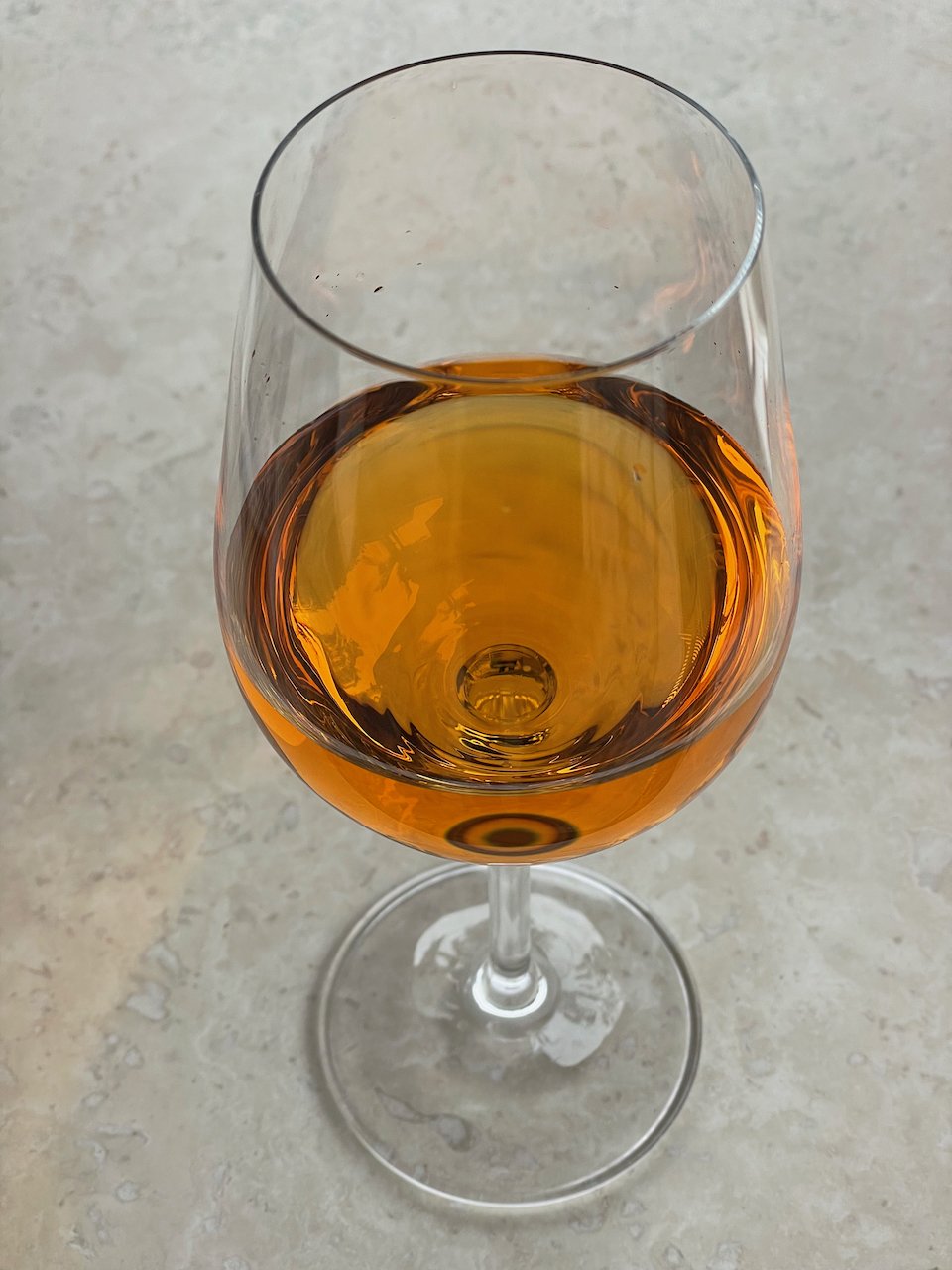
But, there is also a style of wine that has seen recent popularity and it’s orange wine. These wines are produced using white wine grapes, but instead of immediately separating the skins from the juice, the skins remain in contact with the juice during the fermentation process, just as in red wine making.  The skin contact during the fermentation process darkens the juice color to anything from a deep yellow color, an orange color, or even to a golden-brown color.  Thus, 'orange' wine.

And it's not just the color that's different in orange wines. Since the juice has had so much skin contact, these wines can take on bigger, bolder flavors and they can be quite tannic, like a red wine.

Orange wines should be served slightly warmer than a white wine and slightly cooler than a red. So, 55 degrees F would be just about right.

There you go. A wine’s color is all about the skins. Cheers!