
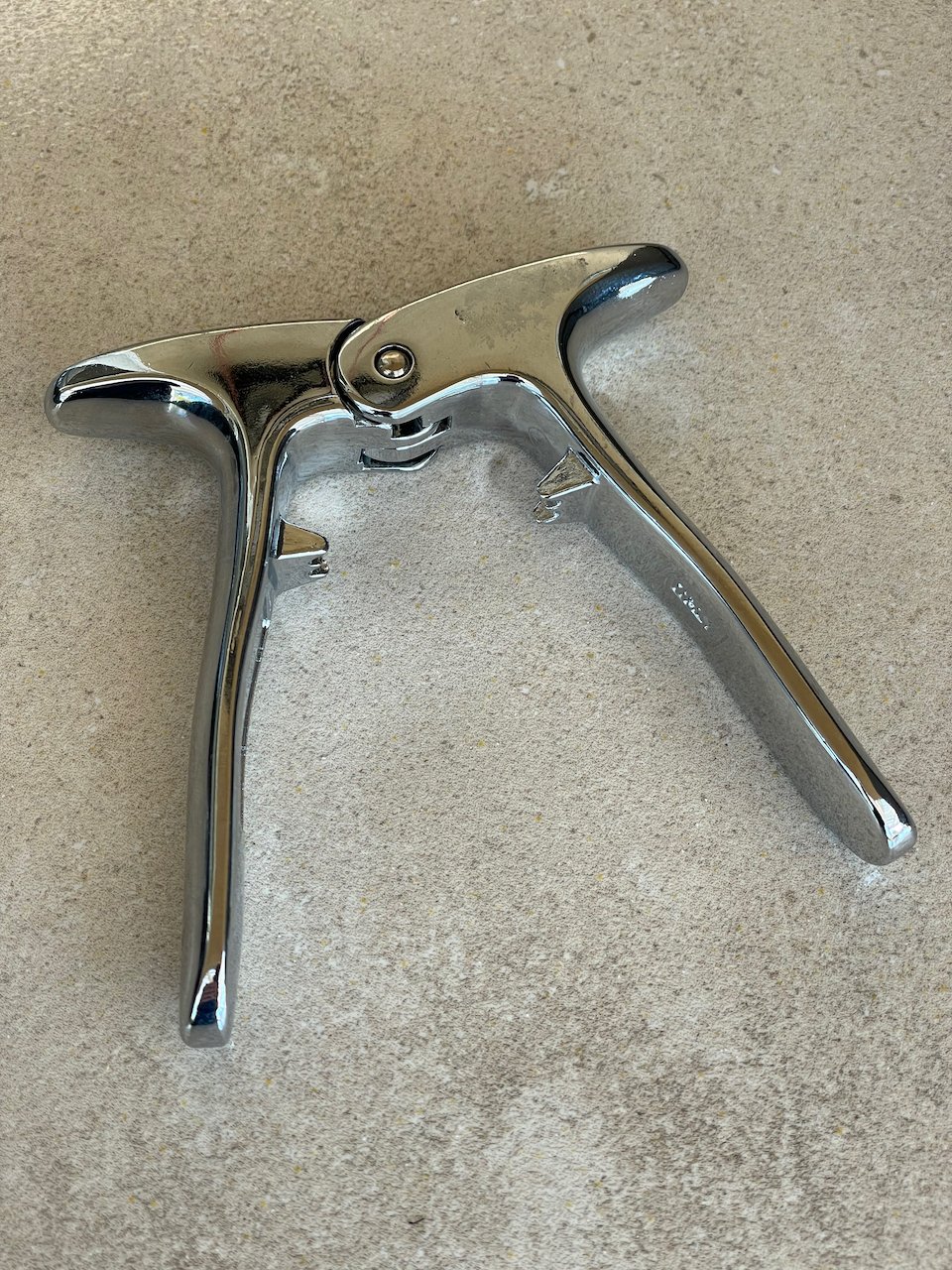
A Mystery Wine Tool

I recently received a gift that came in at small flat box. Knowing that good things come in small packages, I lifted the box only to find it to be very heavy.  Odd.  But, what was even more odd was once I opened the box and removed its contents, I still didn’t know what it was.

Being a bit perplexed, I asked "What is it?" It looked a bit like a tool that would be used to crack walnuts. But, no, it was not a nut cracker. I was told that is a wine tool. Really?

I finally had to ask “Tell me what it is!” and was told it is a Champagne cork opener!  I’d never seen such a tool and was fascinated. It’s designed to grab the cork (or plastic stopper) in a bottle of sparkling wine.  Once you’ve got a good grip on it, you simply twist and pull and out comes the cork. Without injuring yourself or damaging something in the room.

Now, it may not be as showy or fun as sabering the bottle open (if you’re not familiar with that I’ll cover it in a future blog) but it is quite efficient.  So, if you one who drinks a bit of the bubbly or you know someone who does, this makes a great gift. And, a great conversation piece. Cheers!

The Ah So Corkscrew Can Be Your Friend

There are a bunch of corkscrews available to purchase and they all do the same thing. Mostly.

The task of every corkscrew is to remove a cork from a bottle of wine. But not all corks are equal. And, when it comes to older corks, they can be a bit fragile. If you've ever pulled out a prized older bottle of wine but had the cork break apart while trying to extract it, the Ah So corkscrew can be your friend.

The Ah So excels at removing fragile or brittle older corks that tend to fall apart when using a traditional corkscrew. It works by inserting the prongs between the cork and the inside of the bottle's neck. Once inserted, it pinches down on the sides of the cork. Then, by pulling up and twisting, the cork can be extracted.

Because the Ah So does not pierce the cork, it also has been called the "Butler's Friend." As the story goes, a dishonest butler could remove the cork of a bottle of wine, pour himself a bit and replace the cork without his boss knowing otherwise.

Having an Ah So on hand is not a requirement for most wine drinkers, but it can be very useful, with practice, for extracting a fragile or half-broken cork.  Cheers!

What to Do About Sediment in Wine

Sediment_2.jpg

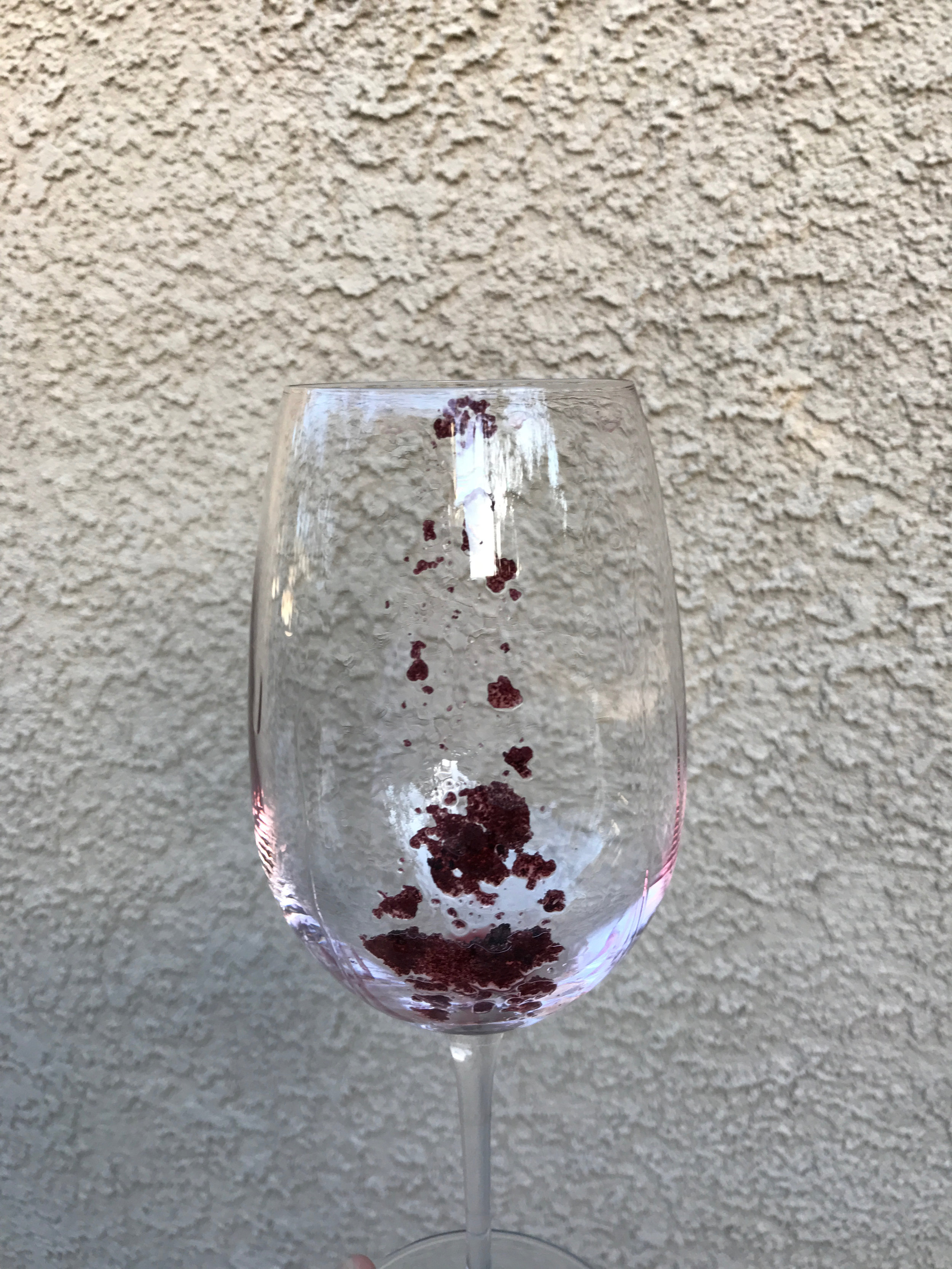
Have you ever gotten to that last sip of a glass of wine only to get a mouth-full of sediment? Instead of savoring that last sip, you end up spitting it out. An unpleasant way to finish.  And that's what recently happened to me as shown in the photo. But it doesn't have to go that way.

As discussed last time, lees (dead yeast cells and bits of grape seeds and solids) are natural in the wine making process and often desirable to be left in the wine during fermenting or aging.  This process is most common in red wines. Some wine makers will then filter out these solids (fining or racking), but others prefer to leave them in the wine as it's bottled to continue to add flavor.

There are several ways to avoid getting a mouth full of these particles in your glass of wine.

The first way is try to keep the solids in the bottle and not in your glass. If the bottle has been standing still and upright for a couple of days, the solids will have naturally fallen to the bottom of the bottle. As long as you are careful to not stir them up while opening the bottle and are gently tipping the bottle while pouring, the sediment should stay in the bottom of the bottle. But why take the risk.

The most dependable way is to do your own filtering before serving. There are several inexpensive devices on the market for doing this. The best one is a combination filter/aerator funnel. You simply hold this funnel above your decanter (or any other suitable container) and pour the wine through.  It has a micro-fine filter built-in that traps all those undesirable particles while allowing all the wine to pass through. As the wine exits the funnel, it gets aerated (exposed to air) which will usually help a young red wine. You'll then find all those undesirable particles trapped in the bottom of the funnel.  Not lurking in your wine glass.

While sediment is not harmful if consumed, it does significantly detract from a nice glass of wine.  So, filter and forget! Cheers!


What is Mulled Wine?

During the winter months and the holidays, mulled wine is a very popular drink, especially in European countries. Partly by tradition and partly because it's a warm drink that is enjoyed on cold evenings.  There are many names for mulled wine including Glögg in Sweden, Vin Chaud in France, and Glühwein in Germany.

A quick check of Webster's Dictionary shows that the word 'mull' can mean to mix thoroughly, or to heat, sweeten and flavor with spices.

This is exactly why this drink is called mulled wine. It's a heated mixture that can be sweetened and flavored with spices.

Now, just like barbecue sauce, meatloaf and pizza, there are no standard recipes for mulled wine. But, there are a lot of common ingredients. 

Most mulled wines start with red wine. You can find examples of white and even rosé mulled wines, but let's stick with red wine.  There is no best red wine to use, but any inexpensive bottle of a full-bodied, fruity, bold and tannic wine will do.  Examples might include Syrah, Malbec, Zinfandel, Grenache or Merlot. Even a red blend would work nicely.

Next, mulled wine includes spices. Often these originally included local ingredients.  But today, common spices in mulled wines include clove, star anise, cinnamon, nutmeg, cardamom and ginger. Even vanilla shows up in some recipes.

Next, fruit is added.  Common fruits include orange, apple, figs, and raisins.  You can also sweeten your mulled wine with sugar or honey.

Then, some mulled wines are given an extra kick with the addition of vodka, brandy, rum, Cognac, sherry or aquavit. Other recipes will include hard cider, Madeira wine, and even Port.

Finally, all these ingredients get mixed together and heated to about 140-150 degrees F (60-70 C). You just want to avoid boiling since that will cause the alcohol to evaporate. Serve your mulled wine in a sturdy glass meant for hot liquids, or a mug. And you'll get to enjoy a warm, comforting drink during the holidays and during those cold winter evenings. Cheers!

Source: https://everwonderwine.com

The Serving Temperature Can Dramatically Affect the Way a Wine Tastes

Wine should be fun and enjoyable. And, my motto on EverWonderWine.com is 'Drink what you like.' So, I try to keep things simple and make your wine experience more enjoyable.  And while the temperature of the wine you drink may seem unimportant, or even a bit snobbish to talk about, it really can affect your wine experience.

The bottom line is that the temperature at which a wine is served matters.  And here's why.  The 'proper' serving temperature will ensure that you get the best experience from your wine.  Serve it too cold or too warm and you can loose a lot of the wine's character.

This is partly due to your nose and how a wine's aroma works along with its taste. And, aroma is greatly affected by the wine's temperature.  A cold wine will have less of an aroma because fewer of the volatile compounds will be released from the wine. Conversely, a warmer wine will easily release these compounds and give you an opportunity to experience the wine's full aroma.

Then there's the way a wine tastes.  Serving a white wine too cold will mute its fruit flavors. White wines taste good when they are served cool because of their acidity and negligible tannin. The fruit flavors are zippy and bright and a bit of a chill will enhance this.  But full bodied white wines that have been aged in oak (e.g., Chardonnay) are best served not quite so cool to allow you experience the buttery and vanilla flavors that oak imparts.

Serving a red wine too cold will emphasize its acidity, bitterness and tannin.   But serving a red wine at room temperature is a bit too warm and can make it seem heavy, lifeless and emphasize the alcohol, yielding a burning sensation in your throat.

So, here are some general guidelines for the 'proper' serving temperatures of wines:

  • Sparkling Wine: 42° - 50° F

  • Light Whites: 46° - 54° F

  • Full Bodied Whites: 54° - 60° F

  • Rosé: 45° - 55° F

  • Light Reds: 50° - 54° F

  • Medium Reds: 57° - 63° F

  • Full Bodied Reds: 59° - 65° F

And while most people don't have specialized multi-zone wine refrigerators to precisely control their wine temperatures, or take the time to use a fancy wine thermometer, here are a couple quick rules-of-thumb.  Sparkling wine can be stored and served directly from a kitchen refrigerator. With white wine, place it in your kitchen refrigerator 30-60 minutes before serving. Or, if it's been stored in a kitchen refrigerator, remove it 30 minutes before serving.  For red wines, put them in a kitchen refrigerator for 30 minutes before serving. This way, your white wines will be cool but not cold and your reds will be slightly cooled and not too warm.

If you really like your red and white wines at kitchen refrigerator temperatures or your red wines at room temperature, go ahead and continue enjoying them. But at some point, give these temperature suggestions a try. Who knows, you might find that your favorite wines are even better at the recommended temperatures. Cheers!