Is Your Wine Sweet or Does it Just Taste Sweet?

During a recent wine tasting, one opinion given of the wine was that it was sweet. My reaction was that it wasn't sweet at all. So, how can a wine seem sweet and not sweet at the same time?

Well, as you'd expect, everyone's perception of taste is different. But, are tastes so different that one person can find a wine to be sweet while someone else can find it not?  The answer, of course, is yes. It's possible.

To understand this, you first have to understand that taste has a lot to do with smell. As soon as you smell a wine's aroma, you are detecting distinct fruit flavors. And, many of these fruit flavors are associated with sweet fruit. Think about black cherries, plums and blackberries. These are all sweet fruits. But, they are also flavors you can get from many red wines.  The wine we were tasting was a Cabernet Sauvignon and it indeed had aromas and flavors of these fruits.

When your brain senses these aromas, you automatically and subconsciously associate them with sweetness. And, with a first sip, your brain will continue you down that path as you taste the various fruit flavors. Sweet fruit flavors. But the wine, as was the case with this Napa Cabernet, had little to no residual sugar (RS).

As we started talking about the wine, it became apparent that indeed the bright fruit flavors were there, but the wine wasn't actually sweet. So, this wine had great flavors of sweet fruits, but having little to no residual sugar, it really wasn't sweet.

The wine world is a fascinating adventure. Get out and try some wines, different varietals or wines from different regions of the world.  You'll find a world of flavors!  Cheers!

How to Reset Your Sense of Smell When Wine Tasting

While our tongue is only able to detect five basic tastes, our nose is capable of detecting millions of different aromas.

When wine tasting, one of the Five S’s is smell.  You stick your nose into the wine glass and take a sniff. You can get a very quick idea of what the wine will taste like and you may even detect some of the fruit aromas. But very quickly, after just about two sniffs, your nose tends to switch off and become insensitive to further sniffs of the same aromas.

One way wineries and wine tasting rooms will address this issue is to re-set your olfactory system by having you smell coffee beans.  This shifts the receptors in your nose and brain to something completely different. That way, when you sniff your next wine, your sense of smell is reset and once again heightened.

But you may not always have coffee beans with you when you are tasting wines. The one thing that you always have with you is your arm. And it can come in very handy when wanting to reset your nose. Just take a quick sniff of your arm (preferably while not wearing any scented lotions, sunscreen or other scented products). This quickly resets your nose and allows you to get back to smelling the intricate wine aromas.

So, here's to smelling your arm!  And, to being better prepared to experience all the wonderful aromas that wines have to offer  Cheers!


What are Jammy, Buttery & Earthy Wines?

Ever wonder how terms like 'Jammy,' 'Buttery,' and 'Earthy' can be associated with wine? A product that made with grapes?

Previously we looked at "How do all those flavors get into wine?" There we learned that taste and smell come from the combination of senses from your tongue and your nose that your brain puts together to form flavor. We also learned that aging a wine, especially in oak barrels, can impart flavors that go beyond the fruit flavors from the grape.

So, let's briefly explore the terms 'jammy,' 'buttery,' and 'earthy' with respect to wines.

The first, jammy, is probably the easiest to understand. Just like a jar of fruit jam that you may spread on toast, jammy wines have very concentrated fruit flavors. And because jammy wines are made from very ripe fruit (i.e., high in sugar content) they can end up with just a slight hint of sweetness to go along with the concentrated fruit flavors. Hence, a jammy wine.  Zinfandel is best known for having jammy characteristics.

Next is buttery. Seemly an odd term to be associated with wine. But buttery flavor can be created in wine in one of two ways. First, putting the wine through the process of malolactic conversion (often referred to a malolactic fermentation) turns the naturally formed malic acid that you might associated with tart green apples into lactic acid that is most commonly associated with cream or butter.  The second process that can add buttery flavor to a wine is oak aging.  While most red wines go through malolactic conversion and oak aging, it's Chardonnay that's best known for showing buttery flavors.

Finally, earthy wines are those that have subtle aromas of damp earth, forest floor, mushrooms or a bit of a dusty aroma. Earthy wines include Pinot Noir and Petite Sirah. These should not be pungent aromas, you should just get a hint. If these aromas are strong it usually indicates that the wine has become tainted.

While these descriptors may sound a bit odd when associated with wine, they really can be wonderful enhancements to your wine drinking experience. So, remember to swirl and smell your wines in the glass, then sip. And then see if you can pick out these interesting nuances. Cheers!


Is There a Relationship Between a Wine's Sweetness and Its Alcohol Level?

When choosing a wine, one of the characteristics of interest to you might be its sweetness.  But how can you really tell if a wine has sweet tendencies?  The label may have some sentences on the back label to tell you just a little bit about the wine but rarely will it give an indication of its sweetness. The only quantified characteristic of a wine that is printed on a label is its alcohol by volume (ABV) expressed as a percentage.

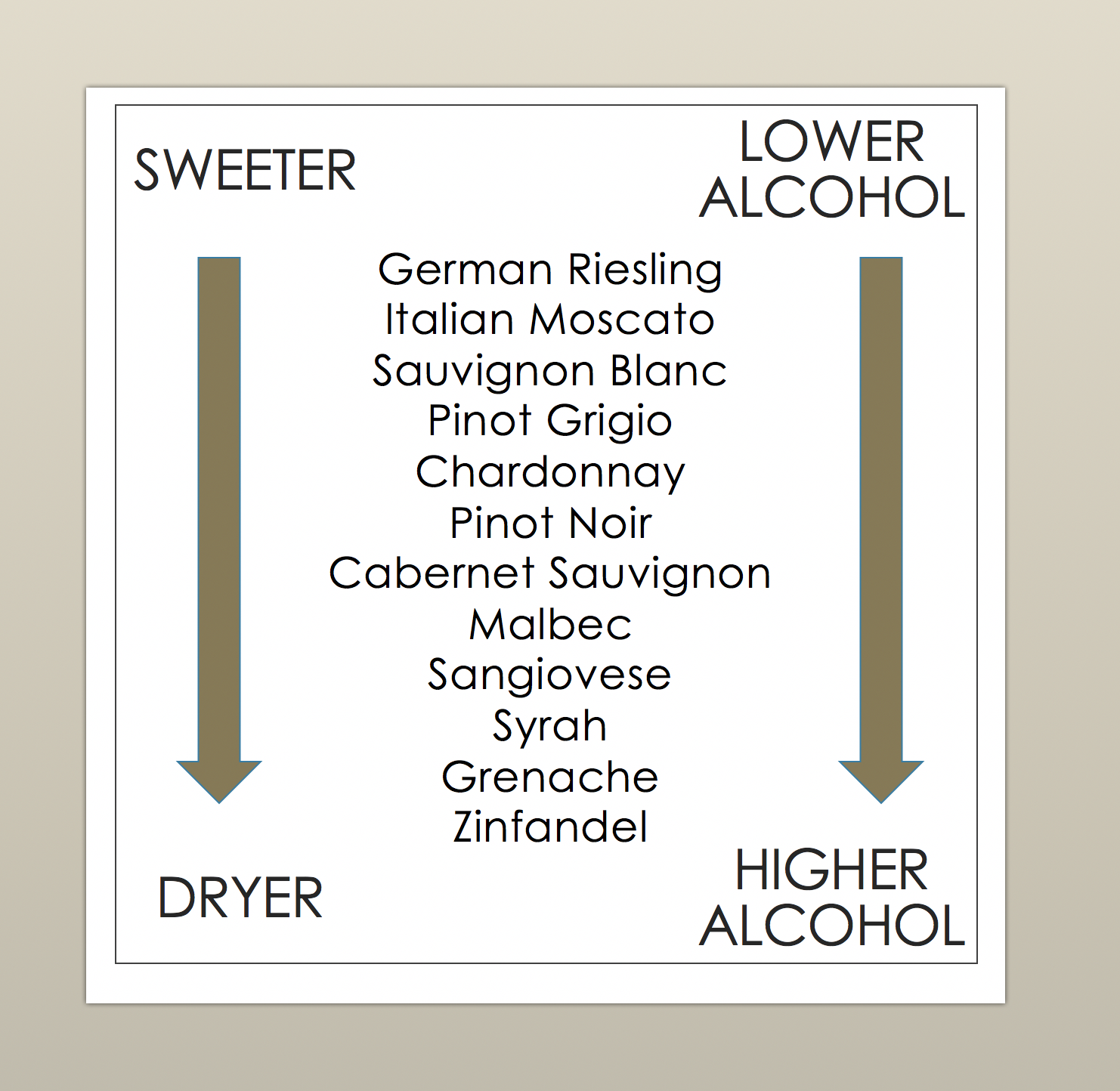
From this, you can make some indirect assumptions about a wine's sweetness. Rough rules of thumb say if a wine's alcohol content is 10% or less it will have sweet characteristics.  Wines that are even lower (especially down around 8 or 9 percent) will definitely be sweet. Wines in the 11% to 12.5% ABV range are considered 'off-dry' meaning that there is some notable residual sugar.  If it’s 12.5 percent or higher, the wine will be 'dry' and have little to no perceptible sweetness.

Most wines under 10% ABV will be sweet. Typically, wines such as German Riesling and Italian Moscato fall in this category. Wines in the range of 10.5% to 12.5% include Riesling's from Austria, Australia and the U.S., Sauvignon Blanc, and Pinot Grigio (a.k.a. Pinot Gris).  Then, in the 12.5% to 15.5% range you find Chardonnay, Pinot Noir, Cabernet Sauvignon, Malbec, Sangiovese, Syrah, Grenache and Zinfandel.

But, as previously pointed out, a grape that starts with low sugar levels, and ferments to the point where all the sugar is consumed by the yeast, will result in a wine with lower alcohol levels and little to no residual sugar. So, this is why alcohol levels are not a dependable way of determining a wine's sweetness.

So, while there’s definitely a loose relationship between a wine’s residual sugar and its alcohol level, it’s not a simple relationship.  But you can use the percent alcohol printed on the label as a first indication. Cheers!

Factors that Affect How Sweet a Wine Tastes

Last time, the topic of residual sugar was discussed.  Simply put, residual sugar (RS) is a measure of the sugar (typically in grams per liter) that remains in wine after fermentation.

During an uninterrupted fermentation, the yeast will continue to convert sugar to alcohol until nearly all the sugar is gone or the alcohol level reaches the point that the yeast can no longer live. But, if a wine maker decides to interrupt the fermentation, for example by lowering the temperature to the point where fermentation stops, they end up with wines having higher residual sugar.  That's one way to get a wine with higher residual sugar that tastes sweet.

In the case of sweet dessert wines, the grapes are either allowed to ripen to the point where they have very high sugar levels, dried to create a high sugar to water ratio (raisins) or, in the case of Ice Wine, the grapes are squeezed while frozen so the water does not get extracted and only a highly concentrated sugar solution results. In all these cases, fermentation starts with very high sugar levels so that upon completion of fermentation, there is a high amount of residual sugar.

Another way that wines can seem sweet has little to do with residual sugar.  Wines such as Gewürztraminer and Chenin Blanc are typically thought of as sweet wines.  But whereas a dry (very low RS) Cabernet Sauvignon or Zinfandel will have 0.5 to 1.0 grams per liter (g/L) of residual sugar, a Gewürztraminer can have as little as 1.5 g/L RS and a Chenin Blanc may have around 3.0 g/L RS.  To put this in perspective, a soda pop will typically have around 100 g/L RS!  So, yes, a Chenin Blanc may have twice the RS of a Cabernet, but it's tiny in comparison to a really sweet drink. So why are these wines often considered sweet?  Typically, it's because these wines have big, bright, bold fruit flavors and aromas that we associate with sweetness such as melon, apple, honey, rose, pineapple and grapefruit. Our nose 'fools' us into believing that the wine is sweet when it really doesn't have a significant sugar content.

On the other end of the spectrum are wines such as a sweet Riesling. These can have RS levels in the 40 g/L range. This is definitely sweeter.  One of the reasons that this sweetness is kept in-balance is by the high acidity of these grapes.  You've probably experienced this with lemonade and sodas such as colas which are very high in sugar (> 100 g/L RS) but also have very high acidity. The characteristics of sweetness and acidity balance each other out for a more enjoyable drink.

Another common wine that tends to be sweeter is White Zinfandel. It can have RS levels of 20-40 g/L.  Hence, it makes a great entry-level wine or just a sweet refreshing wine.

And, while we often think only of white wines and rosés as being the ones that can be sweet, even red wines can be a bit on the sweet side. Examples include common red wine blends found in grocery stores with brand names such as Apothic Red, Menage a Trois, Stella Rossa, Yellow Tail and Barefoot.  Even the very popular Meiomi Pinot Noir has 7 g/L of residual sugar.  Now you know why these brands are so popular!

As always, what's most important is that you drink what you like. And, if your taste buds steer you in the direction of sweetness, there are plenty of wines to explore and enjoy. Cheers!