
Ever Wonder? What Does the Shape of a Wine Bottle Mean?

Wine bottles come in many different shapes, sizes and colors. Ever wonder what the significance is of the shape of a wine bottle?

The simple answer is that wine bottle shapes are largely based on tradition. And, many of the traditions are based on early glass-blowing techniques.

The Burgundy bottle (far left and far right) is most often used for Chardonnay and Pinot Noir. This makes a lot of sense - Red Burgundy is traditionally Pinot Noir and white Burgundy is Chardonnay. These bottles have a long neck and sloping shoulders.

The Bordeaux bottle (Second from the left) is the most common bottle type. A Bordeaux bottle has straight sides and high shoulders. The most popular type of wine in Bordeaux are Cabernet Sauvignon/ Merlot blends. With white wines, this shape is most often associated with Sauvignon Blanc. But, being the most traditional shape, you’ll find lots of wines sold in this shape of bottle.

The Rhône bottle (middle) looks a lot like the Burgundy bottle but is just a little thinner and taller. The neck is slightly longer with more sloping shoulders. Rhône bottles are often embossed with a coat of arms below the neck. This style is also used for Grenache, Mourvèdre, and Syrah.

The Alsace bottle (fourth from the left) is taller and thinner than other types. The main grape contained in Alsace bottles is Riesling.

So, there you go. With these four bottle shapes you should now be able to identify the style of wine before you even read the label!

Next time we’ll take a quick look at some other unique things about wine bottles. Until then, “Cheers!”
Wine Making - It's Veraison Time!

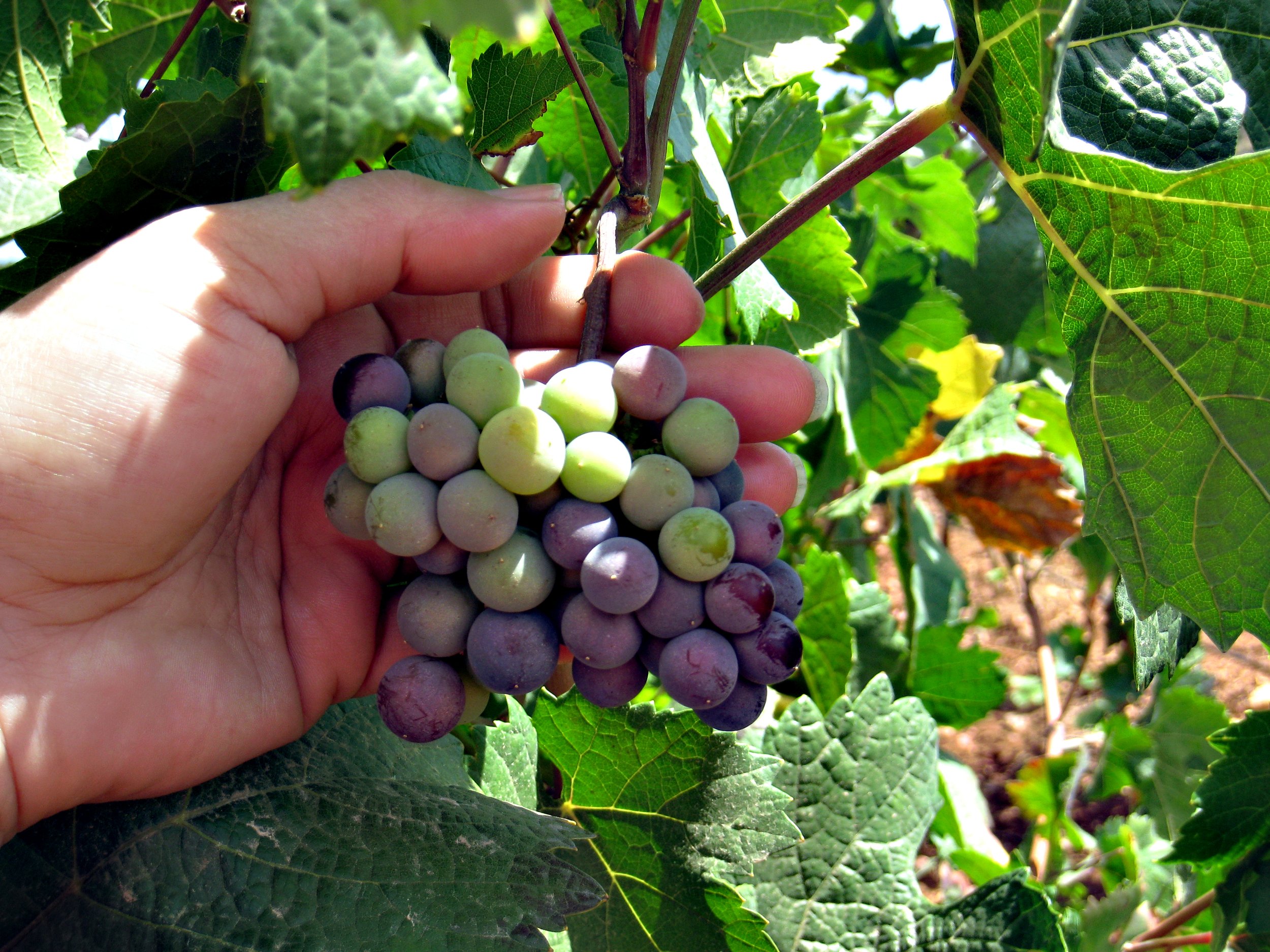
The grape growing cycle is currently at the point where berries (the actual term for individual grapes) begin to turn color. This marks the point at which the grape vines move from berry growth to berry ripening.

The term for this stage is called Veraison (vuh-rey-zhun). And this means that there is now approximately 45 days until the beginning of harvest.

While veraison is most obvious on red wine grapes, white grapes also go through veraison. While their color change isn't as dramatic as the reds, they do change from green to a more yellow or golden green. 

Veraison marks the point where the grapes stop growing in size. But, it's also when the sugar content of the grapes changes significantly. And, the acid begins to decline.

So, winemakers are now very closely watching and testing the grapes to find the point where the sugar content and acidity are just right for the particular wine they are trying to produce.

It's an exciting time in the vineyard and harvest is just around the corner! Cheers!

Ever Wonder What Those Tiny Crystals are on the Bottom of the Wine Cork?

IMG_0971.jpg

In a recent blog, I wrote about sediment in wine. Those are the particle that are left in your wine glass or inside the wine bottle from tiny particles of grape skins, seeds and stems that are a natural part of wine making. And, other than being an unexpected texture in your mouth, they are harmless.

But then I recently pulled the cork on a really nice bottle of wine that had been laying on its side in my wine refrigerator for little over a year. Upon examination I found a bunch of sparkly red crystals on the bottom of the cork (photo). It was obvious this wasn’t sediment because it had defined crystalline structure. So then, what is it?

Well, without getting too much into the chemistry (and there’s a lot of chemistry in wine making), these are indeed crystals that are sometime referred to as “wine diamonds.”

These crystals are formed in a bottle of wine due to the presence of tartaric acid which, along with malic acid and citric acid, naturally appear in wine. Again, all these little crystals are harmless but the crunch you’d experience in your mouth would certainly be unexpected from a glass of wine.

These crystals can form in both white wine and red wine. While some wine makers will put their wine through additional processing (e.g., cold stabilization) for a few weeks to force these crystals to form and drop out, other wine makers prefer to do as little additional processing as possible to their wines which can result in some crystal formation.

So, if you happen to see these little “wine diamonds” either on your cork or in your glass, don’t be concerned. This is a normal and natural phenomenon. Your wine is just fine! Cheers!

Ever Wonder? - What's that Stuff at the Bottom of Your Wine Glass?

Have you ever taken that last sip of wine only to find a nasty surprise either at the bottom of your glass or in your mouth? Sediment! It can be a very unpleasant discovery. But, luckily, it’s nothing to be worried about.

Sediment is a natural bi-product of the wine making process.

Wines are made from the juice of grapes. And, the skins of the grapes. And the seeds. And sometimes the stems. So, there are actually a lot of solids that are involved in wine making. That’s why, in some cases, you get some ugly particles in your wine glass.

It doesn’t just happen with red wines. White wines are susceptible too.

There’s a lot of chemistry involved in for formation of various types of sediment in wine. But, keeping it simple, these solids in your glass are mostly filtered out at the winery and are just microscopic when they leave the winery in the bottle.

But, age and temperature then act upon these microscopic particles to form the stuff you see in your wine glass.

Next time, I’ll get into a bit more detail on this topic. But, for now, don’t worry. This sediment is not harmful to consume. Cheers!

Big Wine Gets Even Bigger

In some of my recent reading, I came across the fact that E. & J. Gallo, The Wine Group and Constellation Brands produce more than half of the wine consumed in the U.S. Wow!

But then early this month I learned that Gallo had entered into an agreement with Constellation Brands to purchase more than 30 wine and spirits brands, along with six wine making facilities located in California, Washington, and New York. Double wow!

So, here’s a listing of some of the most familiar wine labels Gallo previously had in its portfolio — Alamos, Amarone, André Sparking wine, Apothic, Barefoot (this one accounts for almost 5% of all the wine consumed in this country!), Bartles & James, Boone’s Farm (Yup, they’re still around), Branciaia, Bridlewood, Carlo Rossi, Carnivor, Souverain Columbia, Dancing Bull, Dark Horse, DaVinci, Gascon, Edna Valley, Frei Brothers, Ernest & Julio Gallo, Gallo Family, Ghost Pines, J Vineyards, LaMarca Prosecco, Locations Brand (previously owned by Dave Phinney), Louis Martini, MacMurray, Mirassou, Orin Swift, Red Rock, Redwood Creek, Talbott, The Naked Grape, Tisdale, Tott’s Sparking Wine, Turning Leaf and William Hill.

That’s not the full listing, just some of the most notable.

Now, you add to that the labels from Constellation Brands — Clos du Bois, Black Box, Estancia, Mark West, Wild Horse, Franciscan, Hogue Cellars and Ravenswood.

That’s quite a portfolio!

So, maybe you don’t regularly purchase the Gallo label wine, but now looking at this list, you are likely to be purchasing wines that are part of Gallo’s portfolio. Cheers!