
Ever Wonder How to Tell if a Wine has Gone Bad?

Imagine ordering a glass of a light, crisp fruity Sauvignon Blanc expecting the glass to look like the one on the left side of the photo. But, instead you are served a golden-brown glass of wine like the one on the right. You will have been given your first clue. Then you lift your glass to take a sip but even before you do you get a whiff of a nutty aroma. That’s your second clue. But, you go ahead and take a sip and it tastes more like a sherry than a Sauvignon Blanc. You’ve gotten your final clue.

This wine has gone bad. The color, aroma and taste are dead giveaways of an oxidized wine.

Much like an apple or a banana will turn brown if exposed to air, so too will a wine.

Is an oxidized wine drinkable? Well, yes. It won’t hurt you or make you sick. And, if you are a sherry lover, you’ll probably like an oxidized wine. But you won’t get to enjoy the bright, crisp fresh fruit flavors that a Sauvignon Blanc, or most any white wine, should have.

Oxidation is just one of several wine faults that can occur in a ‘sealed’ bottle of wine. And, it can happen to both white and red wines. So, next time we’ll get into the various ways that wines can go bad and how to detect them. Until then, here’s to drinking good wine! Cheers!
Ever Wonder? What's the Best Way to Open a Bottle of Wine?

Opening a bottle of wine would seem to be a no-brainer. You insert the corkscrew and pull the cork. Right?

Well, I don’t know about you but in the past I’ve fought with a wine bottle, struggling to get the cork out. So, short of having a Sommelier open the bottle at your table, you want this to be a quick and simple process so that you can get to enjoying wine.

In today’s wine world, may wineries are packaging their wines in bottles with twist-off caps. So, if your bottle has one of those (and, yes, they are just as good as a cork!) go right ahead and twist that bottle open. But, for those bottles that have a cork, I’ve learned over the years that pulling the cork can almost be as simple.

The “trick’ is to use the right opener. And, there are a lot of different types of wine openers out there. I’ve tried them all and have learned that the double-hinged ‘Waiter’s Friend’ corkscrew (shown in the photo) is the best.

With this type of corkscrew, you use the small serrated blade at end of the handle to cut the foil capsule just below the lower lip on the neck of the bottle. Once the foil is removed, fold the blade back into the handle. Now, pull the screw out of the handle and insert it into the center of the cork. Then, holding the bottle by the neck with one hand and with the base of the bottle on a table or countertop, twist the screw into the cork until approximately one curl of the screw remains visible above the cork. Keeping one hand on the neck of the bottle, place the end of the lever on the lip of the bottle and gently pry the cork out of the bottle approximately half-way. Then, use the second step on the double-hinged lever to pry the cork fully out of the bottle. This process of prying the cork out of the bottle should not be difficult.

The reason that this corkscrew is called a Waiter’s Friend is because it truly is. This corkscrew can be used to open a bottle of wine with just one hand on the opener while the waiter is standing at your table instead of needing to place the bottle on a table and use two hands on the opener like so many other openers require.

A Waiter’s Friend corkscrew is available at most liquor or grocery stores. While you can pay a lot for a hand-crafted model, the basic models of a Waiter’s Friend should be in the $5-10 price range.

Here’s to easily opening a bottle of wine. Cheers!

Ever Wonder? Is it Okay to Drink Rosé Wine in the Fall and Winter?

 Rosé is a wine that is enjoyed in warm weather, by the pool, at the beach and by the lake. It’s wonderfully refreshing and pairs well with most foods. But, like wearing white clothing, rosé is generally not ‘in style’ after Labor Day. And that’s a shame.

Rosé, as previously discussed, is produced from red wine grapes, but extended contact with the dark grape skin is not allowed. The juice from the pressed red grapes is immediately separated before fermentation begins. So, the juice has just a hint of pink color.

So, why do we shy away from rosé during the Fall and Winter seasons? They are delicious and pair so well with so many foods.

Rose’s bright fruit flavors and crisp acidity work with chicken, fish and turkey. Yes, turkey. But is rosé featured on the Thanksgiving table? It should be! And, with a Christmas ham? Absolutely! And on New Year’s Eve and New Year’s Day? Yes, especially sparkling rosé. While it might be frightfully cold outside, that’s not reason to set aside the rosé.

I say embrace rosé - Year-round. Along with those hearty reds. It’s always okay to rosé! Cheers!

Pouring the Right Amount of Wine in a Glass

I recently ordered a glass of wine at a local restaurant. Admittedly it wasn’t a fine dining restaurant. It was a place where you order at the counter and then you are served at your table.

When I got my glass of red wine, it was filled nearly to the top. I’m sure the young man that poured the wine meant well and wanted to ensure that I was getting a full glass. But, for me, it was a bit too full.

Having some empty space in the glass will capture the wine’s aroma. And, as was discussed in a previous blog, your sense of smell is very important to your sense of taste.

It’s usually pretty easy to figure out how much wine to pour in a glass. Just fill it to the widest part of the bowl, as shown in the image. Or, if your wine glass has nearly vertical sides, pour the glass approximately one-third full. Now this may seem like too little wine. I’ve even had friends tease me about being served too little wine. But, I always assure them that there’s more where that came from! But having that empty space in the wine glass will make a positive difference in the way your wine tastes.

There is one exception. When you are pouring sparkling wine in a flute, go right ahead and fill it. That way you’ll ensure that the flute shows off all the wonderful bubbles!

Here’s to pouring the right amount in your wine glass! Cheers!

Ever Wonder? Should You Chill a Bottle of Wine in the Freezer?

Frozen Wine.JPG

It’s a common problem. You buy a bottle of wine that you want to server that same day. And you want it chilled. So, is the freezer a good option for quickly chilling a bottle of wine?

Well, chilling a bottle of wine in the freezer is one method. But, it has a couple of issues.

First, a freezer by definition is an environment that is below freezing. Right? So, that’s 32 degrees F or below. And, assuming you are trying to chill a bottle of white wine, rosé or sparkling wine, the best serving temperatures for those are going to be somewhere in the range of 38 to 55 degree F range, depending of the type of wine. Thus, a freezer is going to be too cold if the bottle remains in the freezing environment too long.

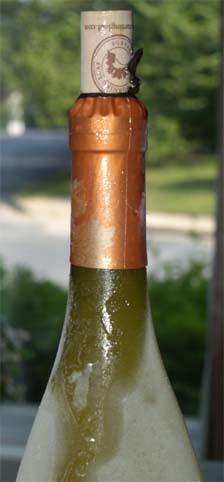
And, you run the risk of actually damaging the bottle. Depending on the alcohol content of the wine, it will freezer somewhere in the 15 to 20 degree F range. Because wine is mostly water, it’s going to expand when it freezes which can either push the cork out of the bottle (see photo) or, even worse, break the bottle!

The second issue with using a freezer to quickly chill a bottle of wine is that it’s really not that quick. It will still take quite a while to get that bottle to your ideal serving temperature.

Wine Bucket with Ice.jpg

So, what’s the best way to quickly chill a bottle of wine? Well, find a container that’s a bit larger than the bottle or bottles, fill it with ice and then fill it with water. The ice-cold water will then fully surround your bottle and it’ll be chilled rapidly. And, you don’t need to worry about it freezing!

Cheers!