Did You Know that Chablis is a Wine Region, Not a Wine Grape?

There was a time when ordering a glass of Chablis was generic for a glass of white wine. No specific type of wine, just a white wine. But there is so much more to Chablis than just a white wine.

Chablis is a region located in the northwest corner of the province of Burgundy in France.  It produces light, dry white wines known for their minerality and crisp acidity. And all white wines produced in Chablis are made exclusively from the Chardonnay grape.  They tend to be dry and fresh in flavor with distinct minerality. Chablis is usually un-oaked to retain its bright, crisp flavors. A few Chablis producers do use oak barrels in their wine making but these are restricted to the higher-quality wines and does not lead to overpowering oak flavors.

The vineyards of Chablis are classified into four tiers of quality, all precisely regulated by the Appellation d'Origine Contrôlée (AOC), and noted on the bottles' label:

  • Chablis Grand Cru AOC- Highest quality wines from seven vineyards on one slope

    • Only region where some oak aging is done. These wines have flavors of passion fruit, apricot, apple and orange rind.

  • Chablis Premier Cru AOC - Seventy vineyards in some of the better locations

    • The limestone soils produce richer fruit with flavors of lemon, starfruit and flint minerality

  • Chablis AOC - Comprised of the vineyards mostly closer in to the town of Chablis

    • These wines have nice flavors of citrus, pear and minerals

  • Petit Chablis AOC - Vineyard areas in the outer areas from the town of Chablis

    • These tend to have higher acidity, tart citrus flavors, and are best enjoyed young

So, when ordering a glass of wine, or shopping for white wines, remember that a white Burgundy from Chablis is a Chardonnay. And, don't just order a glass of white wine, order a French Chablis and enjoy some of the finest white wine the world has to offer. Cheers!

Uruguay's Wine Country

Continuing with the theme of wines of Uruguay, here’s a listing of their wine producing regions and the overall wine grape planting percentages of each sub-region (which are also knows as “Departments”):

  • Northern Riverside (light brown regions): Artigas (0.1%), Salto (0.9%) and Paysandú (1.9%)

  • Southern Riverside (light purple regions): Rio Negro (<0.01%), Soriano (0.1%) and Colonia (5.1%)

  • Metropolitan (Yellow regions): San José (4.7%), Canelones (67%) and Montevideo (12%)

  • Northern (Green regions): Rivera (0.5%) and Tacuarembó (0.1%)

  • Central (Dark Brown regions): Durazno (0.3%), Florida (0.3%), Lavalleja (0.1%) and Treinta y Tres (<0.01%)

  • Oceanic (Blue regions): Rocha (0.3%) and Maldonado (7%)

As you can see by the percentages, the Metropolitan region accounts for nearly 84% of all grape plantings in Uruguay.

While there are many great cities to visit across the wine regions of Uruguay, here are three that are well worth a visit:

MONTEVIDEO

The capital city of Uruguay is also the epicenter of viticultural gastronomy. The metropolitan area contains two thirds of the country’s vineyards, making it easy to visit some of the country’s most fabled wineries.

In the Ciudad Vieja (old city), a walk through the pedestrian district, from the Cabildo de Montevideo to Plaza Zabala, is an excellent introduction to historic Montevideo, within what was the walled city built in 1724. The port market a few blocks away is an excellent place to enjoy lunch. La Rambla, which runs along the edge of the city, offers another perspective on the life that bustles within, especially between Parque Rodó and Punta Carretas. At sunset, the pink granite of the walk lights up to create an enchanting atmosphere for Montevideans to begin their evening. Pocitos and the surrounding area is a great place to enjoy dinner. Wineries worth visiting include the classic Carrau, and the more modern Bouza and Pizzorno Winery. A little further away, in Juanicó, one finds Familia Deicas/Establecimiento Juanicó, one of Uruguay’s most historic wineries.

PUNTA DEL ESTE

The most famous city in Maldonado is also an obligatory stop on the wine tour. A couple of Punta del Este’s major attractions, along with the avant-garde architecture of its hotels, are two different versions of the sea: a calm one, found at a long beach stretching to the west along the Río de la Plata, with barely perceptible waves, and a wilder incarnation that runs north along the Atlantic shore. José Ignacio is a lovely town to visit along this coast. Inland, down rural roads, one finds wineries set in the hilly, sierra landscape. Wineries worth visiting include Garzón, Alto de la Ballena, Bodega Oceánica, and Viña Edén. In addition, there is Bracco Bosca in the Canelones region on the way to Punta del Este in Atlántida. All were founded within the last 20 years and make wines for export. The newest winery is Cerro del Toro in Piriápol is in the Maldonado region.

COLONIA

Colonia del Sacramento is the capital city of the Department of Colonia and was declared a World Heritage Site by UNESCO in 1995. With its colonial architecture, cobbled streets, and tiled roofs, it doesn’t look too different to when it was founded back in 1680 on the shore of the Río de la Plata. Several wine and cheese makers are located in the surrounding area. Los Cerros de San Juan, the oldest winery in Uruguay, was founded in 1854 and is fifteen minutes away on the road to Carmelo. Housed in a recently refurbished stone building, its pulpería (seafood) restaurant is a journey into the past. Carmelo, meanwhile, is a peaceful town at the mouth of the River Uruguay. It boasts old vineyards, as well as more modern ones, along with luxury hotels and several country inns. The wineries aren’t too far away and can be visited by bicycle, except for Narbona, which is a little more remote. Campotinto, Almacén de la Bodega Cordano and El Legado are small, family-run wineries that have appeared in recent years. Familia Irurtia, in contrast, has a more industrial past that it is now looking to revive.

An Overview of the Wines of Uruguay

Uruguay is home to a proud winemaking tradition in an unusual location, and a far cry from the desert-and Andes-dominated landscapes associated with most vineyard regions in the South America continent.

  • Uruguay means “river of the painted birds” in the indigenous Guarani language

  • In Uruguay, the dominant factor is the Atlantic Ocean, whose winds, storms, and tides ensure a cool climate.

  • Uruguay is about the same size as the U.S. state of Wisconsin and its population of 3.5 million is roughly that of Connecticut.

  • In terms of planted vineyards (14,804 acres), it’s a little smaller than Alexander Valley in California’s Sonoma Valley.

  • In terms of worldwide production of Tannat (tahn-naht), Uruguay is second only to France. And, in Uruguay, Tannat accounts for 27% of vineyard plantings.

    • In Uruguay, Tannat is also known as Harriague (Ha-ree-AH-gay), surname of the first producer to plant it in the country

  • Even so, Uruguay is the 4th largest wine producer in South America

  • Other principal grape varieties include:

    • Reds: Merlot, Cabernet Sauvignon, Cabernet Franc

    • Whites: Sauvignon Blanc, Chardonnay, Viognier, Albariño

  • There are 180 active wineries

  • The oldest winery in Uruguay dates back to 1854 and is called Los Cerros de San Juan

  • Only 5% of the wines produced in Uruguay are exported. And, just under 20% of the exports are to the U.S. (i.e., ~1% of wines from Uruguay make it to the U.S.)

  • Most wineries are family businesses with many now in the 3rd and 4th generations

  • Today, Uruguay has a dual character: on the one hand it continues to produce in a traditional style to suit local tastes, with Tannat dominating the scene. On the other, alternative and innovative styles, such as sparkling whites and much lighter reds are appearing.

Look for upcoming Behind the Cork Wine of the Week blogs featuring Tannat from some of the best wineries in Uruguay. Cheers!

Behind the Cork™ - Wines of Flat Creek Estate Winery & Vineyard

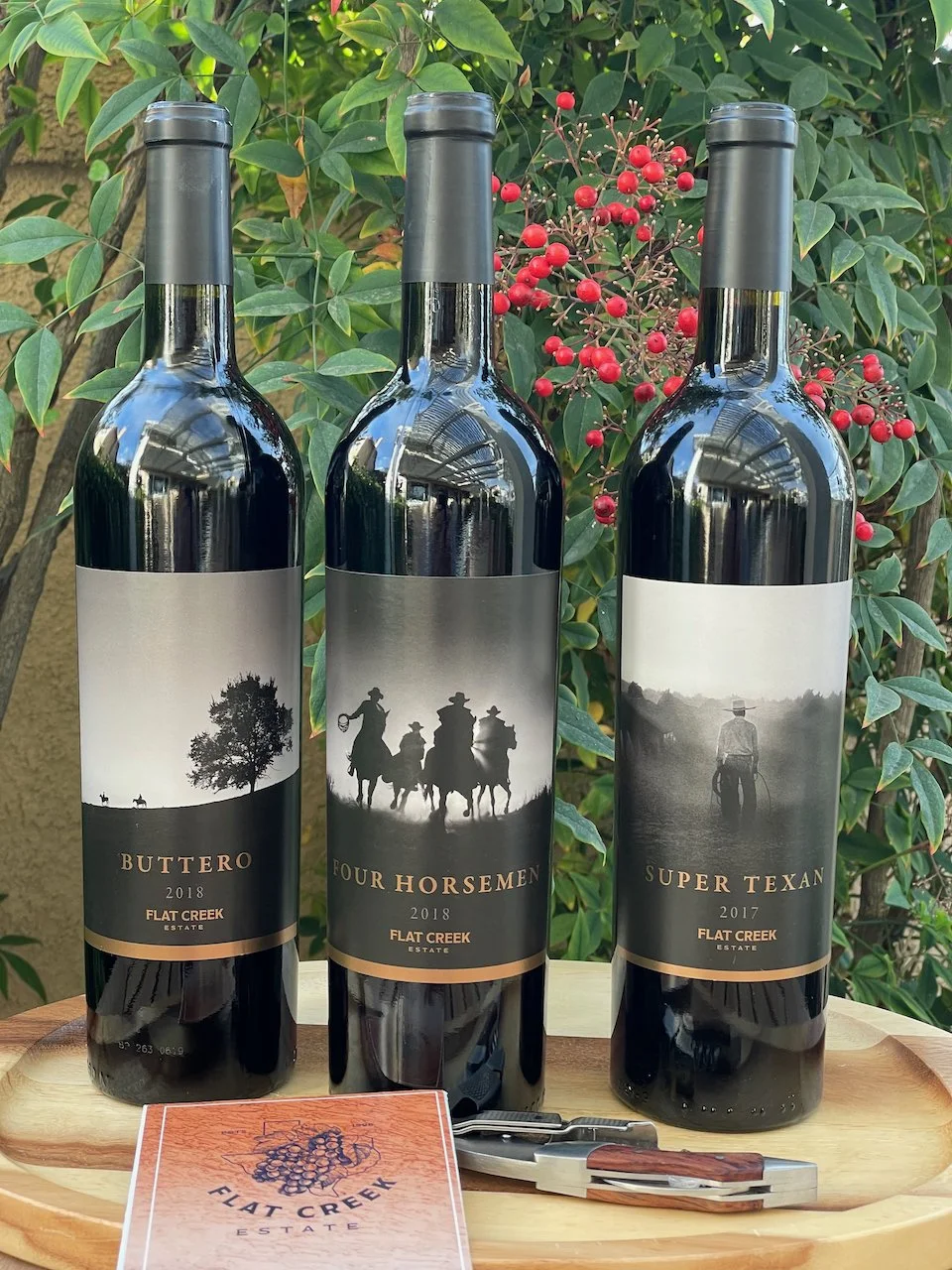
The “Trilogy Pack” from Flat Creek

Great wines from Texas? Indeed! Flat Creek Estate Winery & Vineyard is located roughly 45 minutes from downtown Austin Texas on 80 acres. Their beautiful vineyards combine with an elegant tasting room, full-service restaurant, a covered pavilion and even a one-of-a-kind 18-hole disc golf course!

Located in Marble Falls Texas, the Flat Creek Estate was established in 1996 in the Texas Hill Country AVA. It is dedicated to creating artisanal, handcrafted wines drawing on Old World winemaking practices that accentuate their unique terroir.

Their winery has earned more than 400 awards and accolades, including multiple Double Gold Medals at the San Francisco International Wine Competition.

At the recent Houston Livestock Show and Rodeo International Wine Competition, this “Trilogy Pack” won big with the following awards:

  • 2017 Super Texan ($48) - Double Gold Medal /Reserve Class Champion / Reserve Texas Class Champion

    Elevate your senses with their iconic red blend of Sangiovese, Montepulciano, Petite Sirah and Primitivo has been the flagship of their estate for decades. Cloaked in a deep ruby robe, its complex bouquet entwines luscious black currants, succulent raspberries, and a whisper of exotic Sichuan pepper. With a balanced medium body, it’s your weeknight companion, offering black cherry and fresh plum flavors that dance effortlessly on the palate. A hint of vanilla bids adieu, leaving a soft, lingering impression.

  • 2018 Buttero - Silver Medal

    This Buttero (Italian Cowboy) Italian red blend (Sangiovese, Primitivo and Montepulciano)

    (Coming Soon as part of the Trilogy Pack)

  • 2018 Four Horsemen Red Blend ($45) - Silver Medal

    This Estate Red Blend (Montepulciano, Primitivo and Syrah) is designed to showcase the results when exceptional Texas fruit is crafted with exceptional winemaking skill. This wine showcases their unique terroir and reflects the strength each of the four varieties contributes. The blend was created by choosing only the best barrels for each variety which were painstakingly combined to achieve a wine of supreme depth and balance. This wine was unfined and unfiltered to preserve every subtlety possible. Each limited installment will only be produced when the fruit demands.

This exclusive “Trilogy Pack” is available on their website at a discounted price for the 3-bottle pack.

Flat Creek Estate has been named one of Food & Wine’s top 50 Most Amazing Wine Experiences in America, stating “arguably Texas’s best wines [are] at this Hill Country estate.”

If you are in the Austin area, you need to check out Flat Creek Estate. With all they have to offer, you might even make it a full-day outing. Otherwise, check out Flat Creek Estate on-line. Texas is indeed making great wines! Cheers!


Disclosure of Wine Sample Submission: I received these samples at no cost for review. The opinions expressed are entirely my own.

Media Samples Provided by Flat Creek Estate Winery via CURICH | WEISS

Ever Wonder? What Does Cremant de Bourgogne Mean on a the Label of a Sparkling Wine?

An up-coming Behind the Cork will feature a sparkling wine that is labeled as “Crémant de Bourgogne.” One might assume that this title indicates a style of sparkling wine. But, actually, no. Crémant de Bourgogne is actually the appellation for sparkling white and rosé wines that are produced in Burgundy France.

Crémant (pronounced "cray-mont") covers all French sparkling wines produced outside the boundaries of the Champagne region.

The two main grape varieties grown in Burgundy are Pinot Noir and Chardonnay. Gamay, Pinot Gris and Aligoté are also grown in the region, but on a smaller scale.

Sparkling wines labeled “Crémant de Bourgogne” must be produced from a minimum of 30% of any combination of Chardonnay, Pinot Blanc, Pinot Gris and/or Pinot Noir with no more than 30% Gamay included in any wine.

As stated earlier, sparkling wines labeled “Crémant de Bourgogne” must be grown in land covered by the Crémant de Bourgogne appellation. And, this appellation is large! It covers nearly 5,000 acres from the Grand Auxerrois and environs, in the north, to the southern extremes of Beaujolais. It also includes the villages of the Cotes de Beaune and Cotes de Nuits.

All sparkling wines of Crémant de Bourgogne are made in the methode traditionelle where the second fermentation is done in the bottle.

Crémant de Bourgogne is produced in various levels of sweetness ranging from Brut Nature (no sugar added) to Doux (more than 50 gm/L of sugar). In the U.S., you will probably find either Brut (6-12 g/L) or Extra Brut (less than 6g/L).

So, next time you are looking for a bottle of sparkling wine to enjoy, look for “Crémant de Bourgogne” on the label. Cheers!