Rioja - Spain's Top Wine Producing Region

Rioja - Rioja (re-OH-hah), in northern Spain, is their top wine producing region. It produces red wines made from Tempranillo (>80%), but Carignan, Garciano, Cabernet Sauvignon and Maturana Tinta are also used in red Rioja wines.  Very few white grapes are grown in Rioja but include Chardonnay, Viura, Malvasia, Sauvignon Blanc, Verdejo and Granacha Blanca. These white wines account for less than 10% of Spain’s annual production.

Here are a few facts about Rioja wines:

The controlling board in Rioja, the Consejo Regulador DOCa Rioja, ensures that the Rioja quality requirements are met.

There are various types of Rioja wines:

Rioja” is the most basic. It is aged for a matter of months, bottled and sold. It’s bright and fruity with big cherry flavors.

Crianza” is required to be aged for one year in oak and spend one year in the bottle before being sold.

Reserva” in Rioja actually means something. A Rioja Reserva is required to be aged for one year in oak and then are not sent to market for three years after vintage.

Gran Reserva” must spend a minimum of two years in the barrel and two years in the bottle before being sold with a total of five years of aging. This wine is produced from the best grapes and ends up with the best tannin structure.

There are three wine zones in Rioja:

Rioja Alavesa - With rolling hills throughout this region, its wines tend to be similar to those of Rioja Alta with higher levels of tannin and acidity. 

Rioja Alta - With its elevation and cooler temperatures, Rioja Alta wines tend to be more balanced with good tannin and acidity. Sub-regions include:

Iregua Valley - The Iregua River divides Rioja Alta and Rioja Baja. This valley, which lies in both Rioja Alta and Rioja Baja, produces wines of medium acidity and lower tannin due to its warmer temperatures.

Najerilla Valley - This valley has the highest number of acres of vineyard in Rioja. Growing primarily Tempranillo and Garnacha from old vines (some 80 to 100 years), these wines can have smoky hints of tobacco, red fruit flavors and higher levels of tannin and acidity.

Oja Valley - The vineyards of this valley are planted at the highest elevation in Rioja Alta. The wines produced nearest the Oja river are rich, highly aromatic and lower in acidity.  Wineries on the northern side of the valley are more fruit forward with higher acidity and stronger tannin. These wines do well with aging.

Rioja Oriental - Known previously as Rioja Baja (i.e. lower in altitude), the name was changed in 2018 from Rioja Baja. The sub-region forms the largest portion of the Rioja region, and accounts for 40 percent of its wine output.

The Rioja wine production began in the period from 200 BC to the sixth century. In 1901, the phylloxera mite arrived in Rioja, causing wide-spread devastation in the region's vineyards. It was not until the 1970s that the industry once again came back to full production.

So, try some of the wines from the Rioja region of Spain. And, when you raise your glass, say “Salud!” as you will be toasting good health to everyone. Cheers!

Ever Wonder? Is Montepulciano a Wine Grape or a Wine-Producing Region?

A Montepulciano (mon-ta-pull-channo) wine can be a bit confusing. Typically, the name of the wine either represents the type of grape used to produce the wine or, most commonly in Europe, the place where the grapes are grown.

Montepulciano as you might guess by its name, is an Italian wine. So, you’d probably also guess that it’s from a region or town of Montepulciano, Italy. But, there you’d be wrong.

It is true that Montepulciano is a beautiful medieval town in Tuscany, in central Italy. But, oddly enough, Montepulciano wines are not produced in Montepulciano.

Instead, Montepulciano wines are from Marche, Molise, northern Puglia and most notably, Abruzzo regions of Italy. All of these regions are along the eastern coast of Italy and benefit from the cooling winds off the Adriatic Sea.

So, yes, Montepulciano wines are made of Montepulciano grapes but they have nothing to do with the town Montepulciano.

To make things even more confusing, the wines that are produced in Montepulciano are, like most Tuscan wines, made from the Sangiovese grape.

Montepulciano is the second most planted red grape in Italy. Sangiovese, the grape used to make Chianti, is the most widely planted grape of Italy.

Montepulciano has long held a reputation for being low-priced fruity red wines that go well with pizza and bold tomato-based sauces. This reputation is true. But, there are many producers, especially in Abruzzo, that are making some very well-structured wines displaying notes of cherry, crushed herbs and tobacco.

Although a bit confusing, Montepulciano wines can be quite good and, as the most exported Italian wine to the U.S., it can be very reasonably priced. Cheers!

Some Places to Consider Visiting in Uruguay's Wine Country

Continuing with the theme of wines in Uruguay, here’s some excellent material provided by in a recent “Uruguay Wine 101 Webinar” facilitated Creative Palate Communications and hosted by the following individuals:

  • Buenos Aires-based Joaquin Hidalgo, South American editor at Vinous and weekly wine columnist at Argentina’s leading newspaper

  • Martina Litta, Foreign Trade Manager for the National Wine Institute of Uruguay (INAVI), with specific responsibility for heading up Uruguay Wine, dedicated to the promotion of Uruguayan wines abroad

When considering a trip to Uruguayan wine country, one ought to include some or all of the following cities in their itineraries, all located in southern Uruguay:

MONTEVIDEO

The capital city of Uruguay is also the epicenter of viticultural gastronomy. The metropolitan area contains two thirds of the country’s vineyards, making it easy to visit some of the country’s most fabled wineries from here.

In the Ciudad Vieja (old city), a walk through the pedestrian district, from the Cabildo de Montevideo to Plaza Zabala, is an excellent introduction to historic Montevideo, within what was the walled city built in 1724. The port market a few blocks away is an excellent place to enjoy lunch. La Rambla, which runs along the edge of the city, offers another perspective on the life that bustles within, especially between Parque Rodó and Punta Carretas. At sunset, the pink granite of the walk lights up to create an enchanting atmosphere for Montevideans to begin their evening. Pocitos and the surrounding area is a great place to enjoy dinner. Wineries worth visiting include the classic Carrau, and the more modern Bouza and Pizzorno Winery. A little further away, in Juanicó, one finds Familia Deicas/Establecimiento Juanicó, one of Uruguay’s most historic wineries.

PUNTA DEL ESTE

The most famous city in Maldonado is also an obligatory stop on the wine tour. A couple of Punta del Este’s major attractions, along with the avant-garde architecture of its hotels, are two different versions of the sea: a calm one, found at a long beach stretching to the west along the Río de la Plata, with barely perceptible waves, and a wilder incarnation that runs north along the Atlantic shore. José Ignacio is a lovely town to visit along this coast. Inland, down rural roads, one finds wineries set in the hilly, sierra landscape. Wineries worth visiting include Garzón, Alto de la Ballena, Bodega Oceánica, and Viña Edén. In addition, there is Bracco Bosca in the Canelones region on the way to Punta del Este in Atlántida. All were founded within the last 20years and make wines for export. The newest winery is Cerro del Toro in Piriápol is in the Maldonado region.

COLONIA

Colonia del Sacramento is the capital city of the Department of Colonia and was declared a World Heritage Site by UNESCO in 1995. With its colonial architecture, cobbled streets, and tiled roofs, it doesn’t look too different to when it was founded back in 1680 on the shore of the Río de la Plata. Several wine and cheese makers are located in the surrounding area. Los Cerros de San Juan, the oldest winery in Uruguay, was founded in 1854 and is fifteen minutes away on the road to Carmelo. Housed in a recently refurbished stone building, its pulpería (seafood) restaurant is a journey into the past. Carmelo, meanwhile, is a peaceful town at the mouth of the River Uruguay. It boasts old vineyards, as well as more modern ones, along with luxury hotels and several country inns. The wineries aren’t too far away and can be visited by bicycle, except for Narbona, which is a little more remote. Campotinto, Almacén de la Bodega Cordano and El Legado are small, family-run wineries that have appeared in recent years. Familia Irurtia, in contrast, has a more industrial past that it is now looking to revive.

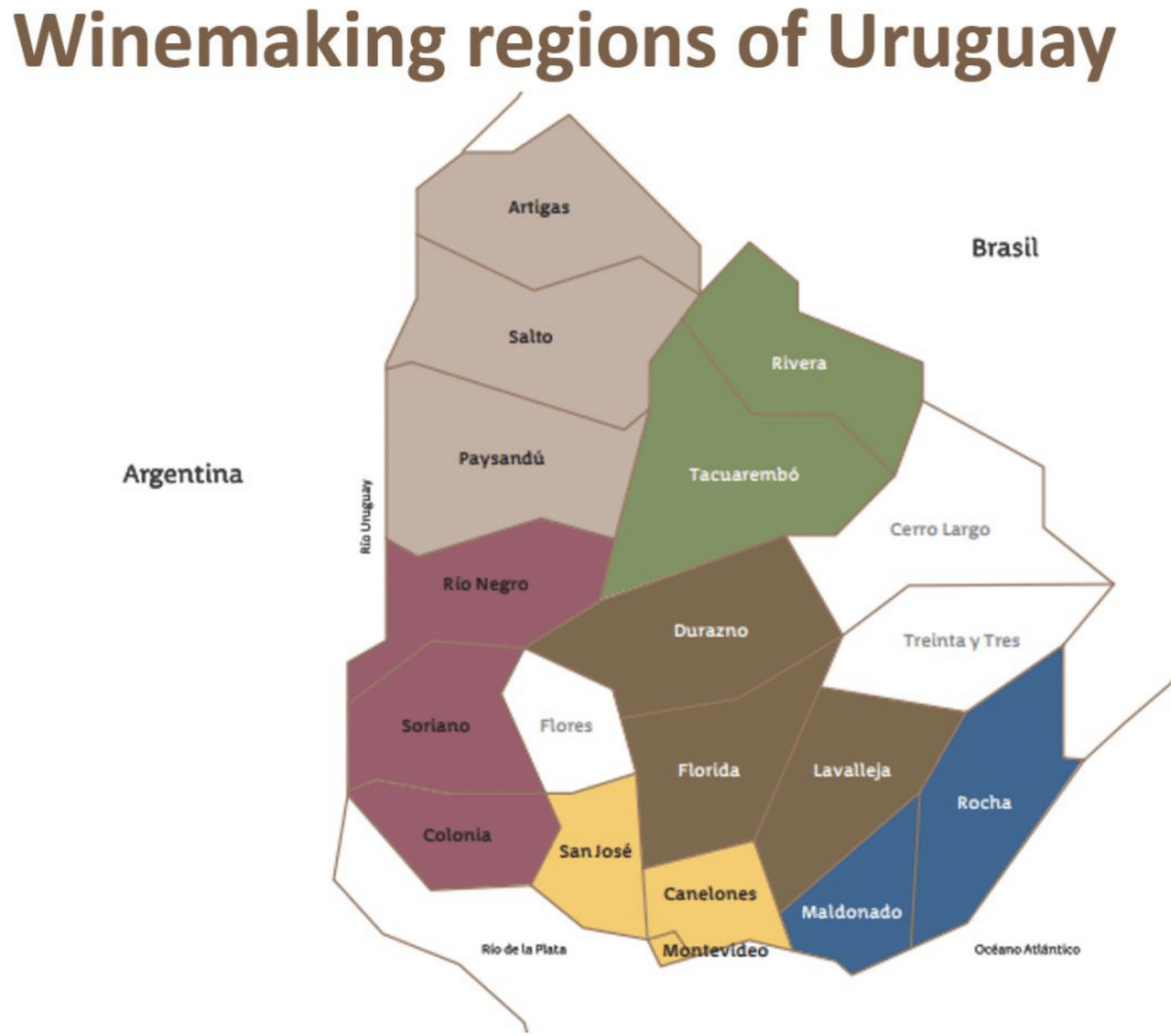
The Five Distinct Terroirs in Six Areas of Uruguay

Image from Creative Palate Communications (Used with Permission)

In Uruguay, the combination of three soil types (clay mixed with different original materials) and its relative proximity to the sea have created six distinct wine making regions:

Northern Shore (Light Tan): This terroir spans the departments of Artigas, Paysandú and Salto along the shore of the Uruguay River. This is a continental terroir, with a temperature range between day and night of up to 20 degrees, and high relative humidity. The soils range from river bed gravel to calcareous clay, with varying amounts of lime and sand. The Northern Shore region accounts for just under 3% of total surface area under vine at 408 acres.

Southern Shore (Burgundy). This region includes Colonia, Río Negro, and Soriano where the influence of the Uruguay River can be seen in the sedimentary soils of Carmelo while the San Juan River has created rockier ones. This region accounts for 5.2% of the area under vine in Uruguay.

Metropolitan (Yellow): This region is made up of San José, Canelones, and Montevideo. It houses two-thirds of the country’s wineries and boasts 83.4% of total surface area under vine at 12,076acres. The greatest determinant of the soils is the Río de La Plata, while the climate is maritime. The deep, clay soils also feature strips of pink granite and make for a terroir well-suited to growing Tannat. Due to the region’s long history, this is where the country’s other classic varieties, such as Cabernet Sauvignon, and Merlot, are grown.

Oceanic (Blue): The region includes Maldonado and Rocha. However, only the former is of importance, with 7.3% or 1,053acres under vine, while Rocha accounts for just 0.3% with47 acres. In this region, the changing orography (topographic relief of mountains) is important, with the Sierra de la Ballena reaching a height of 1,600 feet above sea level and contributing a mixture of granite and ballast to the soils, while the climate is oceanic. White grape varieties dominate here.

Center (Dark Brown): Here, Durazno, Florida, and Lavalleja are the most relevant in terms of area under vine, although they still only account for 0.7% of the total with 109acres. The soil and climate are similar to that of the Metropolitan area.

North (Green): Rivera and Tacuarembó comprise this region with vineyards here that are planted in different geological formations rich in iron. The climate is continental, with significant temperature ranges and the area experiences more hours of sunlight than elsewhere in Uruguay. Cerro Chapeu, which is 720 feet above sea level and borders Uruguay, is an area where sugars and color tend to be more concentrated. In all, it has 84aces of vines, or 0.6% of the total.

So, there’s a top-level summary of the various wine-growing regions of Uruguay. See more on Uruguay’s Tannat and White Wines and stay tuned for additional wines to be featured from Uruguay. Cheers!

Some Facts about Wines from Uruguay

Uruguay is home to a proud winemaking tradition in an unusual location, and a far cry from the desert-and Andes-dominated landscapes associated with most vineyard regions in the South America continent.

  • Uruguay means “river of the painted birds” in the indigenous Guarani language

  • In Uruguay, the dominant factor is the Atlantic Ocean, whose winds, storms, and tides ensure a cool climate.

  • Uruguay is about the same size as the U.S. state of Wisconsin and its population of 3.5 million is roughly that of Connecticut. In terms of planted vineyards (14,804 acres), it’s a little smaller than Alexander Valley in California’s Sonoma Valley.

  • In terms of worldwide production of Tannat (tahn-naht), Uruguay is second only to France. And, in Uruguay, Tannat accounts for 27% of vineyard plantings.

    • In Uruguay, Tannat is also known as Harriague (Ha-ree-AH-gay), surname of the first producer to plant it in the country

  • Other principal grape varieties include:

    • Reds: Merlot, Cabernet Sauvignon, Cabernet Franc

    • Whites: Sauvignon Blanc, Chardonnay, Viognier, Albariño

  • There are 180 active wineries

  • The oldest winery in Uruguay dates back to 1854 and is called Los Cerros de San Juan

  • Most wineries are family businesses with many now in the 3rd and 4th generations

  • Today, Uruguay has a dual character: on the one hand it continues to produce in a traditional style to suit local tastes, with Tannat dominating the scene. On the other, alternative and innovative styles, such as sparkling whites and much lighter reds are appearing

Next time, we’ll take a look at the five distinct terroirs located in six separate areas of Uruguay. Until then, Cheers!