
Get to Know the Pinots -- Pinot Noir

In previous blogs we got an overview of the Pinot grape and the tremendous number of Pinot synonyms (258!) and looked at the least known of the Pinots, Pinot Meunier and Pinot Gris. Now let’s look at the most notable of the Pinots - Pinot Noir.

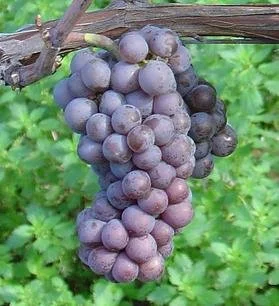
Pinot Noir’s name is derived from the French words for pine and black. The word pine refers to the shape of the tightly clustered, pinecone–shaped bunches of fruit, while noir (black) comes from the dark colored grapes.

Pinot Noir is probably best known as the “red” wine in Burgundy and least known as one of the three primary varietals in the making of Champagne.

Pinot Noir is the world’s most popular light-bodied red wine that is low in tannin. It’s also a favorite for the production of rosé wines and can also be found as a white wine!

Cluster of Pinot Noir Grapes

The most common flavors of Pinot Noir include cherry, cranberry and raspberry. But, its flavors tend to be highly dependent on terroir (i.e., where it is grown). Pinot is grown around the world and most notably in France, USA (California and Oregon), Australia, New Zealand and Chile.

Because Pinot Noir has such delicate aromas, it is generally recommended that it be served in a large round bell-shaped glass. Cheers!

Get to Know the Pinots -- Pinot Gris

In previous blogs we got an overview of the Pinot grape and the tremendous number of Pinot synonyms (258!) and looked at the least known of the Pinots, Pinot Meunier. Now, let’s take a look at Pinot Gris.

A member of the extended Pinot family of grape varieties, Pinot Gris (PEE-no GREE) is a mutation of Pinot Noir that has skins that are not green like other white grape. And, in the vineyard, Pinot Gris and Pinot Noir varieties look identical right up until veraison (when the grapes begin to ripen and change color). This is when Pinot Gris berries take on colors from orange-pink to pale, dusty purple. In fact, the word gris is French for "gray" and refers to the dusty, light-gray sheen the grapes usually take on.

Pinot Gris Grapes

And, by the way, Pinot Gris is simply the French name for the grape that Italian’s refer to as Pinot Grigio. So, they are both the same but, as with all wines, they can taste different based their terrior (i.e., soil, climate, topography).

Pinot Gris wine is typically pale gold in color with aromas and flavors of citrus, pear, green apple, white peach and nectarine. There can also be herbal and spice notes along with floral and honey. It tends to be high in acidity.

So, next time we’ll look at yet another Pinot - Pinot Blanc. Cheers!

Get to Know the Pinots -- Pinot Meunier

In previous blogs we got an overview of the Pinot grape and the tremendous number of Pinot synonyms (258!).

But, there are just four Pinot wine grapes that we’ll now focus on - Pinot Noir, Pinot Gris, Pinot Blanc and Pinot Meunier. But, let’s save those three for later and start with probably the least known of the Pinots but one that plays a very important role- Pinot Meunier.

The word Meunier (mun·yay) is French for "Miller", and gets its name from the grapevines because the hairy underside of its leaves makes it look as though it had been dredged in flour.

Pinot Meunier is a dark-berried grape variety that is mostly grown in France (more than 3/4s of the worlds Pinot Meunier production). While you are less likely to find a Pinot Meunier varietal wine (it does make a very Pinot Noir-like red wine), you’ve more likely experienced it in a blend; namely Champagne. It is one of the three primary grapes used in the production of Champagne along with Pinot Noir and Chardonnay.

Pinot Meunier Grapes

And, yes, the Pinot Meunier and Pinot Noir grapes are dark-skinned but used in Champagne. The grapes are simply pressed to release their juice which is immediately separated from the skins. Remember, it the skins of the grapes that give the wine its color.

In Champagne, Pinot Meunier provides aromatics and fruit flavors to the wine such as cherry, raspberry and pomegranate. Pinot Meunier doesn’t tend to age well so Champagnes with a substantial proportion of Pinot Meunier are intended to be consumed young when its fruit flavors are at their peak.

So, that a quick look at the first of the Pinots. Next time we’ll move on to Pinot Gris. Cheers!

Get to Know the Pinots -- And the Most Common Synonyms!

Last time, in an overview of wine’s called Pinot , it was noted that if you were to do a search on “Pinot” wine grapes you could come up with a list that includes at least 26 different ones. In fact, according to the New Sotheby’s Wine Encyclopedia, there are 258 official synonyms!

But, for brevity, here’s the list of the 26 Pinots that you might have actually heard of:

  • Pinot Aigret (Synonym for Rufete)

  • Pinot d’Anjou or Pinot d’Aunis (Synonym for Pineau d’Aunis)

  • Pinot Beurot or Pinot Burot (Synonym for Pinot Gris)

  • Pinot Bianco (Synonym for Pinot Blanc)

  • Pinot Blanc

  • Pinot Blanc Cramant or Pinot Blanc Chardonnay (Synonym for Chardonnay)

  • Pinot Blanco (Synonym for Chenin Blanc)

  • Pinot Blanc Vrai (Synonym for Pinot Blanc)

  • Pinot Branco (Synonym for Pinot Blanc)

  • Pinot Chardonnay (Synonym for Chardonnay)

  • Pinot Droit or Pinot Fin (Synonym for Pinot Noir)

  • Pinot d’Evora (Synonym for Carignan)

  • Pinot Fin Teinturier or Pinot Teinturier (A parent of the Chardonnay grape)

  • Pinot Fleri (Synonym for Mourvédre)

  • Pinot Giallo (Synonym for Chardonnay)

  • Pinot Grigio (Synonym for Pinot Gris)

  • Pinot Gris (Also known as Pinot Grigio)

  • Pinot Liébault (A clone of Pinot Noir)

  • Pinot de la Loire (Synonym for Chenin Blanc)

  • Pinot Meunier (One of three primary grapes used to produce Champagne)

  • Pinot Nero (Synonym for Pinot Noir)

  • Pinot Noir (The star of the show!)

  • Pinot Noir Précoce (Synonym for Frûhburgunder)

  • Pinot St George (Synonym for Négrette)

  • Pinot Vache (Synonym for Mondeuse)

  • Pinot Verdet (Synonym for Arbois)

Next time, we’ll start looking into the most widely known Pinots - Pinot Noir, Pinot Gris, Pinot Blanc and Pinot Meunier.

Get to Know the Pinots

Grapes are grown worldwide typically for eating or for winemaking.

There are 17 genera (the plural of genus) that belong to the Vitaceae family of flowering plants. But just the one genus, Vitis, is important in the world of winemaking. And, of the nearly 80 species in this genus, just one, Vitis vinifera is generally grown for wine.

It is estimated that there are more than 10,000 grape varieties in cultivation. But, with today’s ability to do DNA analysis, it is thought that this number is actually around 5,000.

Now, if you were to do a search on “Pinot” wine grapes you could come up with a list that includes at least 26 different ones. But, many of these are simply synonyms for other grapes.

So, when it comes to the “Pinot” grapes, there are six primary clonal variations:

  • Pinot Noir/Pinot Nero

  • Pinot Gris/Pinot Grigio

  • Pinot Blanc/Pinot Bianco

  • Pinot Meunier

  • Pinot Teinturier

  • Pinot Noir Précoce

In future blogs we’ll take a further look at these 6 as well as provide a full listing of the 26 “Pinot” grapes. Until then, cheers!