
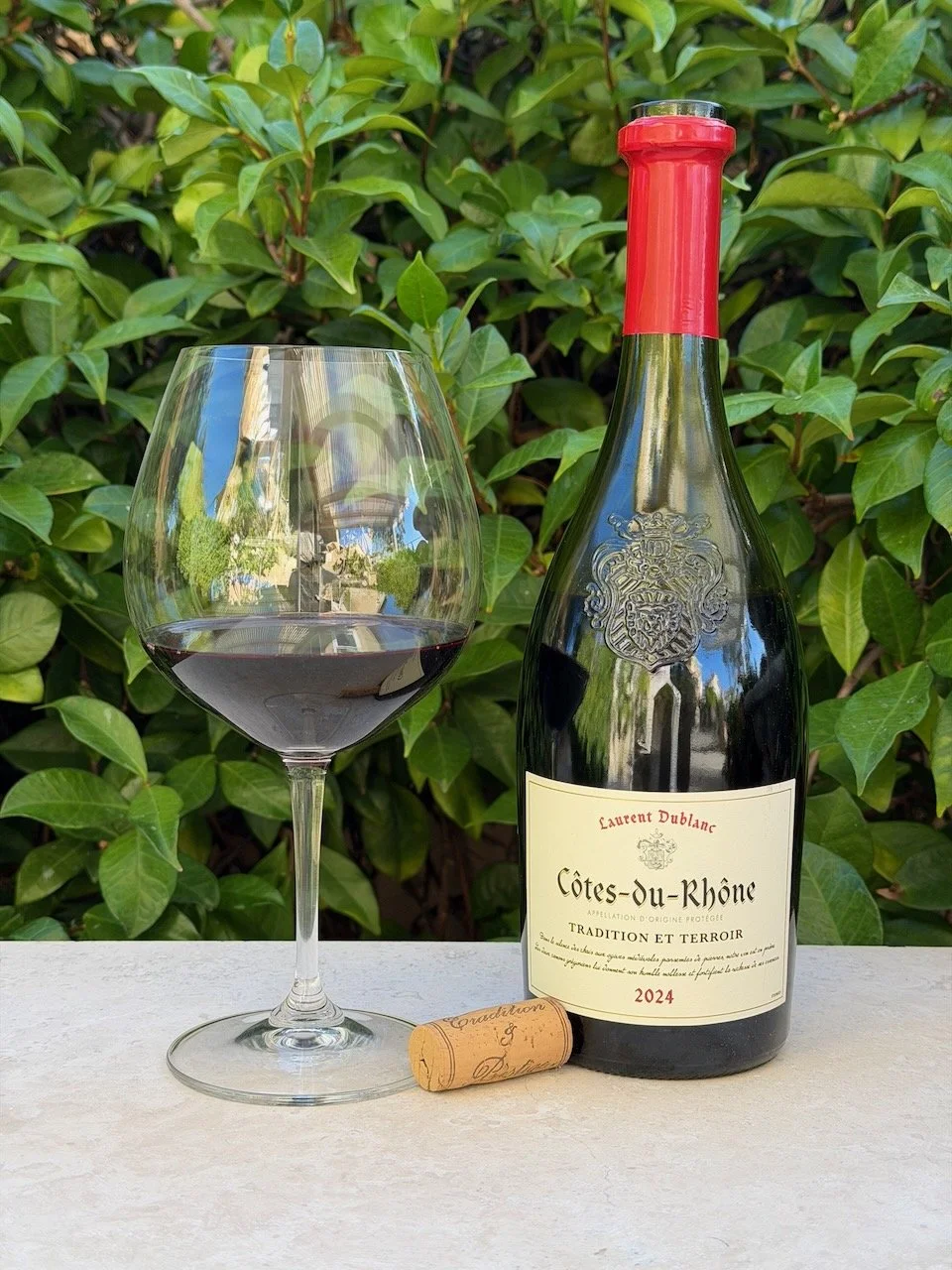
Behind the Cork™ - Laurent Dublanc Cotes du Rhone

2024 Laurent Dublanc Côtes du Rhône ($7.99)

The Côtes du Rhône region is the largest AOC, accounting for two-thirds of Rhône's production.

Côtes du Rhône is a region-wide appellation for red, rosé and white wines covering the entire Rhône Valley. It includes more than 170 villages.

A small proportion of the appellation's wines are white, but the best known Cotes du Rhône wines are red blends based on Grenache, Syrah and Mourvedre (GSM blends) which produce bold and spicy flavors. 

This Laurent Dublanc Côtes du Rhône is a GSM blend that is deep purple in color with aromas of red fruit, plum with hints of herbs and just a bit of earthiness. On the palate, this wine is medium-bodied with moderate tannin, medium acidity with nice flavors of cherry, raspberry and stewed strawberries. It finishes soft with a bit of spiciness.

Laurent Dublanc Côtes du Rhône is a nice and easy-drinking wine at a great price. That makes it a great fit as this week’s Behind the Cork™ Wine of the Week. Cheers!

Ever Wonder? What is a GSM Wine?

You may have come across a wine either on a wine list or on the store shelf that’s called a “GSM” and wondered what kind of wine it is. So, let’s take a look at this funny acronym wine.

A “GSM” wine refers to a blend of three specific grape varieties: Grenache, Syrah, and Mourvèdre. This blend was first developed in the Rhône Valley of France where it has been made for centuries. But today, it has also become popular in regions like Australia (especially in the Barossa Valley), California (especially Paso Robles), and other New World wine regions.

Here’s a quick breakdown of the three grape varieties that make up a GSM blend:

  • Grenache (Greh-NAHSH): Known for its red fruit flavors, such as strawberry and raspberry, and often has a spiciness or subtle peppery note. It provides body and fruitiness to the blend.

  • Syrah (Sir-AH): Known for adding dark fruit flavors (blackberry, plum), along with spicy, savory, and smoky characteristics. It can contribute structure and depth.

  • Mourvèdre (Moor-VEH-druh): Often adds tannins and acidity, along with earthy, gamey, and sometimes leathery flavors. It helps balance the fruitiness of Grenache and the intensity of Syrah.

The GSM blend is best known for being well-rounded, with good fruit flavors, structure, and spice. Grenache is the primary flavor contributor with red-fruit flavor of cherry, raspberry and strawberry. The Syrah provides dark fruit flavors such as plum, blackberry and blueberry. The Mourvèdre adds blackberry and fig notes while also adding herbal notes.

Depending on where it’s grown and how it’s made, a GSM can range from light and approachable to bold and complex, but typically falling in the medium-bodied class of wines.

So, next time you see a GSM blend give it a try. It’s a very versatile and affordable wine. Cheers!

Behind the Cork™ - McPrice Myers 'Beautiful Earth' Red Blend

IMG_2208.jpeg

2013 McPrice Myers ‘Beautiful Earth’ Red Blend ($42)

When I was looking for a good wine to accompany a recent meal, I noticed this Grenache/Syrah/Mourvedre (GSM) from Paso Robles and grabbed it.

Upon pouring it, I immediately noticed that this GSM was a very deep purple color. I was expecting it to be a bit lighter, more like a medium ruby red. Then I took my first sip and again was surprised. It was full-bodied with lots of bold fruit flavors.

Once I turned the bottle around to the back label I realized why the color and taste did not match my expectations for a GSM. It turns out, this is a SGM (79% Syrah, 13% Grenache and 8% Mourvedre). Ah ha! It actually could be labeled as a Syrah!

This turned out to be a super bottle of wine! And, while it was a bit bolder than I would have paired with the meal, it was wonderful to drink. Cheers!

Paso Robles - Great Wine Country

Having made several trips to wine regions throughout California, the one that keeps me coming back is Paso Robles. Located along the central coast of California, essentially mid-way between Los Angeles and San Francisco along Route 101, Paso Robles has lots of charm.

In Paso, with somewhere around 300 wineries, you'll find everything from large corporate wineries selling wines to supermarkets across the country to Mom and Pop wineries selling only from tasting rooms attached to their homes, through wine clubs or simply through word-of-mouth.

Highway 101 splits Paso Robles wine country into the East Side and the West Side. The East has more open plains with some low rolling hills. The West is comprised of steeper hills and canyons, winding roads and large trees.

Hot days and cool nights set up Paso Robles for great grape growing. During the summer, daytime temperature hover around 100 F while the nighttime temperatures drop into the upper 50s F.  This contributes to the multitude of grapes being grown.

The white grapes grown in Paso Robles include Marsanne, Rousanne, Viognier, Grenache Blanc and Chardonnay. Red grapes include Pinot Noir, Grenache, Mourvedre, Syrah, Counoise, Petite Sirah, Cabernet Franc, Cabernet Sauvignon, Zinfandel and Malbec.

It seems that most grapes can grow well in Paso Robles, but the Rhône varietals do especially well.  So, you'll be hard-pressed to find a winery that's not doing some Rhône blends. While the classic Rhône blend of Grenache, Syrah and Mourvedre (GSM) is produced extensively, the number of other blends of grapes seems endless.

So, over next few blogs, I'll share what I've learned about wineries and wine tasting in Paso. While a day trip will introduce you to the wine country, it takes days to really explore the depth of what Paso Robles has to offer. Until next time, cheers!