
Behind the Cork™ - Domaine Bousquet Gaia Malbec

2022 Domaine Bousquet Gaia Malbec ($25)

Gaia, the Greek goddess of the Earth, has been the Bousquet family’s inspiration since founding the winery in 1997. According to Ancient Greek mythology, Gaia (Guy-uh) was one of the primordial deities, emerging fully formed from Chaos to become the divine personification of Earth and the mother of all life. Gaia labels depict the goddess in a festive headdress of colorful fruits and flowers.

Gaia wines are crafted with French winemaking sensibility and made from 100% organic fruit grown at a cool 4000 foot altitude.

This Gaia Malbec was produced from 100% Malbec organic grapes that underwent cold maceration for 72 hours followed by fermentation with native yeast for 12 days. It was then aged in French oak barrels (100% used) for 10 months.

Gaia Malbec is deep purple in color with aromas of blackberry and sweet tobacco. On the palate, this medium full-bodied wine has medium tannin and medium acidity with flavors of blackberry and black cherry. It finishes balanced with some spicy notes. [Alcohol by Volume (ABV): 14.5%, Total Acidity (TA): 5.232 g/L, pH: 3.69, Residual Sugar (RS): 1.94 g/L]

What better way to celebrate Earth Day 2025 on April 22nd than with Domaine Bousquet’s Gaia Malbec. It’s delicious and affordable, making it a great fit as this week’s Behind the Cork™ Wine of the Week. Cheers!


Sample Provided by Domaine Bousquet
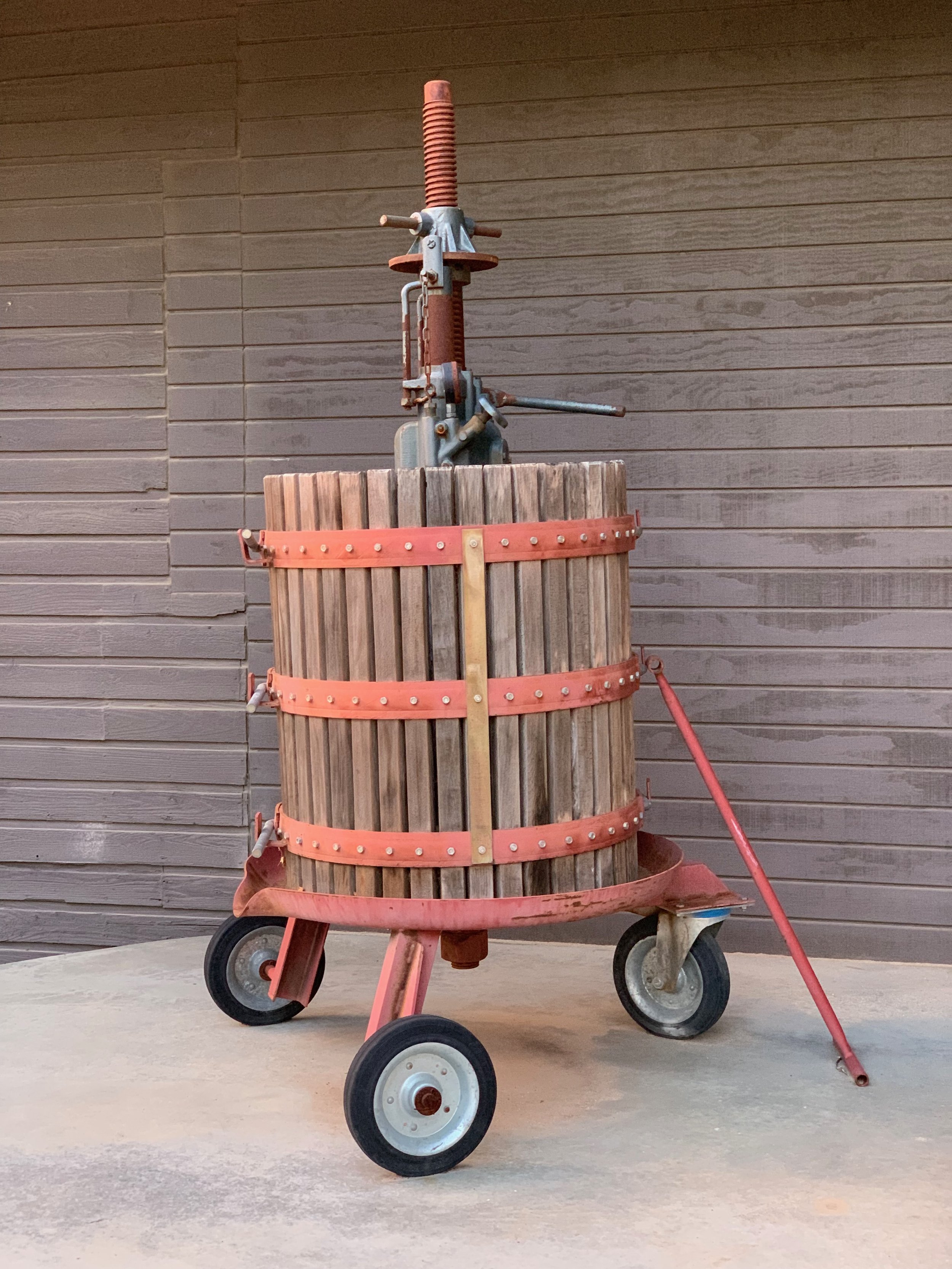
The Art of Wine Making: Deciding How to Press the Wine Grapes

A Small Basket Press

As previously mentioned, wine making is a blend of art and science. Another aspect that is often regarded as an art form is choosing the method to use to press the grapes to extract the juice.

The wine press is thousands of years old. The first wine presses were found in what is now Armenia, where grapes were pressed with the feet. In ancient Egypt, Greece and Rome, presses became more technical and precise. Then, in the Middle Ages, the basket press was developed and its use became widespread.

Today there are three main types of wine presses: screw presses, bladder presses and basket presses.

Screw Press: A horizontal screw press consists of a horizontally enclosed cylinder, in which grapes are added. Inside the drum, there’s a rotating screw, which is applying pressure to the grape skins by plates from both ends. Because of the pressure of grapes against the sides, juices start to drain through the slated cylinder.

Bladder Press: A bladder press consist of a large horizontal cylinder closed at both ends. The grapes are fed from the top, through a pusher or from the side. Inside the rotating drum is a bladder that inflates with air and exerts pressure on the grapes. The juice then flows out through small openings on the sides of the cylinder.

Basket Press: The basket press (see photo above) works by pressing the grapes from the top and bottom. Grapes are placed inside a basket or a cage, then usually two half-moon blocks are placed on the top of the fruit. With the help of an iron ratcheting assembly, pressure is put on the blocks that squeeze the grapes, with juices flowing out from the sides.

The “art” of deciding which method to use comes from multiple factors:

  • Controlling the Style and Flavor: A gentle press extract can extract mostly juice while an aggressive pressing can extract more tannin, phenolics and bitter flavors from the skins and seeds (and stems if pressing whole clusters

    • A screw press can be the harshest

    • The bladder or pneumatic press and be more precisely controlled

    • The basket press can be slow, gentle and is often used for artisanal wines

Pressing the grapes isn’t just a pre-defined step in wine making. The wine maker carefully selects the method that best suits their style of wine making and the desired product. This is yet another aspect of the “art” of wine making. Cheers!

Behind the Cork™ - Sandy Giovese Vino Rosso

Sandy Giovese Vino Rosso ($34.99)

According to their literature, “Like most first borns, Sandy has main character energy. She sets the standard for what boxed wine can be while knowing how to have a good time.

This wine is perfect to drink chilled, you can open and store it in the fridge for up to a month! And, one box is equivalent to four bottles (3L) so there’s plenty to share with friends!

Vino Rosso is made from organically farmed grapes with 85% Sangiovese blended with 15% Trebbiano, a native Italian white grape.

Each wine is crafted from organically farmed Italian grapes, sourced from the sustainability-driven, family-owned Conti degli Azzoni estate in Italy’s Le Marche region.

Sandy Giovese Vino Rosso is deep purple in color with aromas of dark fruit and herbal notes. On the palate, it is medium-full bodied, with medium tannin and good acidity. It finishes light and spicy.

Although this Sandy Giovese Vino Rosso is sustainably packaged, it’s not your typical boxed wine. This is a real Italian wine that very enjoyable by the glass or with a meal. Again, don’t let the packaging fool you, this is a really good wine. And, at the equivalent of $8.75 per bottle, it’s extremely affordable! Hence, a perfect fit as this week’s Behind the Cork™ Wine of the Week. Cheers!


Disclosure of Wine Sample Submission: I received this sample at no cost for review.

Media Sample Provided by Giovese Family Wines via SAVONA COMMUNICATIONS

The Art of Wine Making: De-Stemming the Grapes versus Using the Whole-Clusters

As previously mentioned, wine making is a blend of art and science. Another aspect that is often regarded as an art form is choosing whether to de-stem the grapes for fermentation of leave them as whole clusters.

The choice between using whole clusters and de-stemming grapes can significantly affect the style, flavor and texture of the wine being produced. Winemakers often choose one method over the other based on their specific artistic preferences.

Whole cluster fermentation is a technique that involves fermenting the entire grape cluster, including the stems, skins and seeds. This process can offer several enhancements to the wine’s flavor, aroma, tannin structure, and complexity.

  • Flavor and Aromatics: Fermenting with whole clusters can impart subtle herbal, spicy, and earthy notes to the wine. These flavors can give the wine a slightly “greener” character, including hints of clove, mint, or even green peppercorn.

  • Tannin: Stems and seeds contain tannins, which are phenolic compounds that add structure and mouthfeel to the wine. By fermenting with whole clusters, the wine can develop greater tannin structure.

  • Complexity: Whole cluster fermentation promotes a greater flavor profile. The stems and seeds create greater interactions during fermentation, resulting in wines that can have depth and layers, often with more natural acidity.

Removing the grapes from the stems, while more work, can provide several advantages:

  • It allows for the fruit to control the flavors without the herbal or green notes that stems can impart. The resulting wine will typically be more fruit-forward. 

  • De-stemming also helps to control the extraction of tannins or other compounds. This results in a wine that can be more balanced with less astringency associated with using the whole stem. Hence, softer tannins.

So, whole cluster fermentation adds complexity, structure, and a broader range of flavors, while de-stemming a wine maker to focus on fruit purity and achieve smoother tannins. Both methods work, but the winemaker, using their creative and artistic talents, ultimately decide which method to use. Cheers!

Behind the Cork™ - Conde Valdemar Reserva

2015 Conde Valdemar Reserva ($28.99)

Valdemar Family is comprised of 334 hectares (825 acres) of family-owned vineyards spanning Bodegas Valdemar in Roija, Spain and Valdemar Estates in Walla Walla, Washington. The winemaking legacy of the Martínez Bujanda family dates back to 1889. The fifth generation siblings Ana and Jesús are currently at the helm of both estates on two continents.

For a Rioja to be called a “Reserva” means that it undergoes a minimum of three years of aging with at least one year in barrels and six months in the bottle. In this case, this Conde Valdemar Reserva spent 19 months in American oak (65%) and French oak (35%).

Produced from 85% Tempranillo, 7% Garnacha, 5% Garciano and 3% Maturana, this wine is medium-full bodied. It is a medium ruby-garnet color, showing its age. On the nose, it has muted aromas of fig, plum and cherry. On the palate, this Conde Valdemar Reserva has soft flavors of raisin, prune and fig. Its tannins are smooth, with medium-low acidity. It finishes soft, showing its 10-year age. Its a very nice Rioja Reserva!

To find ten year old wines is difficult, but to find one at this price is amazing! This 2015 Conde Valdemar Reserva is a really nice wine that’s available at a great price. That makes it a perfect fit as this week’s Behind the Cork™ Wine of the Week. Cheers!


Disclosure of Wine Sample Submission: I received this sample at no cost for review.

Media Sample Provided by Valdemar Family via Ten27 Communications