Behind the Cork™ - Albert Bichot Crémant de Bourgogne Sparkling Wines

In 1831, Bernard Bichot founded a wine trading business in his name in Monthélie, France. His son, Hippolyte, succeeded him and bought the first grape vines in Volnay, France. His son, Albert Bichot, the first to bear the name, gave the family business new momentum in the late 19th century and settled in the centre of Beaune (the center of Burgundy wine production ) once and for all in 1912. The Albert Bichot winery indeed has deep roots in France.

The notation on the label of these two sparkling wines of “Crémant de Bourgogne” indicates the appellation for sparkling white and rosé wines of Burgundy in France.

Sparkling wines labeled “Crémant de Bourgogne” must be produced from a minimum of 30% of any combination of Chardonnay, Pinot Blanc, Pinot Gris and/or Pinot Noir with no more than 30% Gamay included in any wine, and made in the methode traditionelle.

Albert Bichot Brut Rosé ($31)

This Brut Rosé is produced from Pinot Noir (80%), Chardonnay and Gamay (less than 10%) that are vinified separately and aged for 9 months. It is then stored on lees for 12 months with a dosage of 10 gm/L.

This Brut Rosé is medium salmon in color with delicate aromas of red fruit and citrus. It is very delicate on the palate with light strawberry and candied-cherry flavors, balanced acidity and a light finish.

Albert Bichot Brut Réserve ($31)

This Brut Réserve is produced from Chardonnay, Pinot Noir, Gamay and Aligote. Each varietal is vinified separately and aged for 9 months. It is then stored on lees for at least 12 months with a dosage of 7-8 gm/L. This sparkling Brut is pale copper in color with aromas of peach and citrus. On the palate it has delicate fresh fruit flavors, balanced acidity and a light finish.

These two Brut sparkling wines from Albert Bichot are perfect for celebrating the holidays, or any time! They are a great fit as this week’s Behind the Cork Wines of the Week. Cheers!


Disclosure of Wine Sample Submission: I received these samples at no cost for review. The opinions expressed are entirely my own.

Media Samples Provided by Albert Bichot Winery via IT Public Relations

Ever Wonder? What Does Cremant de Bourgogne Mean on a the Label of a Sparkling Wine?

An up-coming Behind the Cork will feature a sparkling wine that is labeled as “Crémant de Bourgogne.” One might assume that this title indicates a style of sparkling wine. But, actually, no. Crémant de Bourgogne is actually the appellation for sparkling white and rosé wines that are produced in Burgundy France.

Crémant (pronounced "cray-mont") covers all French sparkling wines produced outside the boundaries of the Champagne region.

The two main grape varieties grown in Burgundy are Pinot Noir and Chardonnay. Gamay, Pinot Gris and Aligoté are also grown in the region, but on a smaller scale.

Sparkling wines labeled “Crémant de Bourgogne” must be produced from a minimum of 30% of any combination of Chardonnay, Pinot Blanc, Pinot Gris and/or Pinot Noir with no more than 30% Gamay included in any wine.

As stated earlier, sparkling wines labeled “Crémant de Bourgogne” must be grown in land covered by the Crémant de Bourgogne appellation. And, this appellation is large! It covers nearly 5,000 acres from the Grand Auxerrois and environs, in the north, to the southern extremes of Beaujolais. It also includes the villages of the Cotes de Beaune and Cotes de Nuits.

All sparkling wines of Crémant de Bourgogne are made in the methode traditionelle where the second fermentation is done in the bottle.

Crémant de Bourgogne is produced in various levels of sweetness ranging from Brut Nature (no sugar added) to Doux (more than 50 gm/L of sugar). In the U.S., you will probably find either Brut (6-12 g/L) or Extra Brut (less than 6g/L).

So, next time you are looking for a bottle of sparkling wine to enjoy, look for “Crémant de Bourgogne” on the label. Cheers!

Behind the Cork™ - Flora Springs Holiday Wines

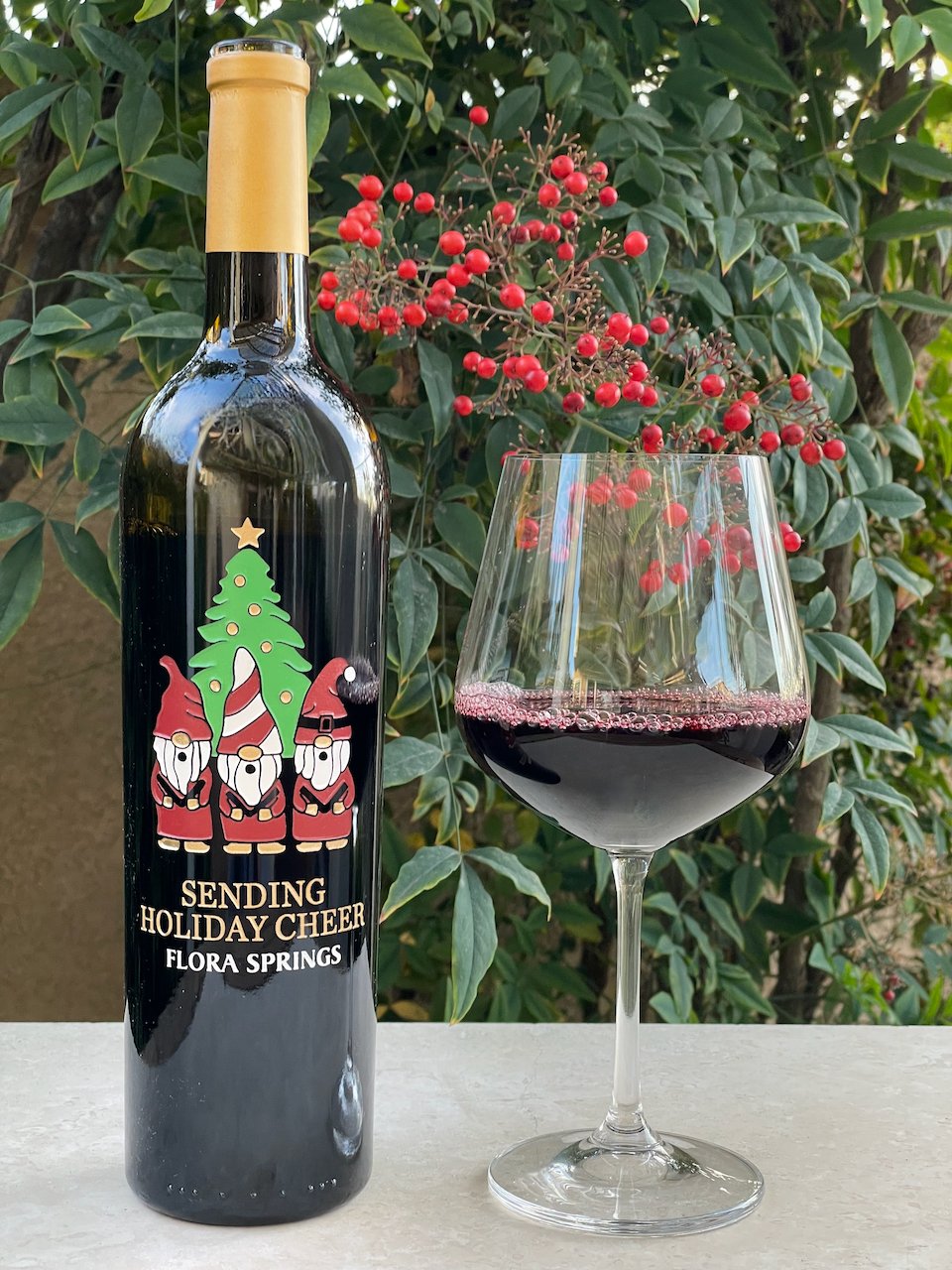
2019 Flora Springs Napa Valley Red Blend ($95)

This is one of Flora Springs’ most popular holiday designs yet, their “Gnome Carolers,” spreading holiday cheer all around. The design is inspired by General Manager Nat Komes’ memory of his grandmother Flora, who loved to carol during the holidays. They are also offering special bottles with “Two Turtle Doves,” “Quail Greetings,” and “Happy New Year.”

Each bottle is meticulously etched and painted by hand, with capsules and back labels applied one-by-one. Each bottle is absolute perfection inside and out.

While these holiday bottles from Flora Springs are very beautiful, the wines are also exceptional. The 2019 Napa Valley Holiday Red Bordeaux Blend consists primarily of Cabernet Sauvignon, combining fruit from two outstanding, sustainably-farmed vineyard sources: the Komes Vineyard in Rutherford and Crossroads Vineyard in Oakville. It was aged 18 months in French (70%) and American (30%) oak barrels. And, with just 230 case produced, this is indeed a rare treat!

This Flora Springs Red Blend is deep ruby in color with beautiful aromas of black fruit, tobacco leaf and cedar. On the palate, this full-bodied wine has rich dark fruit flavors, wonderfully soft tannin, balanced acidity and a smooth finish that just keep on going. It’s so good you only need to pair it with a nice wine glass!

This exceptional Flora Springs 2019 Napa Valley Holiday Red Bordeaux Blend is a real treat for the holidays as this week’s Behind the Cork Wine of the Week. Cheers!


Disclosure of Wine Sample Submission: I received this sample at no cost for review. The opinions expressed are entirely my own.

Media Sample Provided by Flora Springs Winery

Some Key Terms Used in the Production of Sparkling Wines

A Riddling Rack Used in the Production of Sparkling Wines (Photo by Claudio Schwarz on Unsplash)

Méthode Traditionnelle: This is the traditional method for making sparkling wine. With this process, the secondary fermentation takes place inside the bottle, creating the bubbles. The process begins with the addition of a liqueur de tirage (see below) to a bottle of still wine. This starts second fermentation inside the bottle. This results in the production of carbon dioxide and spent yeast cells, or lees, that settle in the neck of the bottle during the riddling process (see below). The lees are then “disgorged” (see Disgorgement below) from the neck of the bottle, and replaced with the “Dosage” (see below) that gives the sparkling wine its sweetness. All Champagne and most high-quality sparkling wines are made using this process. Note: This process is also known as méthode Champenoise or méthode classique.

Liqueur de Tirage: This is a solution of wine, sugar and yeast that is added to a bottle of still wine. The addition of the liqueur de tirage starts the secondary fermentation which gives sparkling wine its bubbles.

Secondary Fermentation: The process that creates the bubbles in sparkling wine. As the wine is bottled, a small amount of yeast and sugar is added before the bottle is temporarily sealed. The yeast ferments the sugars and creating both alcohol and carbon dioxide (CO2). The CO2 gas cannot escape and instead gets dissolved into the wine.

Riddling: This is the process of removing the sediment that remains in the bottle from the second fermentation. The bottle is placed in a rack at an angle with the neck down. The sediment begins to collect on the side of the bottle. As the bottles are riddled, or given a quarter-turn daily and gradually tilted fully upside-down, the sediment falls to the neck of the bottle.

Disgorgement: This technique is used to remove sediment from the neck of the bottle after the second fermentation. Through the riddling process (see below), the sediment settles in the bottle’s neck. The neck of the bottle is then dipped into cold brine and which causes the sediment to quickly become frozen. The bottle is turned upright and the temporary seal is removed. The plug of frozen sediment is popped out by the pressure of the built-up carbon dioxide.

Dosage (doh/zahzh): This is a small amount of wine (usually mixed with sugar) that is added back to the bottle once the yeast sediment is disgorged. This is also known as liqueur d'expedition.

Residual Sugar (RS): Unfermented sugar in the finished wine.

Styles of Sparkling Wine:

  • Brut Nature - This style is bone dry meaning it has little or no residual sugar (0–3 g/L RS).

  • Extra Brut - This style is also very dry but it can have 0–6 g/L RS

  • Brut - This is the most common style having 0–12 g/L RS

  • Extra Dry - This style is sweeter with 12–17 g/L RS

  • Dry - Even higher sweetness of17–32 g/L RS

  • Demi-Sec - Very sweet (32–50 g/L RS)

  • Doux - This one, while very rare to find, is really sweet (50+ g/L RS).

Behind the Cork™ - Domaine Bousquet Sparkling Wines

Domaine Bousquet is located in the Gualtallary Valley, a scenic, remote, arid terrain high in the Tupungato district of the Uco Valley in Argentina’s Mendoza region, close to the border with Chile. With altitudes ranging up to 5,249 feet, Gualtallary occupies the highest extremes of Mendoza’s viticultural limits. Having purchased the bare land in 1997, today, Domaine Bousquet has a striking modern winery, complete with a hospitality area and restaurant, and the property accounts for 667 acres planted under vine.

Domaine Bousquet is Argentina’s largest exporter of wines made from certified organic grapes. All wines are made from 100% certified organic fruit. They are known for producing a wide range of premium red, white and rosé wines, in addition to these two wonderful sparkling wines.

Méthode Traditionnelle Brut Rosé ($18)

This Brut Rosé sparkling wine is produced from 75% Pinot Noir and 25% Chardonnay (two of the traditional grapes used in Champagne). The grapes are manually harvested and undergo cold maceration for 24 hours before being fermented for 15 days. After six months of aging on lees, the second fermentation takes place in the bottle in the traditional method.

This sparkling rosé is pale copper in color with dusty aromas of tropical fruits and citrus. On the palate it is subtle grapefruit flavor, good acidity and so of a sweet/tart finish.

ABV = 12%, Total Acidity = 8.75 g/L, pH = 3.05, Residual Sugar = 8.1 g/L

Méthode Traditionnelle Brut ($18)

This Brut sparkling wine is produced from 75% Chardonnay and 25% Pinot Noir, just the reverse proportions of the sparkling rosé. The grapes are manually harvested and undergo cold maceration for 24 hours before being fermented for 15 days. After six months of aging on lees, the second fermentation takes place in the bottle in the traditional method.

This sparkling brut is pale gold in color with faint aromas of yellow apple and almond. On the palate it has delicate flavors of tropical fruit, good acidity and a pleasant aftertaste.

ABV = 12%, Total Acidity = 8.92 g/L, pH = 3.05, Residual Sugar = 8.1 g/L


These two sparkling wines from Domaine Bousquet are perfect for celebrating the holidays and affordably priced, making them this week’s Behind the Cork Wines of the Week. Cheers!


Disclosure of Wine Sample Submission: I received these samples at no cost for review. The opinions expressed are entirely my own.

Media Samples Provided by Domaine Bousquet and Origins Organic Imports